


Social media as a best answer channel
In 2026, social media has become a primary environment for B2B brand visibility and influence, even as organic reach continues to decline across nearly every platform. Algorithmic feeds and AI-driven discovery have made attention harder to earn through publishing alone. LinkedIn, in particular, has solidified its role as the center of B2B social engagement, with 76% of B2B marketers identifying it as the most effective channel for thought leadership (Content Marketing Institute).
As visibility tightens, social media’s value has shifted from reach to relevance. For B2B brands, social networks now function as systems for building brand influence, collaborating with trusted influencers and creators, and reinforcing credibility through consistent, authoritative signals that increasingly shape AI-powered search and answer engine visibility.
At the same time, the formats that perform best on social have evolved. Short-form video, expert-led commentary, co-created influencer content, and live discussions now outperform static promotional updates. Success depends on how well brands integrate thought leadership, influence, and experience into social content that earns attention, builds belief, and compounds visibility across both human and AI-driven discovery. This is the essence of Best Answer Marketing.
AI in social media: gaining speed while staying in control
Artificial intelligence has moved from novelty to necessity in B2B social media execution. According to Content Marketing Institute, 95% of B2B marketers report their organizations are using AI-powered applications, with 87% citing improved productivity and 80% reporting greater operational efficiency
At the same time, quality remains a differentiator. While 58% believe AI has improved content quality, 12% say quality has declined, underscoring a critical Best Answer Marketing principle: efficiency cannot replace judgment.
Within Best Answer Marketing AI plays a supporting role. It accelerates research, production, targeting, and optimization, but it does not replace human insight, strategic integration, or creative leadership. This balance matters as 60% of marketers plan to increase investment in both social media advertising and AI tools (eMarketer).
The opportunity in 2026 is not simply to use AI, but to use it in service of clarity, credibility, and consistency across social channels.
Thought Leadership and influence: the trust engine of social media
As social feeds grow more crowded and algorithmic discovery becomes less predictable, trust has become the defining currency of B2B social performance.
TopRank Marketing and Ascend2 research found that 97% of B2B marketers say thought leadership is critical to full-funnel success, yet only 43% extend it beyond acquisition into post-sale engagement.
Original research remains one of the strongest trust signals available to B2B brands. 93% of marketers using research-based thought leadership report it is effective at driving engagement and leads, with performance increasing dramatically when influencers are involved. 74% of frequent influencer collaborators rate their research content as very effective, compared to just 29% of others.
This is where social media becomes a force multiplier. When thought leadership is co-created with trusted experts and distributed through credible voices on social platforms, it functions as a living trust system, reinforcing authority with every interaction.
LinkedIn’s role in B2B discovery and credibility
LinkedIn continues to anchor B2B social strategy in 2026. 76% of B2B marketers identify LinkedIn as the most effective channel for thought leadership, making it the primary environment for professional credibility, peer validation, and executive engagement (Content Marketing Institute).
However, discovery habits are shifting. Answer Engine: The State of B2B Thought Leadership in 2026 reports that 32% of professionals now discover thought leadership through GenAI tools, meaning social content must increasingly be structured, cited, and credible enough to surface beyond native feeds.
In Best Answer Marketing terms, LinkedIn is not just a publishing platform. It is part of a broader and increasingly important discovery ecosystem where social, search, earned media, and AI-driven visibility intersect.
Social listening: from signals to strategy
Data-informed clarity is foundational to BAM, and social listening has emerged as one of the most valuable inputs for B2B marketers.
Hootsuite reports that 62% of social marketers now use social listening tools, making it the second-highest organizational priority in social media strategy
More importantly, social listening strengthens accountability. Marketers who actively listen are significantly more confident in proving ROI than those who do not. By connecting sentiment, conversation themes, and engagement patterns to broader performance data, social listening helps unify brand and demand signals.
In practice, this allows social teams to move beyond activity reporting toward insight-driven optimization that aligns with revenue outcomes.
Social platform strategy: meeting buyers where they are
While LinkedIn remains the place for B2B’s to be online, B2B buyers are active across a broader set of platforms than many strategies reflect. Pew Research Center data shows widespread usage across multiple networks:
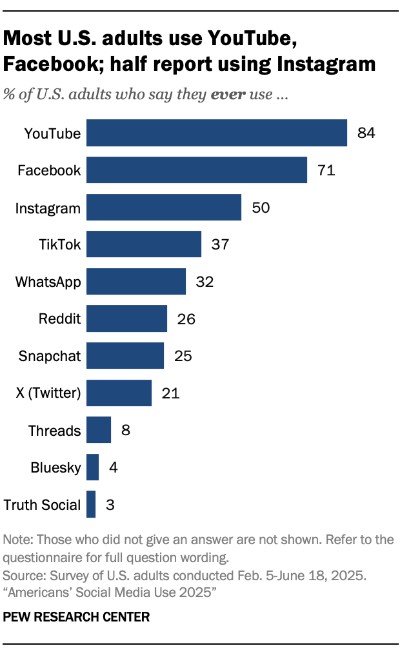
Source: Pew Research Center
Best Answer Marketing does not require brands to be everywhere. It requires purposeful presence where buyers seek answers, recommendations, and validation. That may include video on YouTube, community engagement on Reddit, short-form insights on LinkedIn, or emerging visibility through AI-powered discovery.
Social media through the BAM framework
When viewed through the lens of Best Answer Marketing, social media becomes a coordinated system:
- Data-Informed Clarity: Social listening, engagement data, and audience insights guide content decisions.
- Integrated Strategy: Social content reinforces brand narratives, demand initiatives, influencer programs, and sales enablement.
- Trust System: Research, expert voices, customer stories, and earned validation compound credibility.
- Experiential Content: Video, live events, and interactive formats turn insight into memorable experiences.
- Multi-Channel Discovery: Social content is structured to surface across feeds, search engines, and AI answer engines.
- Unified Analytics: Social performance is connected to pipeline influence and revenue impact.
This integration transforms social media from a distribution outlet into a strategic engine for building brand trust, engagement and growth.
Key social media marketing takeaways for B2B marketers in 2026
To maximize the impact of social media marketing in the year ahead consider these takeaways:
- Invest in AI to improve efficiency, while maintaining human oversight and strategic intent.
- Use original research and thought leadership as the foundation for social content.
- Collaborate with influencers and internal experts to strengthen trust signals.
- Prioritize LinkedIn while expanding discovery across relevant platforms.
- Apply social listening to inform strategy and demonstrate ROI.
- Measure social performance as part of a unified view of brand, demand, and revenue.
B2B social media marketing in 2026 rewards brands that answer real questions with relevance, credibility, and consistency. Those that treat social media as part of an integrated Best Answer Marketing system will not only earn attention, but confidence, consideration, and long-term growth.
Learn more about how you can optimize your social media marketing to become a Best Answer Brand, check out our social media marketing solutions here.