
B2B influencer marketing isn’t just having a moment anymore. It’s gone mainstream.
Our 2027 B2B Influence & Creator Marketing Report found that 83% of B2B marketers either have an influencer marketing program, are building one, or plan to launch one within the next year.
When we started this research in 2020, B2B influence was still largely experimental. Today it’s becoming a strategic standard.
Not only are more marketers investing in B2B influence, nearly all of them are seeing results: 93% of respondents running influencer programs rate them effective. But only 46% call their program “very effective.”
I don’t know about you, but if I hear that some folks are getting “very effective,” I’m not going to settle for “somewhat effective.” The relentlessly optimizing marketer within all of us will not rest at “doing okay.”
Fortunately for all of us, TopRank Marketing and Ascend2 asked more than 400 senior B2B marketers (manager or above, at companies with 100+ employees) how they run their influencer programs. And we separated the very effective programs from the rest of the pack.
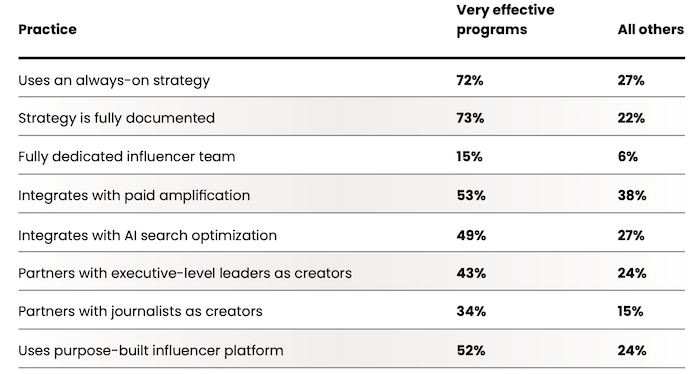
What are the “very effective” folks doing differently? Here are seven stats that stand out.
Seven features of highly effective B2B influencer marketing programs
You’ll see as we go through the data that some less-effective programs are also using some of these techniques. But the very effective folks are far more likely to be doing them — the correlation of these features with success is high.
#1: Partner with a broader mix of influential creators
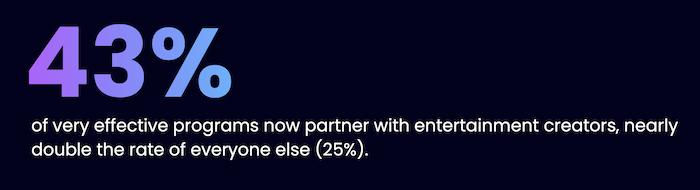
- Very effective: 43% partner with entertainment creators
- All others: 25%
What it means: B2B influence comes in a lot of different shapes, sizes and specialties, and the people who power it are increasingly called creators rather than influencers, representing a meaningful expansion of the category. We’ve long said that everyone is influential about something and brands are embracing this more than ever.
Leaders are building rosters that go beyond the usual suspects. Along with entertainment creators, very effective programs are more likely to partner with journalists (34% vs. 15%) and executive-level leaders as creators (43% vs. 24%).
Why it works: B2B marketers (wisely) prioritize trust and relevance over reach. Trustworthiness and credibility (46%) and audience relevance (40%) top the list of selection criteria, well ahead of audience size (30%). A diverse creator mix lets you balance credibility, expertise and reach instead of betting everything on one type of voice.
#2: Invest in the relationship, not just the transaction
- Very effective: 47% offer creators formal training and onboarding
- All others: 32%
What it means: Compensation is now standard practice. Only 22% of marketers aren’t compensating influencers, and pay-per-deliverable (51%) has overtaken performance-based pay (48%) as the most common model. Paying creators no longer sets you apart. What sets leaders apart is what they invest beyond the check.
Very effective programs are also far more likely to give creators exclusive access to events, research or announcements (46% vs. 25%).
Why it works: It’s still important to cultivate relationships with influencers. A purely transactional relationship will result in uninspired content and inauthentic vibes for your audience. Creators who understand your brand well enough to speak on it independently produce content that sounds like expertise instead of an ad read.
Formal arrangements help here, too. A contract with clear deliverables, performance expectations and measurement actually builds relationships, because it ensures everyone’s on the same page and will get their needs met.
#3: Use purpose-built influencer marketing technology
- Very effective: 52%
- All others: 24%
What it means: It’s possible to find and manage influencers without dedicated tools. You can search LinkedIn, hit up Google, or browse industry forums. But this doesn’t equate to a scalable and sustainable system. Platforms designed for influencer identification, engagement and management make the whole process simpler and more efficient.
Why it works: Identifying, qualifying and connecting with the right influencers is the single most-cited challenge in our survey (41%). B2B influence needs to balance knowledge, experience, relevance and reach. Sure, Influencer X might have 1.5 million followers, but when he posts about #LLMs, does he mean large language models or the law degree?
Purpose-built tools help you find the most meaningful creators for your program without dozens of hours of searching.
#4: Integrate influence with AI search optimization
- Very effective: 49%
- All others: 27%
What it means: At a 22-point spread, AI search optimization (AEO/GEO) is the widest integration gap of any function we measured. The integration advantage shows up across the mix, just less dramatically: paid media (53% vs. 38%), events (49% vs. 34%), ABM (43% vs. 25%) and sales enablement (42% vs. 25%).
Leaders also deploy influence across the full funnel rather than treating it as an awareness play, including evaluation (62% vs. 44%), decision (63% vs. 48%) and post-sale (46% vs. 25%).
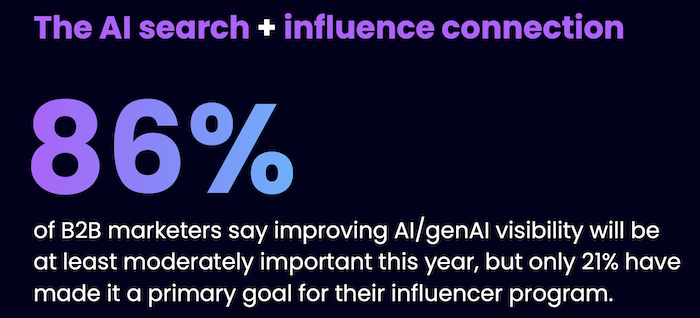
Why it works: Answer engines don’t cite what brands say about themselves nearly as often as what others say about them. Roughly 89% of citations for unbranded prompts come from third-party sources. Creators are those trusted third-party voices, and they play a key role at every stage of decision-making.
The results show up in our data. Very effective programs are more than twice as likely to appear in AI Overviews (45% vs. 21%) and to call genAI visibility very important (77% vs. 33%). And this isn’t a big-budget game: mid-market companies (44% to 45%) are out-integrating enterprise (35%) on AEO/GEO, which suggests agility matters more than spend.
#5: Document your influencer marketing strategy
- Very effective: 73%
- All others: 22%
What it means: A fully documented strategy is written down and actually guides decisions. It’s not a slide deck from last year’s kickoff. Overall, 46% of marketers now have one, up from less than half in our 2022 report. But very effective programs are more than 3x as likely to have one as everyone else.
Why it works: This may be the biggest single opportunity for marketers to improve. A documented strategy is where you decide who you’ll partner with, how you’ll integrate, what formats you’ll invest in and how you’ll prove it all worked.
That last part is critical! Most marketers still measure what’s easiest to track, like engagement (48%) and reach (45%), while revenue attribution (33%) and pipeline influenced (25%) lag behind. Meanwhile, C-suite respondents say they care more about revenue (38%) and pipeline (25%). Your strategy is where you close that gap.
Measure everything you can. And make a measurement plan before you reach out to a single influencer.
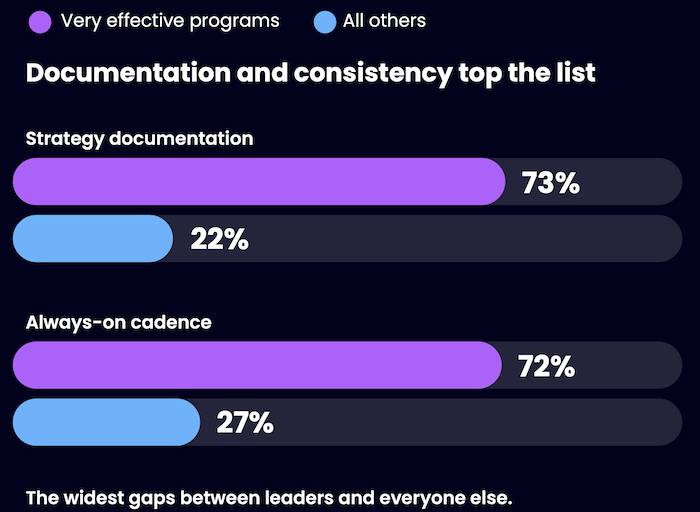
#6: Run an always-on influencer program
- Very effective: 72%
- All others: 27%
What it means: Most marketers start an influencer marketing program as a series of one-off engagements. You research influencers, cultivate relationships, co-create content, publish the content… and then start all over again from scratch.
An always-on program continues nurturing, relationship-building and collaboration between big campaigns. It can also mean putting your influencers in touch with each other to create a community: a group of enthusiastic experts who can work with and advocate for the brand.
The good news: this is catching on. In our 2023 report, 21% of respondents ran always-on programs. This year, it’s 48%.
Why it works: Running an always-on program is more efficient. It takes some effort to keep going, but it’s far less of an investment than restarting from scratch every time.
It also performs better where it counts. Always-on programs attribute nearly double the revenue to influencer marketing compared to campaign-based programs (42% vs. 24%), and report being cited in genAI responses at a higher rate (43% vs. 26%).
Every consistent cycle trains two audiences at once: the human community that learns to trust your brand’s voices, and the answer engines that learn to associate your brand with its topics. Episodic campaigns reset both clocks to zero.
#7: Invest in durable content
- Very effective: 37% invest in podcasts
- All others: 19%
What it means: Most influencer collaboration is lightweight and social-first. Social media posts (60%) and short-form video (50%) are the most commonly co-created formats. Leaders are thinking bigger. Along with podcasts, very effective programs are more likely to invest in research reports (35% vs. 22%) and newsletters (38% vs. 25%).
Why it works: A social post has a shelf life measured in hours. A podcast series, research report or newsletter keeps working, fueling multiple channels over time and giving answer engines substantive, citable expertise to pull from. As short-form social content becomes more commoditized, expect investment in these higher-effort formats to keep climbing.
Ready to join the very effective?
Put these seven features together and you find a pattern: leaders treat influence as a system rather than a series of tactics or campaigns. Documented, always-on, integrated and built on content that lasts.
At TopRank Marketing we were doing influencer marketing before it was cool. We may not have invented it, but we’ve been at it a long time. In addition to knowledge, experience and access to the latest tools, we have established relationships with hundreds of B2B influencers in dozens of industries.
Want to see where your program stands? Download the full 2027 B2B Influence & Creator Marketing Report or contact us today. We’d love to be the secret driver of your very effective influencer marketing program.