

TLDR Summary:
Google I/O 2026 confirmed what we’ve been preparing for at TopRank Marketing: AI Mode is now the dominant search experience, reaching over a billion monthly users with queries growing fast. The traditional blue-link search result is no longer the primary way buyers find information on Google.
New behavioral data from Google shows the average search query is now triple the length of a traditional search, follow-up conversations are up 40% month over month, and one in six searches are already multimodal. Buyers are exploring, deciding, learning, planning, and creating through AI search, and the content that shows up in those moments is authoritative, expert-led, and structured to be cited.
Google’s own guidance for AI search optimization confirms that the tactics circulating in the market, including chunking content, LLMS.txt files, and manufacturing mentions, simply do not work. What does work is exactly what Best Answer Marketing is built around: unique, non-commodity content backed by original research, genuine thought leadership, and credibility signals that AI systems recognize and reward.
For B2B brands still optimizing for clicks, the window to adapt is narrowing. For brands already building topical authority and trust across channels, this moment is a significant advantage.
The latest search update from Google I/O overhauls the search experience, are B2B marketers ready?
The good news is that at TopRank Marketing, we’ve been adapting to changes in search for over 25 years and Best Answer Marketing is a system built for this exact moment.
When Google I/O 2025 announcements dropped last year, we wrote that the old SEO playbook of chasing rankings was being replaced and that AI-powered search represented a fundamental change in how customers discover, consume, and interact with information. At the time, AI Mode was new, agentic capabilities were just starting to be introduced, and how those changes would impact B2B marketing was still being sorted out.
A year later, the Google search experience is on track to change completely. The impact on content strategy could be game changing but the go forward is clear.
“All search is now AI search.”
At Google I/O 2026, Google pretty much confirmed the end of 10 blue links in search. In their place is an AI-powered experience that is built around synthesized answers, autonomous information agents, and generative user interfaces that can be created on the fly. Google is evolving the search experience from discovery to fueling decisions across the buyer journey.
“It’s not about showing up on the page one of Google. It’s about getting referenced inside of an AI answer… Zero-click search is just a simple example of that, where they’re not going to your website… The playbooks that we used to use just don’t work anymore.” – Jon Miller, Co-Founder Stealth AI Start-up, Co-Founder Marketo
With the days of attracting website traffic from ranked links and clicks coming to an end, say hello to the age of zero click marketing – which is also the name of a new book by Amanda Natividad and Rand Fishkin.
In addition to search interface changes, Google has also released behavioral data showing how people are using AI Mode in the U.S.. Customer centric data is at the core of Best Answer Marketing and this user behavior research is informative about what kind of content strategy will be required for B2B brands to be visible, trusted and chosen in line with how buyers use AI search.
Marketers at B2B companies that have been investing in credibility, trust, and structured content built to be cited by AI are already seeing gains in visibility, brand preference and pipeline growth from AI search. But for B2B brands that are still optimizing around traditional organic click-through, understanding these changes are essential for your marketing roadmap.
To help B2B marketers who are still working to understand and prioritize how to be visible, relevant and effective in this AI powered search environment, this post will drill down into what has changed, what the behavioral data tells us, and what B2B brands should do next.
What did Google I/O 2026 actually announce?
There were several compelling announcements about search made at Google I/O 2026 including:
- A change from ranked lists to an AI-mediated experience.
- More conversational, multimodal search interface
- Scaled AI Mode to over a billion monthly users
- Launched continuous Search Agents
- Enabled Generative UI to build custom interactive apps on the fly
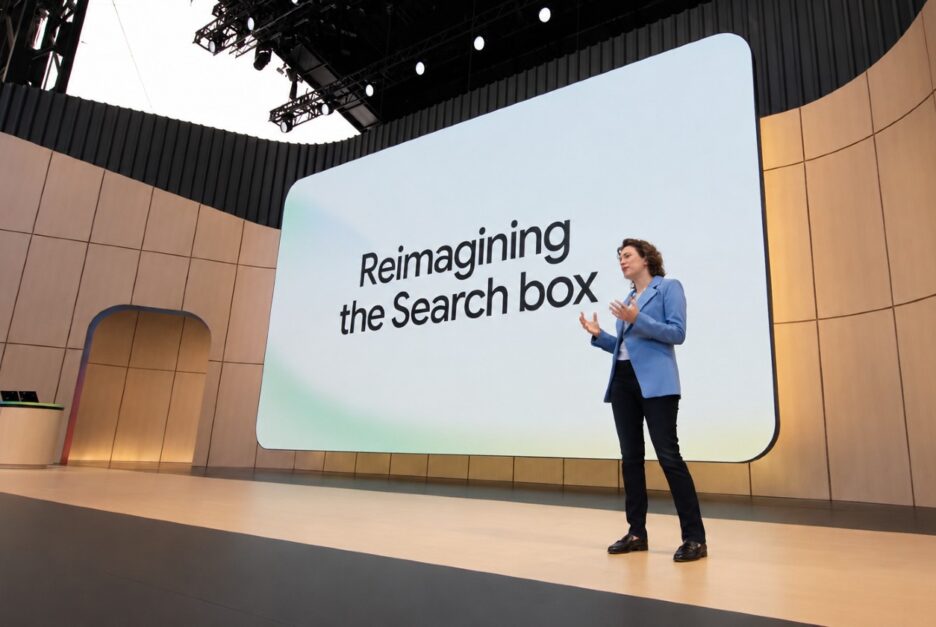
Google’s VP of Search Elizabeth Reid described the I/O 2026 announcements as “the next step in bringing together the best of a search engine with the best of AI.” So what do these changes mean?
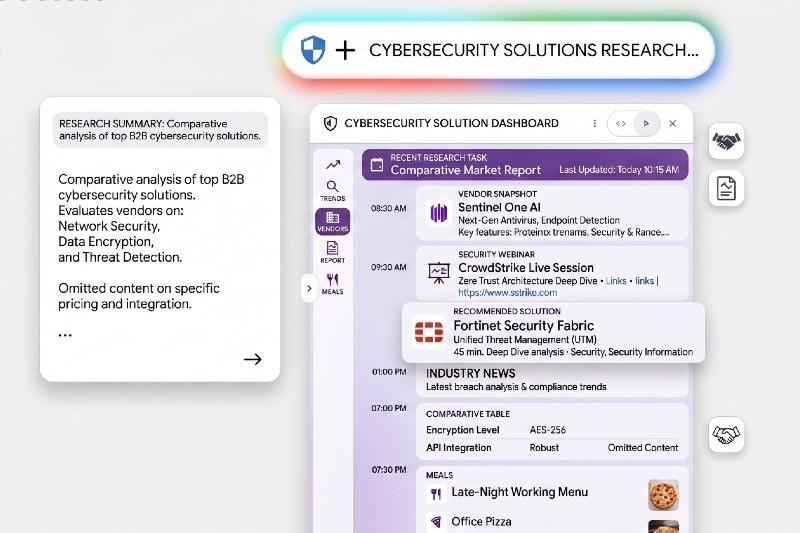
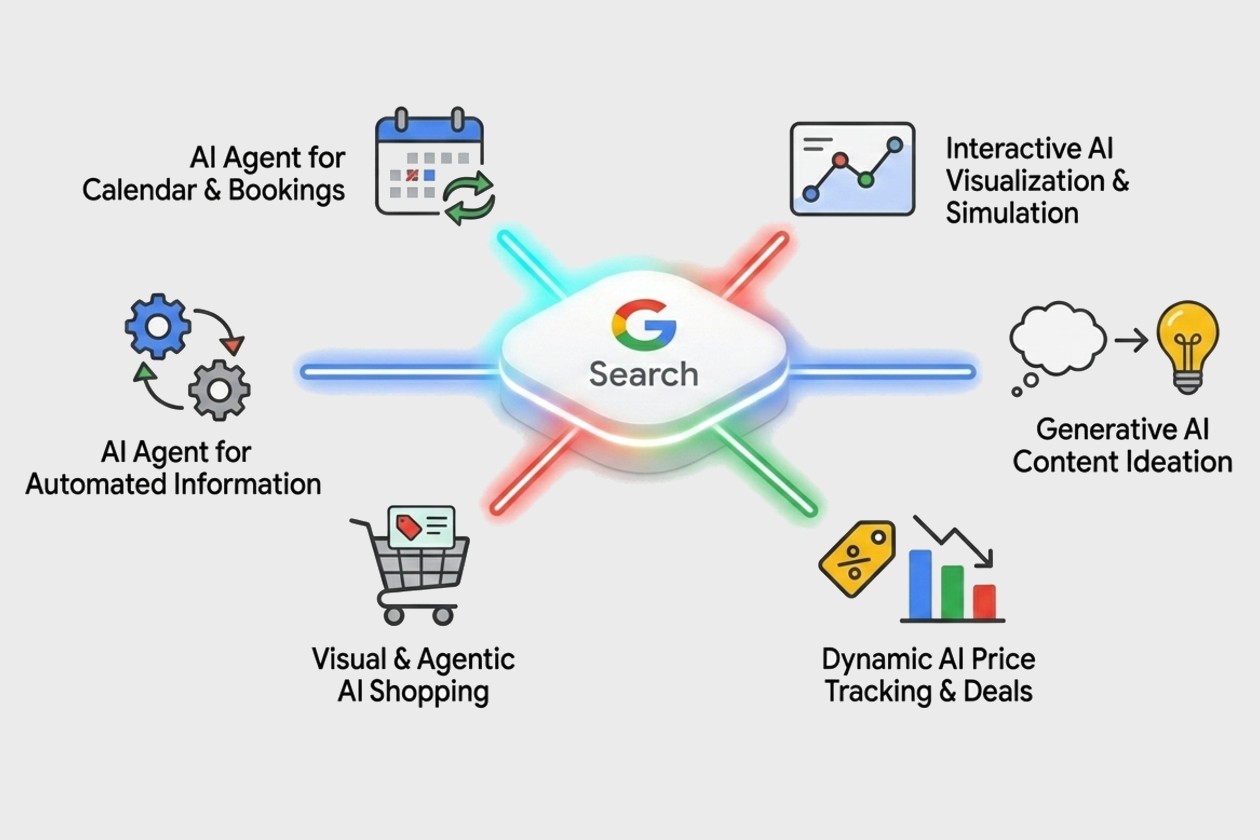
Simulation
A reimagined search interface
The search box has been completely rebuilt for the first time in 25 years. With the implementation of these changes it will expand dynamically to support longer, more conversational queries, accept multimodal inputs including text, images, files, and video, and provide AI-powered query suggestions that go beyond autocomplete. The added functionality might turn some Google users off, but for others, it opens doors to next level capabilities for researching solutions, identifying resources and providing the information needed to make confident decisions.
AI Mode at scale
Just one year after launch, AI Mode has surpassed one billion monthly users, with queries more than doubling every quarter. AI Overviews now reach 2.5 billion monthly users. The traditional blue-link search results we’ve all known and loved for so many years are no longer where the majority of the Google search experience is happening. As I mentioned above, all search is now AI search.
Search agents
Your B2B customers can now use the Google search interface to create, customize, and manage AI agents that work in the background 24/7, scanning the web to monitor topics, synthesize changes, and deliver updates. Instead of a list of links, these agents will return a synthesized answer with recommended actions. The age of agents as a secondary audience to humans will be facilitated by the search agent feature.
Generative UI
Google search is now planning on making it possible for users to build custom interactive experiences on the fly in direct response to what your customers are asking or searching for, from visual explainers to stateful mini apps that users can return to over time. For example, buyers will be able to tell Google to create a comparison table of features between vendors right within the search experience. I’ve been using Manus to do this for a year and it can be incredibly helpful.
The “query fan-out” capability Google shared last year, where AI Mode issues multiple related searches concurrently across subtopics and synthesizes the result, has now evolved into a full agentic system that can function autonomously on behalf of buyers. Google’s own AI optimization guide confirms that both query fan-out and retrieval-augmented generation (RAG) continue to play an important role in its core search ranking systems, which means foundational content authority still influences what gets cited.
As TechCrunch’s Sarah Perez reported, this change means that “searching the web” will increasingly be performed by AI agents instead of humans, with people focusing on acting on the information that those agents find and provide. The notion of agent as an audience has traction as of late. Adobe’s Marissa Dacay calls this the New ABM “agent based marketing” and Forrester has been talking about B2A “business to agent” strategy.
How are people actually using AI mode?
Behavioral AI Mode trend data Google shows several important changes:
- The average query is triple the length of traditional search
- Follow-up queries have grown by over 40%
- Non-text (multimodal) searches are rapidly increasing.
This proves that content must be structured to directly answer ‘What’ and ‘How’ questions instead of optimizing solely for specific keywords.
The fact that the average AI Mode search query is triple the length of a traditional search query means people are no longer worrying about the right way to write their questions, they’re just asking. This is proof that keyword-based content strategies are no longer aligned with how buyers now search.
“Full-sentence, contextual, nuanced questions are the new input standard and the art/science of delivering answers to those questions is what B2B marketers need to master in order to stay relevant.”
Follow-up behavior means buyers are not asking one question and leaving. They’re going deeper, exploring related angles, and continuing the conversation. B2B brands that own only a narrow slice of a topic may drop out of consideration at the second or third follow-up.
The top first words in AI Mode queries are What, How, I, Is, and Can. The top keywords are Information, Identify, Find, Explain, and Summarize. Together, these signals point to a evolved search experience beyond keywords to one that is built around questions and explanations. Content that answers “what” and “how” directly, with clear definitions, frameworks, and expert perspective, is the content AI Mode is designed to surface. This is exactly the formula used by Best Answer Marketing’s integrated strategy.
Delivering content experiences beyond text is more important than ever. According to Google’s research, more than one in six AI Mode searches are now non-text (multimodal), and image input is up more than 40% month-over-month since launch. This makes visual and multimedia content essential for B2B content strategy in an AI powered search environment. Again, this aligns with BAM, experiential content to be specific.
According to the AI Mode usage report, Google organizes what people are doing in AI Mode across five behavioral modes:
- Explore (Top of Funnel, TOFU)
- Decide (Middle of Funnel, MOFU/Evaluation)
- Learn (Ongoing Buyer Education)
- Do (Planning and Execution)
- Create (Content Production)
For B2B marketers, these modes are well aligned to the buyer journey and each provide useful insights for how you approach content. Let’s take a look at each:
Explore: Brainstorming-related queries are growing 30% faster than AI Mode queries overall. Google’s data shows that people are coming to AI Mode to discover new ideas and explore open-ended concepts, not just to find something they’ve already defined. B2B buyers do the same at the earliest stage of problem identification before they know what category of solution they need. TOFU brand content must take this exploratory, open-ended mode into account vs. the basics of informational keyword intent.
Decide: Searches beginning with “which” have increased 40% faster than AI Mode queries overall. In B2B, “which platform,” “which provider,” “which approach” are the kind of evaluation-stage queries where trust signals, comparative content, and credible third-party validation has a big influence on visibility.
Learn: AI Mode is being used for professional development and deep-dive learning extensively. A lot of B2B buyers behave the same way in how they build competency in a category before evaluating vendors. Brands that produce educational content, from original research to expert/creator/influencer-led explainers, can become the source material that AI Mode draws from during these learning sessions.
Do: Planning-related queries in AI Mode have grown 80% faster than AI Mode queries overall in the past six months. Google says AI Mode’s Canvas tool is being used for complex, multi-step structured planning tasks. B2B brands that publish structured, actionable content such as step-by-step guides, decision frameworks, and templates can become the source material or best answer for those planning sessions.
Create: Image creation queries in AI Mode have more than tripled since the start of this year. B2B buyers are increasingly using AI Mode as an active productivity tool. Modular, repurposable content that AI can incorporate into creation workflows can create a visibility opportunity that most B2B brands have not even considered yet.
How does the Best Answer Marketing help B2B brands adapt to Google I/O search changes?
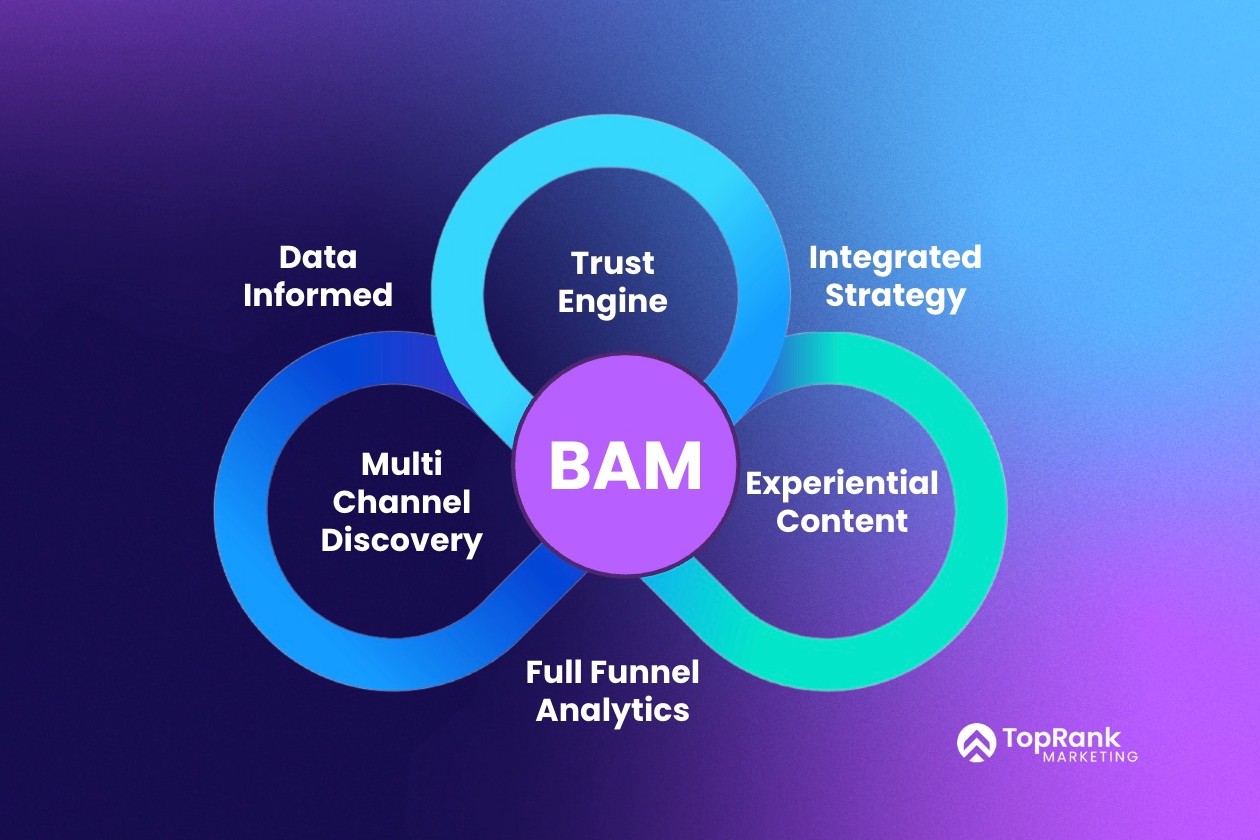
The Best Answer Marketing (BAM) framework was built on the premise that buyer behavior evolves and the technology that buyers use to find, evaluate, and trust content will also change. Today, those changes are largely due to AI.
Of course these changes are relevant for B2B content in general, but they are also impactful for fast growing content categories like B2B thought leadership. According to our own research in Answer Engine: The State of B2B Thought Leadership in 2026, 35% of marketing leaders say AI and GenAI platforms are changing how content is discovered, trusted, and acted upon. Separately, 32% of B2B professionals now report discovering thought leadership through GenAI tools. Those numbers are undoubtedly even higher now than when we fielded the survey.
It’s also worth noting that Google’s own guide to optimizing for generative AI search, published May 2026, validates this direction directly. The distinction between what works and what doesn’t in AI search optimization is important. Google’s recent AI search optimization best practices explicitly identifies the AEO and GEO tactics that do not work for its AI search features, including creating LLMS.txt files, chunking content, rewriting copy for AI systems, seeking inauthentic mentions, and overfocusing on structured data. BAM was not built around these kinds of shortcuts. There’s no shortage of confident advice without data in the SEO industry, so balance what you hear from both Google and SEO experts with strategies informed by data, experience and real-world measurable impact.
There are best and worst practices with all kinds of marketing. In this case, Google has confirmed what does work and those best practices happen to align with each BAM pillar below.
Data Informed: Answer the questions buyers are actually asking
The shift to triple-length queries means buyers are no longer translating their questions into keywords. They are asking whatever is on their mind. The top AI Mode query intents (What, How, Explain, Identify, Summarize) can help define a content brief as clearly as any keyword research tool. The important thing is that credible content is in demand from buyers and industry publications that influence buyers as much as LLMs.
“The content that we find that’s really valuable is the content that’s based in proprietary data and actually has a really strong foundation for saying something different in the industry.” – David Rowlands, Head of Product at B2B Marketing & Propolis
BAM’s Data Informed pillar draws on customer surveys, CRM data, audience research, and original research to identify the specific questions buyers need answered. That process now directly maps to the question structures AI Mode is built to handle. Brands that have invested in genuine buyer question research have a content architecture AI Mode can work with.
Integrated Strategy: Depth and Coherence Win Follow-Up Conversations
The 40% monthly growth in AI Mode follow-up queries is the behavioral proof for why topic cluster depth and coherent narrative orchestration matter. A buyer asking about data center optimization, then following up on differentiation strategies for cloud service providers, then researching Xeon Scalable performance benchmarks, then exploring Intel Select Solutions, will cycle through multiple related pieces from brands that have built out that full topic ecosystem. And brands that haven’t, will simply fall off the radar.
As we shared in last year’s Google I/O post, B2B buyers are no longer using Google alone, sourcing information across LinkedIn, Reddit, TikTok, and GenAI platforms like Perplexity and ChatGPT. BAM’s Integrated Strategy pillar aligns brand, demand, and lead generation content goals into a unified plan with consistent narratives across formats and channels. BAM focused topical coverage across the buyer journey is now a prerequisite for relevant AI Mode visibility.
Trust System: Credibility determines who gets cited in the decide stage
The 40% faster growth in “which” queries should place the Decide mode at the center of a B2B brand’s AI Mode strategy. When a buyer asks AI Mode “which cybersecurity solution for fintech should I consider,” the brands that get chosen in AI powered answers are those with the strongest credibility signals.
“GEO builds on great SEO tactics. It does not replace it. So, structure and clear answers and credible authorship make content easier for systems to extract data and information and reuse that.” – Kelsey Voss, Principal Marketing Analyst at EMARKETER
Google’s AI optimization guide draws a direct line between what it calls commodity content, common knowledge that could come from anyone, and non-commodity content, unique expert and experienced takes that go beyond what is generally known. Google also warns that seeking inauthentic mentions provides little benefit and that its systems are designed to reward genuine, high-quality content. BAM’s Trust System is built to produce exactly the latter through:
- Original or proprietary research
- Thought leadership from named practitioners
- Influencer content
- Earned media coverage
Our Answer Engine research found that 97% of B2B marketers agree thought leadership is critical to full-funnel success, and 35% say original research is significantly more valuable than AI-generated content for building trust and authority. The E-E-A-T principles Google has championed for years carry even greater weight when AI Mode is selecting sources for decision-stage recommendations.
Experiential Content: Multi-format, structured, and built for AI recommendations
The multimodal growth data makes the case for visual and multimedia content investment even more concrete. One in six queries are now non-text, with image input up 40% month-over-month, and image creation queries tripling. Since AI Mode is increasingly a visual experience, B2B brands publishing only text-based content are putting themselves at a significant disadvantage.
Also, the 80% faster growth in planning queries and the Canvas planning tool show that structured, actionable content is what AI Mode draws on for the Do behavioral mode. Google’s generative UI capabilities create even more opportunity for impact: Search can now build interactive experiences directly from web content. BAM’s Experiential Content pillar, which addresses both format richness and content structure for AI citation, responds directly to this and extends what we outlined last year as the need to create content structured for AI parsing and repurposing.
MultiChannel Visibility: Owning discovery across all five behavioral modes
The five AI Mode behavioral modes that Google’s research has outlined: Explore, Decide, Learn, Do, and Create don’t all happen through the same content format or channel.
- Exploration now happens through open-ended brand and thought leadership content.
- Decision happens through comparative, validation-heavy content.
- Learning happens through educational long-form and research assets.
- Doing happens through structured, actionable formats.
- Creating happens through modular, repurposable content.
TechCrunch reported that these changes will probably decimate Google referrals to publishers which are already suffering due to AI Overviews. We addressed this trajectory last year in the context of zero-click search experiences – this is now the dominant reality. Our Answer Engine research shows 33% of marketers say reliance on too few channels limits their success, and buyers now use an average of 10.2 channels during a purchase journey (McKinsey). BAM’s MultiChannel Visibility pillar was built to drive discovery across the full range of formats and channels that align to each buyer mode.
Unified Analytics: Measuring What Matters in an Agent-Driven World
As AI search removes the direct click as the primary performance signal, the metrics that matter now must change toward AI citation rates, brand mention share, topic authority signals, and pipeline influence. Tracking those metrics across disparate sources requires an analytics infrastructure well beyond a standard dashboard.
BAM’s Unified Analytics pillar brings together disparate data sources in an AI-powered data warehouse, with visualization tied to full-funnel outcomes: TOFU brand, MOFU demand, BOFU revenue. In a world where AI agents are doing the searching on behalf of buyers and buyers are using AI Mode across the five distinct behavioral modes outlined by Google, unified measurement is really the only reliable way to know whether a content program is working.
The window for B2B brands to adapt is narrowing
Google confirmed the new Search interface is rolling out now. Generative UI will come this summer. Information agents and mini-app building will follow for subscribers first, and broader free access after that. As TechCrunch noted, there isn’t much time left for publishers to adapt. That includes B2B brands publishing content with the expectation of attracingt, engaging and converting customers.
The behavioral data Google shared makes this sense of urgency compelling. Triple-length buyer questions are now the norm. Follow-up conversations are becoming more common. And multimodal search is growing fast. The five behavioral modes that define how buyers use AI Mode are active now, and brands that build content strategies around them are positioned to create authority and choice preference for AI systems and humans alike. Those choice preferences compound over time.
Last year we said that embracing a Best Answer Marketing strategy was the path for B2B marketers to move beyond simply being found to becoming the indispensable answer customers are looking for, no matter how or where they search. A year later, Google’s behavioral data confirms that is exactly where the search experience is heading.
“Building brand credibility and consensus across channels through integrated content experiences is how B2B companies go from blending in to becoming Best Answer Brands.”
If you’re ready to tap into the best answer system, let’s start the conversation.