



Why the smartest B2B brands use thought leadership to create value long after the contract is signed
B2B marketers are under more pressure than ever. AI is flooding every channel with generic content. Platforms are noisier. Organic reach continues to shrink. Buyers are more skeptical and more demanding at the same time.
Most B2B marketing teams respond by prioritizing their pipeline growth efforts, often with fewer resources and higher expectations. But one question still gets less attention than it deserves:
How can marketing continue to create value after the deal is closed?
This is where thought leadership becomes a post-sale powerhouse-and where many B2B brands leave meaningful opportunity on the table.
Our research shows that 97% of B2B marketers believe thought leadership is critical to full-funnel success, yet only 47% actively use it to engage customers post-sale. That gap matters. Trust doesn’t disappear once a contract is signed. In fact, the post-sale phase is where trust becomes even more influential. The proof in the value of thought leadership applied across the entire customer lifecycle can be found on how high ROI B2B marketers use it:
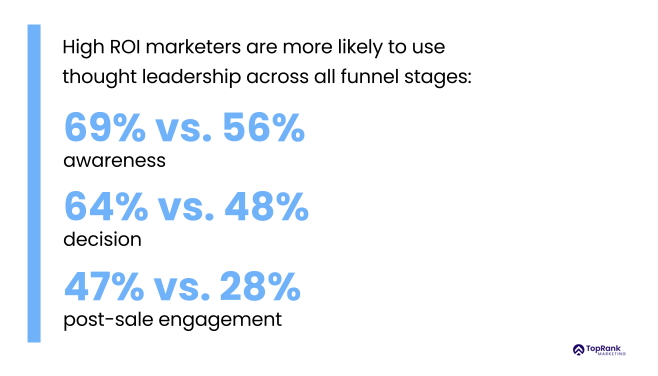
When done well, thought leadership doesn’t just attract buyers. It supports customers long after onboarding-strengthening relationships, accelerating adoption, enabling internal alignment, and creating momentum for renewal and expansion.
Why thought leadership matters after the sale
Thought leadership for B2b companies is often treated as a top-of-funnel tactic that is designed to spark interest or signal category leadership. While it plays that role, its impact is often greater after the sale.
Once a deal closes, customers move from evaluation to execution. New processes are introduced. Expectations rise. Internal scrutiny increases. At this stage, high-quality, research-backed insight reinforces confidence and reminds customers why they chose your organization.
As Stephanie Losee, Director & Executive Editor at Salesforce, shared on the Beyond B2B Marketing podcast:
“Customer success… their life is made so much better by thought leadership in particular content, because they’re having continuing conversations with these valuable clients. And you want as many as possible of those conversations to be CTA-free.”
This is a critical shift in mindset. Post-sale thought leadership isn’t about promotion-it’s about enabling better conversations. When customer success and account teams are equipped with credible insight, they can help customers think more clearly, act with confidence, and stay aligned internally.
Stephanie also tied thought leadership directly to renewal and expansion:
“When it became so successful, it was just as much because of the internal channels we built to help customer success and sales understand how to use this information… sales and customer success openly gave us credit when that particular client became the biggest contract renewal ever in Autodesk history, $150 million.”
That’s not just brand awareness. That’s business impact.
From a Best Answer Marketing perspective, this is where value compounds. Brands that continue to show up with credible, useful answers-grounded in customer needs-become trusted partners, not just vendors.
B2B thought leadership builds confidence, adoption, and advocacy
Post-sale thought leadership helps customers self-educate, which accelerates adoption and reduces friction. Clear, credible insight gives teams the context they need to make better decisions, move faster, and feel confident they are on the right path.
It also plays a critical role in internal advocacy. After the sale, customers are often justifying continued investment to stakeholders who were not part of the original buying decision. Thought leadership gives them language, evidence, and perspective they can use to align teams, defend decisions, and build momentum.
Industry research reinforces this dynamic. Harvard Business Review says that effective thought leadership helps audiences make sense of complexity and feel more confident in their decisions-reducing uncertainty and buyer regret, both of which influence long-term loyalty and retention.
Similarly, Gartner emphasizes that B2B decisions-both initial purchases and renewals-are driven by large buying groups that require ongoing consensus. Helping customers align stakeholders and reduce perceived risk is essential well beyond the point of sale, making shared insight and clarity critical throughout the customer lifecycle.
Thought leadership can become the connective tissue that helps customers align internally, validate their decisions, and move forward with confidence long after the contract is signed.
What post-sale thought leadership should deliver for B2B customers
Effective post-sale thought leadership reflects what customers care about after they become customers:
- The initiatives they’re responsible for advancing
- The outcomes they must deliver
- The market shifts shaping future priorities
The strongest programs function as an answer engine-continuously translating insight into guidance customers can apply. When thought leadership is grounded in customer realities, meaningful data, and practical expertise, it becomes a resource customers return to, not a one-time asset.
Grounding thought leadership in research and insight
Post-sale thought leadership becomes far more powerful when it is anchored in evidence rather than opinion.
Executives, subject matter experts, and customer-facing teams bring valuable perspective. But their influence increases significantly when supported by original research. Data helps insight cut through noise, reveal what’s actually happening in the market, and guide customers with confidence.
Our research found that 53% of marketers cite customer feedback as the most influential input in shaping research-based thought leadership, reinforcing the importance of grounding insight in real buyer needs.
This is a core principle of Best Answer Marketing: authority isn’t claimed, it’s earned through insight that reflects lived experience and validated data.
Turning research into actionable strategic insight
A point of view is only as strong as the evidence behind it.
Narrative helps ideas resonate, but research gives them authority. Without data, a POV is subjective. With original research, it becomes a trusted guide customers can use to understand change and decide how to respond.
Our State of B2B Thought Leadership in 2026 research shows that decision-makers place significantly more value on research-backed insight. We found that 37% of B2B marketers say original research-backed content is more valuable than AI-generated content for building trust and authority.
As Cindy Anderson, CMO of IBM’s Institute for Business Value, shared on the Beyond B2B Marketing podcast:
“Thought leadership requires data. It requires research. It requires perspective. And it must be independent from the commercial aspect of the enterprise.”
That independence is exactly why customers trust it, before and after the sale.
Amplifying thought leadership with the right voices
Internal expertise is a strong foundation for B2B brand thought leadership, but its impact grows when reinforced by trusted external voices.
Collaborating with credible industry influencers expands reach, reinforces authority, and accelerates trust. These voices already have the attention of the audiences your customers respect. When they engage with your executives or research, credibility transfers.
Post-sale, this matters even more. Customers want reassurance that they’ve partnered with a brand recognized across the industry. Influencer collaboration isn’t a promotional add-on-it’s a strategic accelerator that extends the lifespan and impact of thought leadership across the customer lifecycle.
Creating experiential thought leadership beyond the PDF
Thought leadership shouldn’t stop at a static report.
Modern audiences expect experiences that are engaging, accessible, and worth returning to. Experiential formats including video series, podcasts, interactive data, learning hubs, and live or virtual events-turn insight into something customers remember and share.

A great example of experiential thought leadership content is the Ivanti: Digital Experience Report Series
Based on a survey of 6,000 office workers and 1,200 IT and cybersecurity professionals, this data rich, interactive report includes
- Audio version of the report content,
- Embedded video of Ivanti experts
- Companion ebook
- Executive summary CTA
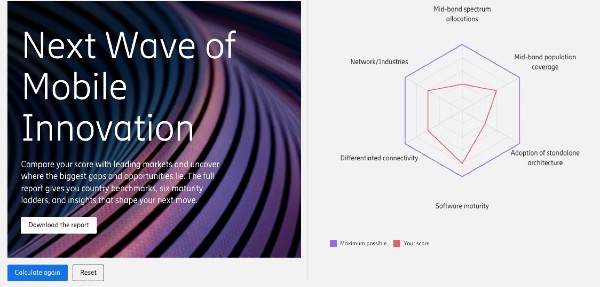
Another example is Ericsson’s report: Next Wave of Mobile Innovation.
This report website features Ericsson’s CTO and an industry expert with embedded video and a benchmarking tool for a mobile infrastructure maturity index. Allowing users to interact with the data in this way increases engagement and likelihood of taking next steps to read the full report.
While effective at any stage, post-sale, these kinds of experiences make complex ideas easier to absorb and easier to champion internally. A research finding carries more weight when brought to life through expert discussion or interactive storytelling.
Turning post-sale thought leadership into a growth engine
I think we can agree that Thought leadership isn’t just an awareness tactic. It’s a strategic brand, demand and revenue building asset that can support customers long after the initial sale-building trust, accelerating adoption, enabling advocacy, and opening the door to renewal and expansion. Here are five use cases illustrating how thought leadership can create impact for retention and expansion of customer engagements:
-
Decision Justification and Buyer Group Alignment
Why it matters: Retention risk can increase when post-sale stakeholders are missing on confidence or context. Thought leadership can help customers justify the buying decision as scrutiny, leadership changes, or budget reviews come up.
Example: A B2B SaaS company provides its customers with quarterly research briefs on industry benchmarks and emerging risks that internal champions can share with finance and IT leaders to support why the platform continues to be strategically important and valuable. -
Accelerating Time-to-Value and Adoption
Why it matters: Faster realization of value from the purchase decision directly correlates with the likelihood of a renewal. Thought leadership can help reframe onboarding and enablement as strategic insight rather than just product training.
Example: A cybersecurity vendor publishes post-sale executive POV content on evolving threat landscapes and best-practice operating models, which helps customers understand how to operationalize capabilities faster in response to the real-world risks they are seeing. -
Expansion Through Strategic Reframing
Why it matters: Expansion revenue is more likely when customers see new needs through an informed, future-oriented lens without explicit CTA like a product-centric upsell would have.
Example: A cloud infrastructure provider uses research-driven thought leadership to highlight new regulatory and scalability challenges, and then positions additional services as a natural next step in the customer’s growth roadmap. -
Enabling Customer Success as a Strategic Partner
Why it matters: Customer success teams that are armed with credible insight can elevate conversations from account maintenance to value creation, which can strengthen engagement renewal and expansion.
Example: A martech platform equips its CSMs with industry trend reports and expert commentary that anchor quarterly business reviews around strategic priorities vs product features. -
Internal Champion Enablement
Why it matters: Most renewals and expansions depend on internal advocates who often have to defend the partnership multiple times and with different stakeholders. Thought leadership gives them authority, language, and proof to do that.
Example: An enterprise services firm creates executive-ready slide summaries of original research that customers can reuse in board presentations to support their continued investment and even program expansion.
Brands that consistently deliver credible, research-backed answers across the customer journey position themselves as long-term partners. That’s the essence of Best Answer Marketing.
Want to go deeper?
If you’re exploring how to build thought leadership that creates value across the full customer lifecycle:
- View the full TopRank B2B Thought Leadership Report (or download the PDF) to see how leading brands use research, influence, and experience to earn trust and drive impact
- Explore the Best Answer Marketing Playbook to learn how research-driven insight, experiential content, and influencer collaboration work together to create lasting visibility, credibility, and growth
When you’re ready to become a best answer brand for your customers, we’re here to help.