Greetings, B2B marketers. Step right up to my crystal ball for a glimpse into the future of influencer marketing and creator-driven content.
At TopRank Marketing, we’ve been surveying the field and publishing our benchmark research on B2B influence dating back to 2020. Through this exercise, and our numerous client engagements over the past decade-plus, we have a clear picture of where the discipline has been.
What matters, of course, is where it’s going.
We think we’ve got a pretty good handle on that too — from analyzing year-to-year trends, breaking down data from the 2027 B2B Influencer & Creator Marketing Report, and speaking to leaders and experts who are deeply plugged in. Based on all of these signals, here’s what we see on the horizon.
6 trends that will shape B2B influence in 2027 and beyond
Some of these shifts are already well underway. Others show up as early signals in the data, mostly among programs that rate themselves very effective. Together, they show a discipline that is moving past proving it works and toward working at a higher level.
Influence moves from table stakes to tiebreaker
Since our first report in 2020, I’ve watched B2B influence grow from a side experiment into something buying committees genuinely trust.
There’s no doubt that influencer marketing maturity has come a long way. In reviewing trends that have played out through our research, a few things stand out:
- In 2023, half of B2B marketers surveyed did not track influencer performance at all. In 2027, only 3% of programs go unmeasured.
- Only 2% of respondents in our latest survey said they are operating with no documented strategy and have no plans to create one. Back in 2022, lack of a documented strategy was cited as the No. 1 challenge, with nearly a quarter of B2B marketers saying they had no influencer strategy at all.
- The percentage of B2B marketers saying they practice always-on influence has risen from 21% in 2022 to 48% in 2027.
With 83% of B2B marketers now saying they either currently run influencer programs or have plans to start, success going forward will come down to innovation, differentiation and expert execution.
Unconventional creator partnerships become the norm
In the past, B2B influencers typically fell into a defined set of archetypes: industry analysts, keynote speakers, so-called “brandividuals.” These remain highly effective partners for many programs, but the scope is widening, as reflected by the increasing use of “creators.”
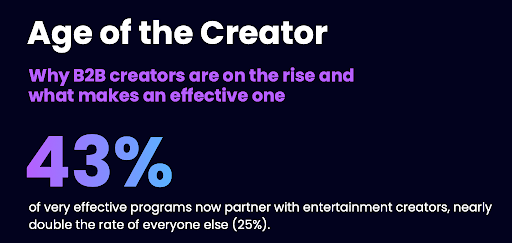
One influencer type that found its way into our list this year is “entertainment creators,” a category that might include satirists or TikTok personalities. Very effective programs were almost twice as likely (43% vs. 25%) to say they partner with this emerging profile.
Focus shifts deeper into the funnel
Historically, B2B influencer marketing has been viewed primarily as an upper-funnel play, which makes sense. Your brand is reaching new, relevant audiences through a trusted and credible voice. It’s a great way to get on the radar of buyers, especially with AI search taking over discovery. (More on that in a moment.)
Targeting the upper funnel narrowly with influencer marketing, however, sells its impact short. The same trust and credibility that creator partnerships imbue are powerful in late-stage decision-making and even post-sale communications.
In looking at funnel coverage, our research found that very effective programs are considerably more likely than others to use influencer marketing in support of the evaluation stage (62% vs. 44%), decision stage (63% vs. 48%) and post-sale stage (46% vs. 25%).
“In 2027, B2B influencer marketing will increasingly influence the full funnel, combining trusted relationships, original insight, and human connection to shape decisions and AI discovery.” – Desirée Porcaro, Senior Director of Social Media at UKG
AI search visibility becomes a primary objective
The data shows it hasn’t happened yet. But it needs to, and that was perhaps the biggest takeaway from our latest report.
B2B marketers clearly see the stakes. 86% say improving visibility in generative AI tools will be at least moderately important for their influencer programs this year, and more than half (53%) call it very important. Yet only 21% have made AI/LLM visibility a primary program goal, and just 37% have integrated influencer marketing with AI search optimization (AEO/GEO).
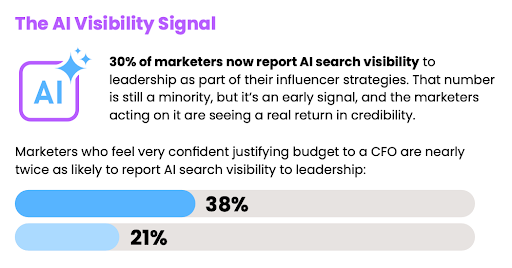
The gap shows up in leadership reporting too. Only 30% of marketers currently report AI search visibility to leadership as part of their influencer strategy. Those who do have a stronger hand in budget conversations. Marketers who feel very confident justifying influencer budget to a CFO are nearly twice as likely to report AI visibility to leadership (38% vs. 21%).
“Expertise will be a vital vetting metric in 2027 due to AI search now reading and ranking creators. As AI answers become more impactful, brands will vet creators on a second metric: whether large language models cite them.” — Georgina Whalen, Director of Influencer, Affiliate & Social at TrueLearn
Influencer-driven content formats become more durable and diverse
A standalone social post or guest blog will no longer be viewed as the model for influencer content. Social posts are still the most commonly co-created format overall (60%), but they no longer separate leaders from everyone else.
The formats that do are more durable. Compared to all others, very effective programs are more likely to co-create these with influencers and creators:
- Podcasts (37% vs. 19%)
- Newsletters (38% vs. 25%)
- Research reports (35% vs. 22%)
- Industry presentations and conference content (36% vs. 22%)
These formats take more effort, but they keep working long after they’re published. A podcast episode gets clipped and shared. A research report gets cited across surfaces. A newsletter builds a standing audience that returns every issue.
Expect even more creative activations from here, such as:
- Comedy series built with entertainment creators who can poke fun at an industry’s quirks
- Animated explainers voiced by trusted experts
- Live and in-person experiences where creators, customers and prospects share a room
When so much content is AI-generated, formats that bring people together are hard to imitate.
“The future of content creators and marketers is about human connection and relationships that live outside an algorithm. As marketers head into budget season, I would put in-person experiences near the top of the list.” – Joe Pulizzi, Founder of The Tilt
Compensation becomes more structured and standardized
Over years of running enterprise influencer programs, we’ve seen a big change in how partners get paid. Influencers used to team up with brands for exposure or credibility-by-association alone, but that’s no longer the default.
Today, about four in five B2B marketers (78%) compensate influencers in some form. Pay per deliverable (51%) and performance-based models (48%) lead the way. Structure also increases with scale: credibility-based compensation rises from 23% at small companies to 48% at enterprises.
More structure means more to manage, from scoping and rate negotiation to contracts and disclosure. Getting it right takes real expertise.
Bring your B2B brand into the future of influencer marketing
As our latest report puts it, B2B influence is moving “from campaign to system, from reach to citation, from tactic to infrastructure.”
See where your program stands with the full 2027 B2B Influencer & Creator Marketing Report. It includes benchmark data from 400+ senior B2B marketers and a practical action plan. When you’re ready to put it to work, we’re here to help.
Download the report or contact us to put your strategy in motion.