

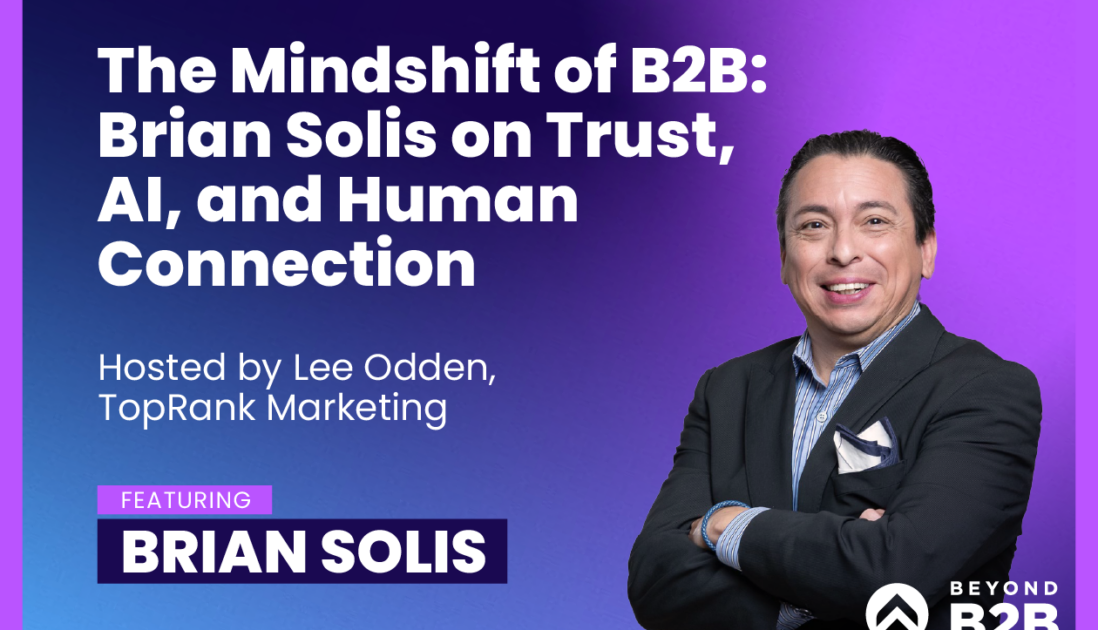
In this 10th episode of Beyond B2B Marketing, our host Lee Odden talks with Brian Solis, Head of Global Innovation at ServiceNow, about how AI is reshaping business, leadership, and the role of marketing. Brian shares why AI should be treated as a forcing function for reinvention rather than a tool for incremental efficiency, and why many organizations are moving fast without truly challenging their assumptions.
The conversation explores what this moment means specifically for B2B marketers. Brian explains how teams can move beyond automating legacy workflows to rethinking how value is created, discovered, and delivered. He emphasizes the importance of learning, unlearning, and reframing success metrics in a world where AI is accelerating change in customer behavior, content discovery, and decision-making.
Brian also offers an important perspective on thought leadership and trust. He distinguishes subject matter expertise from true thought leadership, arguing that credibility comes from empathy, relevance, and helping audiences navigate uncertainty. In an era of AI-generated sameness, he makes the case that human insight, originality, and meaningful connection are what will ultimately differentiate B2B brands and marketers who lead.
Listen to the full podcast with Brian here:
Key Takeaways:
- AI should be used to reimagine marketing, not just automate existing processes.
- Most marketing teams are moving faster without truly challenging their assumptions.
- The biggest opportunity with AI is innovation, not efficiency.
- Marketers must learn, unlearn, and relearn as customer behavior continues to change.
- Thought leadership is about helping people see what’s next, not just sharing expertise.
- Trust is built through empathy, relevance, and usefulness-not volume or visibility.
- AI-generated sameness makes human creativity and perspective more valuable than ever.
- Marketing success now depends on understanding how people discover and evaluate content through AI tools.
- Leaders who embrace uncertainty and exploration are better positioned to drive meaningful change.
- The future of B2B marketing belongs to brands that pair intelligent technology with human insight.
Watch the interview on YouTube:
Here’s a transcript of the conversation:
Lee:Hello and welcome to the Beyond B2B Marketing Podcast. I’m your host, Lee Odden, CEO of TopRank Marketing. And today, our guest is someone I’ve known for, wait for it, 18 years. He is a nine-time bestselling author, international keynote speaker, digital futurist, world traveler, and source of inspiration to tens of thousands of business people around the world. And currently he’s head of global innovation at ServiceNow. Of course, I’m talking about my good friend, Brian. Welcome to the show, Brian.
Brian: Lee, it’s good to see you. When you said wait for it, my guess was 20, but pretty close at 18.
Lee: We connected on LinkedIn 18 years ago and have been friends for about 19, so something like that. It’s good to have you here. Over that time, a lot can happen, and you’ve had an amazing journey. When we met, you were a pioneer in digital marketing and PR.
Brian: I’ve been at ServiceNow for three years, and I’m in the Innovation Office. The work started with running and building global innovation centers around the world, where we’d bring customers in to explore what’s next and what’s possible.
We also publish shorter-form research reports that are specific and forward-looking. For example, when Jensen Huang said IT will be the HR for AI agents, we studied what that could mean. What does it look like to apply HR methodologies to agents for training, onboarding, offboarding, management, performance, and more? We published a paper that broke it down and helped organizations think about transformation in a way that’s approachable, meaningful, and measurable.
When Satya Nadella said “SaaS is dead,” we unpacked what he was really trying to say, which is that in an era of AI, the idea of a user interface changes and how software works changes.
And there’s also research showing a huge percentage of companies aren’t getting value from AI investments because they’re not thinking big enough. They’re applying AI to yesterday’s work with yesterday’s structures, and it reinforces silos. What we try to do is help leaders see what needs to change and what they can do now.
Lee: You’re referencing the brand transformation at ServiceNow as well. The marketing is showing up differently.
Brian: The fact that you’re citing our marketing is a testament to the work our CMO and team have done. He’s been here about a year and a half and has driven an incredible transformation at the brand level. The work, the messaging, even the print ad in the Wall Street Journal about putting AI to work for people, not replacing people, was a proud moment.
At a high level, what ServiceNow does is connect workflows across the enterprise. We connect workflows, data, and now AI to power those workflows across the organization.
Lee: Thank you for that. You’ve also written a lot of books. Your latest is Mind Shift: Transform Leadership, Drive Innovation, and Reshape the Future. Why is this book so timely right now?
Brian: It’s my first book in five years. I didn’t know if I was going to write another one, but there have been major disruptions in our world.
The idea was seeded years ago, as I was watching how the world of information was changing and how disruption keeps showing up. The core question is, what are we going to do differently moving forward? How do we ride disruption toward positive outcomes?
The book is about changing mindset first. How do I stop putting new realities into the box of business as usual?
Before you can do anything, you have to be aware enough to realize you might not be seeing things clearly. Research shows most people think they’re self-aware, but only a small percentage actually are. The first part of the book helps unlock that awareness. The second half gets into how to move from awareness into action.
Lee: A key idea is that you have to change how you think before you change what you do. That connects to why new technologies aren’t yielding the results people expect.
Brian: I was just in New York with a group of marketers across B2B, B2B2C, and B2C. And we all say “start with the customer,” but we don’t really do it.
Starting with the customer means understanding who they are, how they think, what they value, and what they aspire to. We often think about how to get to the customer and then put them through our journey. But the customer is already living their own journey.
An experience is an emotion in a moment. If I’m calling customer service, I’m probably feeling frustrated or anxious. What we have access to now, including AI, is the ability to be more human, to design better experiences, and to create better feelings in those moments. That’s where real value is created.
Lee: That aligns with what we’ve been working on called the Best Answer Marketing System. It’s customer-centric, data-informed, and focused on building trust, meaningful experiences, and discovery across channels.
Brian: Let me answer your leadership question with a piece of advice. You mentioned Colin Fleming earlier. If people don’t follow him, they should. He’s showing the mindset in real time through what he publishes and even how he explains the roles he’s hiring for.
The mindset is critical thinking, curiosity, imagination, and possibility. It’s being able to say, I don’t know what I don’t know, and that’s okay. Now I’m going to use frameworks that help me think differently. Then I’ll use AI to help create something entirely new that benefits customers and the business.
That’s the place to start. Once you explore what’s unknown, you’re already in a different place than your competitors. You’re already in a different place for new value creation.
Lee: That takes bravery. In marketing, there’s fear of messing up. But now is the time.
Brian: Courage isn’t the absence of fear. Everybody fears messing up. The key is learning in a way that transcends the moment into something bigger. You can’t put all your eggs in one basket, but you do have to take steps, learn, and move forward. Fear and courage go together.
Lee: It reminds me of the idea of doing it wrong quickly, learning fast, and moving forward.
Brian: Fail fast, fail forward.
Lee: AI is becoming ubiquitous, and a lot of marketers are using AI-powered tools. But it’s also creating sameness and what you’ve called AI slop. What’s your take?
Brian: I’m studying wrong ways to use AI because we don’t talk about that enough. We hear scaling and AI fluency, but not enough about what the future of work looks like in practice.
If you take a role in marketing, you can define potential outcomes, then work backward into how jobs evolve, what skills people need, and what technologies are required. That’s how you get your arms around the future of work more than you did yesterday.
This is hard work, but that’s the point. It’s what makes you better. These are the kinds of conversations I had with marketers in New York. They didn’t know what they didn’t know. Now they’ve heard it, and it changes what their to-do list looks like.
And it starts with reading Mind Shift.
Lee: Let’s talk about thought leadership. You’ve published research papers, written bestselling books, and delivered keynotes around the world. Thought leadership roles have also evolved inside big companies. How do you define it today?
Brian: We’ve helped shape the role of thought leadership into something more formal and measurable. The challenge is that there are plenty of people calling themselves thought leaders who aren’t really influencing anything.
I define influence as the ability to cause effect or change behavior, whether that’s a change in thinking or action.
Thought leadership starts with understanding what people are asking, what they’re trying to learn, and what challenges they’re facing. Those are the inputs. I won’t go on a keynote stage without knowing the questions the audience is wrestling with, because then the presentation is for them.
Whether it’s an article, report, video, or speech, the goal is to unlock new ideas, imagination, and possibility, and give people something inspiring, motivating, and actionable. People don’t want a landing page or a knowledge base. They want something human, meaningful, and relatable.
Lee: Thought leadership can create trust, but some brands struggle to build trust with what they produce. They just put out information.
Brian: Trust is one of the greatest aspirations of what I do. Trust is connection. And when you can’t be in front of someone in real life, empathy becomes the bridge.
I’ll give you a real example. I was sitting outside a hotel and someone jogging stopped and said they’d read my books, that the work helped them make decisions, grow, and learn. That’s the physical manifestation of trust and connection. We ended up going to dinner and I introduced her to people. Thought leadership can accelerate real-life relationships when it starts with empathy.
A lot of people try to be the smartest person in the room or have the wildest opinion. That can drive traffic, but empathy builds connection.
Lee: We completed research for a report called Answer Engine, the state of B2B thought leadership in 2026. One of the findings I wanted to share
Brian: I’d qualify any trust metric by saying make sure it’s empathetic thought leadership. That’s how you humanize the company and extend the brand.
Lee: IBM’s Institute for Business Value surveyed 4,000 C-level executives and found that 87% said they made a purchase decision in the last 90 days influenced by thought leadership they consumed.
Brian: That’s powerful. And it’s exactly why companies invest in thought leadership when they’re trying to reach the C-suite. It’s why you see the marketing transformation and why we publish future-forward research. You have to earn the invitation to come to the table.
Then you apply those insights to sales so that what you sell connects to the vision. Thought leadership works.
Lee: Another finding: 32% of buyers reported using GenAI tools like ChatGPT to discover and consume thought leadership content, compared to 38% on LinkedIn and 34% on YouTube.
Brian: This is the question of the moment. It’s not a question, it’s an action. You have to do it. The difference comes back to mindset. Are you going to take your existing approach to thought leadership and try to optimize it for AI, or are you going to rethink what you create and how it shows up in those environments?
Lee: As a futurist, do you think we’re moving toward a world where agents do more discovery and decision-making?
Brian: If you look at what’s possible with agent experiences, you can have agents research and shop for you. You can prompt it once, give it access, and it can discover and take action. In that scenario, no humans are involved other than the prompt.
We’re designing for humans and for agents. There will be things I want to orchestrate as a human, especially when experiences and people are involved. But the discovery-and-act loop is changing.
That’s the world marketers live in: what someone asks, what they find, how they feel, and what they do next. Now we need to design for agents, and humans with agents, and put content and experiences in the places that accelerate those moments.
Lee: Let’s wrap with something beyond B2B. If you could be doing anything else as a career, what would it be?
Brian: I absolutely love what I do. I don’t know the answer to that.
If I could do something differently, it would be accelerating my ability to rise above the chaos and clutter, and create work that doesn’t read like everything else, something that stands out as human, helpful, and appreciated.
Lee: Thank you. Where’s the best place for people to connect with you?
Brian: If you’d like to know more about ServiceNow, it’s brian.solace@servicenow.com. For my thought leadership and what I publish, brian.solace.com, and LinkedIn at Brian Solace on most platforms.
Lee: I’ll include links in the notes. Thanks again, Brian. I really appreciate it.
Brian: Thank you, Lee.
To find the Beyond B2B Marketing podcast on your preferred podcast platform, check out the links below.