

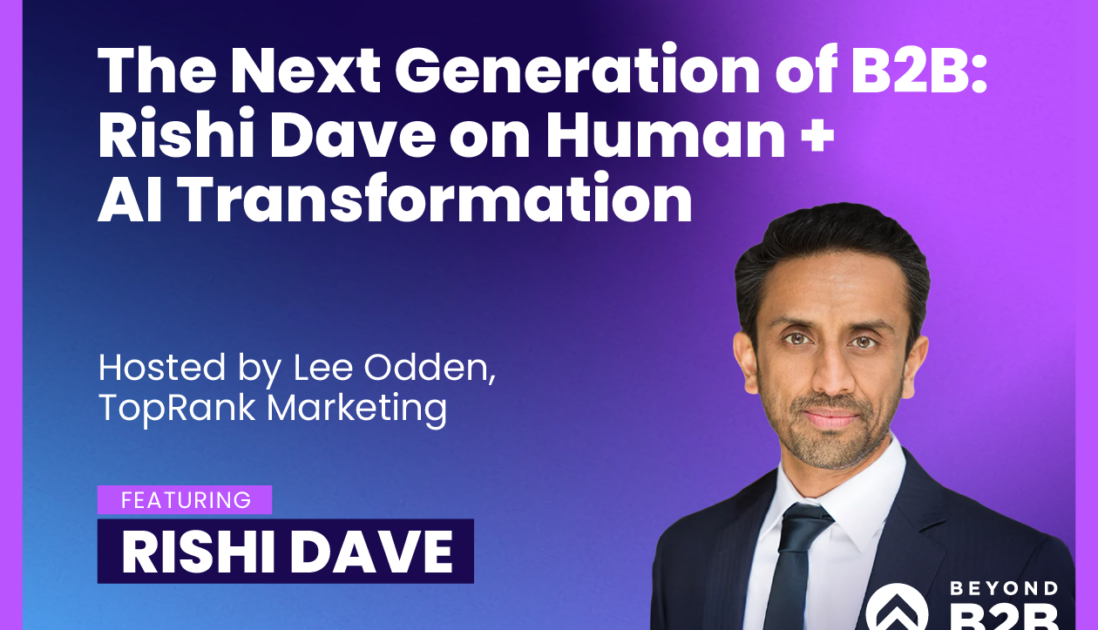
In this 11th episode of Beyond B2B Marketing, Season One, our host Lee Odden speaks with Rishi Dave, Partner at Bain & Company and former CMO at Dell, Dun & Bradstreet, Vonage, and MongoDB, about how B2B marketing is evolving in an era shaped by AI, complex buying groups, and rising expectations for trust and relevance. Their conversation explores what it takes for marketing leaders to modernize go-to-market strategies without losing the human insight and creativity that differentiate strong brands.
Lee and Rishi discuss why buyability has emerged as a critical framework for B2B growth, highlighting how fear of risk, hidden buyers, and peer validation influence purchasing decisions long before a deal enters the pipeline. Rishi explains why category fame and being on a buyer’s Day-One List matter more than isolated demand tactics, and how original research and thought leadership help brands earn credibility across the entire buying group.
The conversation also examines the practical realities of AI-enabled marketing transformation, from redesigning content and operating models to aligning marketing, sales, and customer success around scalable systems. Rishi emphasizes that AI amplifies human strengths rather than replacing them, making skills like messaging, storytelling, and customer understanding more valuable than ever as B2B teams prepare for the next generation of AI-powered discovery and growth.
Listen to the full podcast with Rishi here:
Key Takeaways:
- B2B marketing is moving from disconnected campaigns to always-on systems that align marketing, sales, and customer success.
- AI delivers real impact only when organizations redesign processes, not when it’s layered onto broken workflows.
- High-quality, insight-driven content matters more than volume in an AI-enabled marketing environment.
- Original research and differentiated messaging are essential for training AI and standing out in crowded categories.
- Buyability depends on reducing buyer risk through peer validation, category relevance, and trust signals.
- Being famous for the right category matters more than general brand awareness in B2B buying decisions.
- Hidden buyers and buying groups shape outcomes, making broad stakeholder influence critical.
- Human creativity, storytelling, and empathy remain key differentiators as AI scales execution.
- Strong product marketers and strategists are becoming more valuable as AI amplifies human insight.
- Future-ready B2B teams will be faster, more personalized, and more discoverable across AI-powered channels.
Watch the interview on YouTube:
Here’s a transcript of the conversation:
Lee: Hello and welcome to the Beyond B2B Marketing Podcast. I’m your host, Lee Odden, CEO of TopRank Marketing. And today we have a guest that is someone that I go back way, way back with back to 2013 when my company was providing some marketing consulting services to him when he was executive director of digital marketing at Dell. And then again, when he was CMO at Dun & Bradstreet. Now he’s gone on to serve as CMO at Vonage and CMO at MongoDB. And today, he is partner at Bain & Company. Of course, I’m talking about Mr. Rishi. Welcome to the show, Rishi!
Rishi: I’m so excited to be back with you again. It’s been so long.
Lee: It has been a long time. So let’s jump right into it. So you’ve been CMO at some pretty substantial companies. I’m kind of curious if you could tell us about what led you to transition from that CMO role to partner at Bain & Company.
Rishi: Yeah, so I was actually at Bain & Company early in my career and then I had left for a long time and I came back. And I think the main reason why I kind of went back to Bain & Company was, I had been a CMO at multiple companies, as you mentioned, and they are tough jobs and they are stressful jobs. I was ready to take a break from my CMO roles and do something a bit different.
And so Bain had an incredible opportunity to really build its capabilities in B2B marketing. And so I joined really focused on building Bain’s B2B marketing capabilities. And I love it. And what I love about it is focusing on my passion, which you and I both have, which is B2B marketing. And then two, just working with a wide variety of companies that all different sizes with marketing and specifically, I mean, what more exciting time to be consulting in marketing than now with the changes in tech and data and AI. And so it’s very exciting for me to be in this role.
Lee: It, I agree, it is an exciting time. There’s so much change and that means opportunity, right? For folks who have the vision to see it. I’m curious if you can lean in a little more into like, kinds of things are you doing as a consultant or for the kinds of work at helping other companies advance their B2B marketing initiatives at Bain?
Rishi: Yeah, so a wide variety of work.
You can guess the last couple years, a lot of it has been around AI. And the big questions around AI and marketing have been, not necessarily what I do with AI day to day, but more how do I implement AI and make the operating model changes I need to get real scalable benefits and scalable changes that really drive bottom line benefits like bottom line profitability, things faster time to market and improve the quality of things going to market. Just that rapid acceleration enabled by AI. And so I’ve been focusing a lot on that.
A lot of marketers, and even beyond marketing, they’re trying AI in kind of these isolated use cases or within existing models and seeing little micro productivity gains like I’m a content writer, I can write content a little bit faster.
But what we’re really seeing the benefits and what I’m spending a lot of my time is let’s step back and relook at the entire process of building content now that we have AI. How do we drastically reduce the time to market and improve the quality? And so I spend a lot of time doing that.
That’s the most probably the most most of the things I’m doing right now. But I also spend a lot of time doing marketing operating model changes. So a lot of companies are rethinking their marketing operating model and then doing a lot of capability building like data, tech, AI, and digital. And so there’s just a lot of things going on.
The last thing I spend a lot of my time doing is how do you really go to market more effectively with the sales team in B2B? And so a lot of integrated go to market strategy and planning and execution.
Lee: Great, great. So we actually did an interview once before, and this was 10 years ago. And you mentioned content. And so let’s kind of dust that off and ask you a question about one of your predictions. You said there may not be a need for more content, but there is a need for higher quality content that delivers new insights.
Rishi: Yes.
Lee: Which I think is couldn’t be more relevant and timely. So I’m kind of curious what you think specifically about the role of original research and thought leadership. What do you think about the role of research, original research driven content or thought leadership content as a platform for that call for higher quality?
Rishi: I think it’s critical. What we’re finding, let’s say leveraging AI for content creation, is training the AI on a smaller amount of high quality content and insights is actually more effective than just doing a big dump of everything you have. And so I think that original research, that strong differentiated core messaging for your company and the surrounding case studies, et cetera, a small set of high quality content can more effectively train the AI and then you can leverage the AI to do more personalized content, content for different formats, all kinds of different campaign content, blog content, et cetera.
But unless you have strong original research, messaging that’s differentiated and compelling for users as kind of the core kernel that you’re leveraging to train the AI, it won’t be effective. And so we’re definitely seeing a move to that.
Also, and that’s not just with marketing content, but also with sales enablement content. A lot of what marketers do is sales enablement in B2B. Sellers spend a lot of their time in non-customer facing activity. A lot of that is spent trying to find the right content, find the right marketing or product marketing expert or any expert in the company to come talk to their client, figuring out how to coordinate all those things.
Now with AI, you can say, look, here’s the core set of critical content and expertise, and then you can train a chatbot or some other capability so that sellers can access that very quickly and drive up their productive time.
Quality content is more important than ever. Less is more. And then leave it to the AI to create the permutations for the different channels, different personalization for different types of customers and industries. But that core content is critical.
Lee: Yeah, I agree. I think now about what you’re talking about is if we’re able to aggregate those universal truths, that distinctive and original information perspective about a brand, about your company, and then you allow different stakeholders or customer success, sales, marketing to tap that source of truth via an AI chatbot. You can then use natural language to ask questions about data, examples, even emulate a customer. And there’s a lot of opportunity there if I’m tracking correctly.
Rishi: Yeah, no, absolutely. But one key enabler is missing in a lot of organizations: not enough people who are strong at writing great messaging, doing great original research, driving something that’s differentiated, and really understanding their users. They’re more important than ever.
Oftentimes they’re product marketers, but they can be other functions as well. Most companies are either under invested or not happy with the quality of the people who are doing that.
Finding someone who is good at messaging, good at writing something differentiated, and getting front line sellers and front line marketers excited about it is difficult. And then understanding the user for your product and understanding the product you sell and having a deep understanding so you can do that well-having both that combination is hard. Those people are more critical than ever because you need that original thinking and original research.
Lee: We recently completed a report for a research project on original research and thought leadership as an engine for the flywheel of content. The vast majority of respondents said thought leadership has full funnel benefits, and yet far fewer actually take it that far.
Rishi: The closer a client gets to that final decision, the more important it is that thought leadership and peer validation and opinions of other people, bringing that all together, becomes more important as you get close to that decision.
Lee: A couple of weeks ago, I attended an event in New York where Mimi Turner and Jan Swartz from LinkedIn’s Marketplace Innovation Group presented on a concept called buyability. You are listed as a co-author along with your peer Jamie Cleggorn of a report that they shared called Five Rules of Buyability. Could you describe the notion of buyability and why it’s so important and relevant right now.
Rishi: Yeah, absolutely. Buyability is essentially giving B2B marketers a playbook and messaging strategies to maximize the probability that they’ll win over the buying group they’re targeting versus a traditional brand versus demand, MQLs, and those kinds of metrics.
When buying groups buy in B2B, they have a lot of fear of messing up. They want a safe choice so that if things don’t go well, they won’t get criticized for making the choice. So they want peer validation, case studies, and reassurance.
There’s also the notion of hidden buyers. There’s not just the core buyer or user for your product. There’s also the CFO, head of procurement, and others. Marketers don’t always target them, even though they influence the purchase. And they often care about brand: have I heard of this company? That’s how they mitigate downside risk.
So you need to expand beyond talking about product strength. You need peer validation and you need to be well known in the category you care about.
We talk about getting on the day one list. When a buyer is ready to buy, the short list they already have in mind is about six companies on average. They may add one or two, but a large share of the time they buy off that initial list. It ties back to the safe choice mindset, peer validation, and top of mind recognition, especially for hidden buyers.
We’re still early on this concept. We’re translating research into playbooks: what makes companies buyable, why, and what sales and marketing playbooks they use. Big brands may be well known generally, but not famous in the category they care about. That’s why big tech companies can be beaten out by smaller, high-growth AI startups-those startups are the companies people associate with that category.
Lee: That makes sense. There’s a connection to the 95-5 rule and concepts like mental availability. It moves the market forward.
Rishi: One concept that has taken off with CMOs is category fame. It’s not about being a well-known brand in general. It’s about being famous in the category that’s critical for you. Many big brands are not.
Lee: We have a synonym for category fame, and we call it Best Answer. Are you the best answer for what your customers are looking for?
Rishi: Yes, I remember that. That’s a classic Top Rank notion.
Lee: You’ve talked about building marketing capabilities that scale across channels and functions. A lot of B2B organizations still operate around campaigns and disconnected campaigns. What do you think it’s going to take to evolve from that campaign perspective to building systems?
Rishi: The traditional model-marketing runs a campaign, generates leads, passes them to sales-is being upended. With tech and data, you can coordinate sales and marketing more effectively.
We have a concept called Sales Play System. It starts with getting clear on the specific set of accounts you want to go after. Now it’s possible to define that set, define the sales cadence and marketing cadence, and coordinate both to go after those accounts. You can automate that through marketing automation and sales cadence software.
You build the content to enable that, keep it consistent across marketing and sales, and measure it. You also have to train teams to execute and monitor it over time.
This coordinated, programmatic approach tends to drive huge returns compared to traditional siloed campaigns. With AI, you can scale the number of plays, the content used in those plays, and the cadences across products, geographies, and segments.
Lee: It’s an always-on system versus quarterly campaigns.
Rishi: Yes. Some plays will always be on and others will be tied to launches or windows. The beauty of systematizing is predictability. You can understand what pipeline will look like, when it will hit, and average close rates. It becomes more effective.
Lee: In your work with AI adoption and transformation, how do you know an organization is ready? What are red flags?
Rishi: Everyone has to do it, but readiness depends on a few enablers.
First is a top-down mandate. Bottom-up AI is happening everywhere, but without leadership sponsorship you get micro productivity gains from automating parts of an existing process. Automating a bad process doesn’t make it good.
Second is willingness to upend how things happen today. You have to redesign the process first and then bring in the right AI tools, which are often off the shelf because things are moving so fast.
Third is change management. Even if you build a new process and capabilities, people will hold onto the old way unless you remove the old tools and force the change.
Lee: Documenting the real workflow is often an eye-opener.
Rishi: Exactly. Mapping the real process-who has knowledge, where approvals bottleneck, what the actual waits are-creates the baseline reality and helps you identify what needs to change.
Lee: Could you walk us through a scenario where AI created value beyond efficiency and impacted marketing outcomes?
Rishi: Content is usually the top AI use case in B2B marketing organizations. The content process is often long and convoluted. It goes from product marketer to writer to approvals to executive reviews, and it’s all manual, so people wait on other people. It can take months.
The approach is to map the real process, remove unnecessary middle steps, and then use AI to codify best practices and automate checks. That way, when humans do come into the loop, most of the work is already done.
We call it shift left: minimize the steps between the person who owns the messaging and getting content out the door. You can create multiple versions quickly, reduce approvals, and deliver faster.
That accelerates time to market, increases personalization, and lets teams run more coordinated sales plays in a quarter than they could historically. It also allows scaling across products, geographies, and play types.
Lee: How do you preserve the human, creative, emotional edge in an environment increasingly leaning on AI?
Rishi: It comes down to the kernel-what you train the AI on. If that core content is interesting, unique, differentiated, and resonant, everything else builds from that.
Even with AI video, you still need a professional perspective on storytelling, storyboarding, scene design, transitions, lighting, and craft. You can produce faster, but you still need the skill to create something that stands out.
Lee: AI makes you more of what you already are. The tool amplifies the expertise of the person using it.
Rishi: Absolutely. The market is still crowded. The way to break through is to train AI on something truly unique and use your skills to produce something truly unique. Creativity is still critical.
Lee: Let’s look ahead a couple of years. What will the new normal look like for AI-native B2B marketers and go-to-market teams?
Rishi: The teams that survive will be faster and higher quality. They’ll rewire processes and become more agile. That enables more personalization, more targeted execution against accounts and categories, faster measurement and iteration, and stronger alignment to category fame and buyability.
Influence is going to matter more because discovery and peer validation increasingly happen through channels like communities. Marketing organizations will need to participate in and influence those channels.
There will also be more focus on optimizing for AI, which may change operating models depending on how the ecosystem evolves.
Lee: As you look back on your career, what are you most proud of?
Rishi: The large-scale transformations I’ve led. At Dell, building B2B marketing capabilities early. At Dun & Bradstreet, transforming brand and messaging. At Vonage, doing similar work. And now doing it again with AI, which is even more exciting.
Lee: Not many leaders get to drive transformation at that level.
Rishi: One reason it was possible is working for great CEOs who were transformation-oriented and very supportive. Advice I would give marketers is to look for great CEOs who want transformation. That makes a big difference.
Lee: Let’s switch to non-work. What passion outside of work has influenced you the most?
Rishi: I’m a prolific reader, and I mostly read fiction. It helps me develop empathy toward audiences and improves how I think about storytelling. I read across genres, but I read a lot of science fiction.
Lee: If you could be doing anything else as a career, what would it be?
Rishi: I would love to be a writer. I have a lot of respect for authors and the way they tell engaging stories and innovate in storytelling. So being a writer would be the thing.
Lee: Rishi, what’s the best place for people to get a hold of you or connect with you?
Rishi: Definitely LinkedIn. I post a lot of stuff on LinkedIn and I monitor it a lot. Just shoot me a note on LinkedIn. That’s the best way to connect.
Lee: I want to thank you for tuning into the Beyond B2B Marketing podcast. Be sure to subscribe so you can stay tuned for our next super smart, interesting guest. And remember, there’s no better time than now to break free of boring B2B.

To find the Beyond B2B Marketing podcast on your preferred podcast platform, check out the links below.