

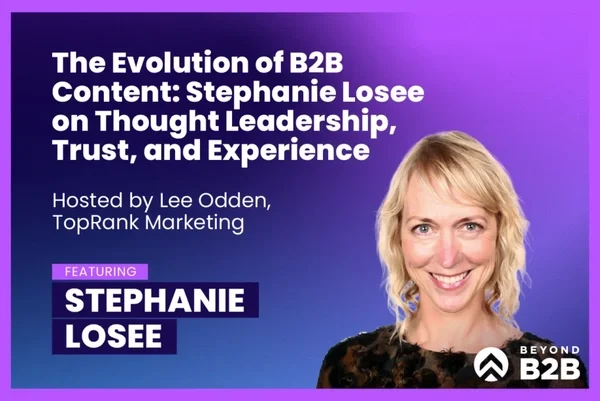
In this final episode of the first season of Beyond B2B Marketing, Lee Odden speaks with Stephanie Losee, Director and Executive Editor at Salesforce, about how B2B content and thought leadership have evolved and why they matter more than ever in an AI-driven world. Drawing on her experience building content programs at enterprise brands, Stephanie explains how thought leadership helps brands earn trust by showing up with credible answers on the topics customers care about most.
The conversation explores a critical blind spot in B2B marketing: post-sale content. Stephanie shares why thought leadership is uniquely valuable for customer success and sales teams, supporting ongoing, CTA-free customer conversations that build confidence, accelerate adoption, and even influence renewals and expansion. She emphasizes that content performance often hinges less on external distribution and more on internal activation across sales and customer success.
Finally, Stephanie looks ahead to the future of B2B content, addressing the role of AI, personalization, and experiential formats. She makes a clear distinction between scalable production and true editorial leadership, arguing that AI won’t replace human insight, judgment, or credibility. Instead, it raises the bar for brands to deliver thoughtful, research-backed content that creates real value across the entire customer lifecycle.
Listen to the full podcast with Stephanie here:
Key Takeaways:
- Thought leadership becomes more valuable as AI reshapes content discovery.
- You can’t game LLMs, but you can earn visibility by consistently providing credible answers.
- Most B2B content underperforms because it isn’t activated internally with sales and customer success.
- Post-sale thought leadership supports ongoing customer conversations without relying on CTAs.
- High-quality insight helps customers validate decisions and reduces post-purchase uncertainty.
- Thought leadership can directly influence renewals and expansion when aligned with customer success.
- Original research is essential for building trust and authority in an AI-saturated content environment.
- AI can scale content production, but it cannot replace editorial judgment or human insight.
- Experiential formats make complex ideas easier to absorb and advocate for inside customer organizations.
- The brands that win treat content as a strategic capability, not a campaign asset.
Watch the interview on YouTube:
Here’s a transcript of our conversation:
Lee: Hello and welcome to the Beyond B2B Marketing podcast. I’m your host, Lee Odden, CEO of TopRank Marketing. And today our guest is someone that I go back with over 10 years when she was working as one of the first managing editors for a Fortune 500 company. Now since then, she’s founded the content studio at Politico, built the first content marketing function at Visa, worked for a top 50 FinTech firm, led multiple advancing global leadership roles at Autodesk and now she is director and executive editor at Salesforce. Of course, I’m talking about none other than my good friend, Stephanie Losee.
Stephanie: Thank you. I’m so delighted to be here.
Lee: You’ve been at the center of the content marketing movement since day one. When did you realize content marketing was going to be the thing that drove your professional career, or such a big part of it?
Stephanie: I was the second technology reporter at Fortune Magazine, and I was at day zero of the advent of digital and what it did to journalism. I was a young mother and I was getting divorced, and I had to think about my career in a more monetized way. That made me pay attention to what was happening with brands and digital and the disintermediation of media.
I asked a lot of my PR friends what I could do for them. They asked me to write op-eds as if I were their client’s CEO because the pieces weren’t getting placed. I would write them, and the Wall Street Journal would accept them. That’s when I understood brands needed journalists to accomplish their goals for owned content, even though we didn’t call it that at the time. We were calling it brand journalism.
That led me to working for Dell’s agency of record. I was doing their brand journalism as a consultant, along with work for other tech companies. Then I heard about Dan Roth at LinkedIn and Tomas Kellner at GE. That’s when I proposed to Dell that they create a managing editor role, and that’s how it happened.
Lee: Fast forward to today and you’re at Salesforce. Tell us about your role there. What’s your mission?
Stephanie: I’ve come full circle, as has the profession. Salesforce wanted what Dell wanted back in 2012: to invest more in an increasingly editorial approach to their newsroom.
Internally, we also have something called the 360 Blog, which is more marketing-driven and promotional, but it includes high quality thought leadership. So now we’re publishing in two places. A big project I’m working on is creating a single front door for Salesforce, a single content hub that brings together the newsroom owned by comms and the 360 Blog owned by marketing. That will take time and will include content strategy and an RFP and the full set of steps. Those are the two focuses of my work right now.
Lee: We saw each other at Content Marketing World where you spoke about content distribution. A lot of companies are facing big challenges because of changes in search and social algorithms. What advice do you have for B2B marketers when it comes to distribution?
Stephanie: In that keynote, I said I wasn’t going to talk about paid, owned, earned, social, influencers, or the usual channel list because everyone knows those. I wanted to talk about something more basic that many content marketers don’t build: the channel between content and customer success, and between content and sales.
Sales is easy to understand because there’s always been tension between sales and marketing. Customer success is harder to understand because their life is made better by thought leadership content, especially content that supports ongoing conversations with valuable clients. You want as many of those conversations as possible to be CTA-free.
At Autodesk, we built an integrated program that became the signature marketing program: State of Design and Make. What was different was how driven it was by customer value. I gathered budget across the company, then asked for more so I could do an international focus group and ask customers what content they wanted.
They said they liked Autodesk’s innovation content, but it wasn’t helpful for their business. What they wanted was insight into what investments their competition was making in the one-to-three-year timeframe so they could make better decisions in the same window. I brought that back internally, and it was contrary to what the business expected us to focus on.
It became successful in large part because we built internal distribution channels so customer success and sales understood how to use the information. One stakeholder in Australia customized slides from the Australia data, built a presentation, and told me he got their CTO to come to the QBR for the first time. We turned the research into a book, and the CEO asked us to keep the same horizontal format each year so he could line them up on his shelf. We later presented internally at sales kickoff about how teams could use the content. That internal channel helped establish business impact metrics, including credit from sales and customer success when one client renewal became the biggest in Autodesk history, $150 million.
Lee: We worked together about 11 years ago when you were managing editor at Dell for the launch of TechPage One. That program was credited with a billion dollars annually of influence pipeline. Are you seeing major B2B brands making those kinds of investments in content destinations today? If they’re not, should they be?
Stephanie: It comes and goes. I’m seeing the same headlines again now about brands hiring journalists to build newsroom-style initiatives, and it’s framed as if it’s new. Salesforce made the investment to bring in a high-powered journalist to lead this initiative, and other brands are doing it too.
At the same time, you’ll also hear about big layoffs and disinvestment. Content marketing still goes through investment and disinvestment cycles, and it’s still treated as a cost center too often. I hope that cycle ends and content becomes a bedrock of marketing.
Lee: In today’s environment with AI, search, and AI-powered discovery, what’s your take on the value of thought leadership?
Stephanie: Thought leadership becomes more important. I was recently in a workshop with content marketing leaders about the value of websites in the post-LLM world, and we heard from a VP at Google who shared insights. He said anything that provides an answer is content that becomes increasingly important in the era of LLMs. He also said you can’t game the system, but you can make sure your thought leadership content informs your company’s reputation and finds its way into the answers people see.
Thought leadership is about being known for the themes and topics you want your company’s perspective to be associated with. At Salesforce, we talk about the agentic enterprise, and if someone is trying to figure out how AI interacts with customers or employees, we want to show up in those answers.
We continue to see trust degrading across institutions. Edelman’s trust barometer captures that, and brands are increasingly trusted relative to traditional media and government. That creates responsibility for corporate newsrooms to provide high quality content that is data-based, valuable, and not overly promotional, while being transparent about what it is and where it comes from. Best practices include inviting outside speakers and letting customers tell the stories so the brand story comes through in the process.
Lee: Our research report, Answer Engine: State of B2B Thought Leadership, found that 97% of B2B marketers say thought leadership is critical for full-funnel success, but fewer make it central to their strategy. Does that track with what you see?
Stephanie: It sounds true. It’s often a function of where budgets sit and how org charts are structured. Whether marketing and comms roll up to the same leader affects how thought leadership translates into budget and action. These are perennial problems.
The marketers who accomplish impactful work with upper-funnel content build relationships across the entire company and stitch together budgets across departments. If that’s the part someone hates most, they should change jobs because it’s built into the system.
Agencies that understand the complexity on the brand side can help unlock outcomes and navigate the internal environment more effectively.
Lee: One tactical theme from our research is that respondents think thought leadership would be more impactful with video, events, influencers, and podcasts. Does that align with your experience?
Stephanie: Yes. With State of Design and Make, we used executive engagement events as an outlet. At one event in Tokyo, the stats were used as an anchor in the keynote. They also set up iPad kiosks where attendees took a benchmark survey, provided consent and information, and received a customized PDF that benchmarked their organization against others in the research. That tactic came from an ABM content approach and worked well in an experiential format. People enjoyed it and it delivered results.
Lee: If an organization doesn’t have a content practice and wants to build one, where should they start?
Stephanie: Start with executive sponsorship. At Dell, I pitched the role to a powerful leader, Kelly McGinnis. Her influence made space for innovations and experiments. She had a monthly one-to-one with me and asked one question: how can I get out of your way? When she left, it was like a warm blanket was ripped off, and I realized how much her sponsorship enabled the work.
If a content initiative lives and dies by one sponsor, it won’t last. You need a structure that ensures business success beyond one person. You need measurement tied to business metrics from the beginning so that if leaders move on, others can see the benefits in data.
Lee: What’s at the top of your list in terms of AI concerns related to content right now?
Stephanie: I’m not worried about AI creating junky content. I’m focused on what AI changes operationally. Salesforce owns Slack, and I’m in an environment where Slack and AI are embedded in daily work. I barely use email. I use Slack to recover threads, summarize notes, and stay current.
As we build a common content hub for Salesforce, I’m thinking about what it means to have an agentic content site. How do we make that experience satisfying, whether the person arrives via paid, organic, or social? What role does the agent play in making that visit effective?
We’ll also need to consider the agent experience on a website versus the human experience. Agents will crawl and interact differently than humans, and that will change how we design sites.
Lee: If everyone has AI, how does a brand stand out from a content perspective? You’ve said that AI won’t help marketers differentiate on its own, but creating a true value exchange will. Can you expand on that?
Stephanie: Launching an ABM content team at Autodesk made that clear for me. We created a global ABM content organization because regions need content created in-region to solve local business problems, not just localized versions of headquarters content.
A true cluster is specific. For example: business leaders of German retailers trying to align post-COVID online experiences with brick-and-mortar experiences. The content plan becomes an e-book with customer examples of how they solved that business problem, focusing on what they did and how they thought about it, not which products they used. The CTA is “give us a call,” not “buy this product.”
That’s the intersection of account-based marketing and thought leadership, and it shows how thought leadership can connect to business outcomes by starting with a real problem and delivering real value.
They give you attention and time, and you give them information they need. It’s not what you want to tell them, it’s what they need to hear.
Lee: Looking ahead, what’s one change you’d like to see or expect will happen in B2B content marketing in the next couple of years?
Stephanie: Because of AI, LLMs, and agentic experiences, B2B marketers will finally have the tools B2C marketers have always had. B2C customers expect personalization. In B2B, we rarely have that signed-in experience. With agents, we can understand customers and deliver that level of personalization in a way we haven’t been able to before.
Lee: What are you most proud of in your career?
Stephanie: I once needed my career to change for very personal reasons, and I ended up being part of a group that created this career. People have taken it far beyond what it was at the beginning, and to know I had a piece in making these jobs possible, giving them structure and meaning, makes me satisfied.
Lee: What hobby or passion outside of work has influenced your work the most?
Stephanie: Endurance sports. I’ve run a half dozen marathons and climbed a number of mountains over 14,000 feet. Endurance sports teaches you that you always have one more step. It disciplines your mind, helps you be less reactive, and helps you breathe through barriers. It has informed how I manage people and teams.
Lee: If you could be doing anything else as a career, what would it be?
Stephanie: I’ve only ever wanted to do one thing. I’m a nonfiction writer, and I’ve found a way to make a living at it my whole life. I’m actively working on a nonfiction book, a hybrid memoir. There will be a day when I’m 100% a journalist again, after I finish paying for college for my youngest.
Lee: Where’s the best place for people to connect with you?
Stephanie: I’m happy to connect with people on LinkedIn.
Lee: This has been fantastic. I want to thank you for tuning into the Beyond B2B Marketing podcast. Make sure you subscribe so you don’t miss out on our next exciting guest. And remember, there’s no better time than now to break free of boring B2B.

To find the Beyond B2B Marketing podcast on your preferred podcast platform, check out the links below.