

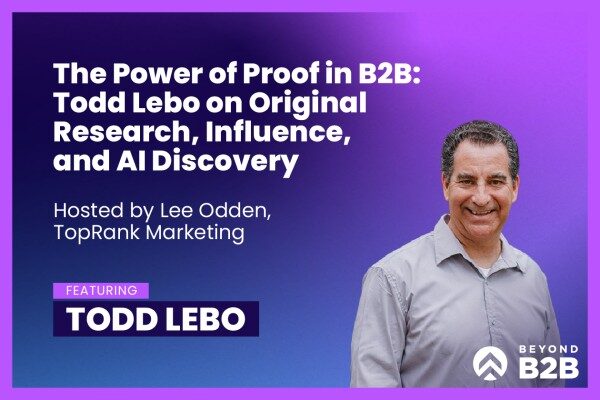
We kick off the second season of Beyond B2B Marketing, with Todd Lebo, CEO of Ascend2,, who joins host Lee Odden to discuss their collaboration on new research at the intersection of B2B thought leadership, influence, and AI discovery. Their conversation explores the growing role of original research in B2B marketing and why research-driven thought leadership is becoming a critical advantage in an environment where content is endless and attention is scarce.
Todd shares why original research consistently outperforms other content formats by helping buyers benchmark themselves, reduce uncertainty, and build confidence in their decisions. Together, they unpack why many B2B brands still underutilize research by limiting it to top-of-funnel awareness, despite its ability to drive impact across sales enablement, customer onboarding, and post-sale engagement.
The discussion also looks ahead to how AI is reshaping content discovery and why distinctive, data-backed insight is increasingly favored by search and answer engines. Todd and Lee explain how combining original research with credible influencers and experiential formats creates trust, improves visibility, and positions brands as the best answer in a complex, AI-driven buying journey.
Listen to the full podcast with Todd here:
Key Takeaways:
- Original research is one of the most effective ways to earn credibility in B2B marketing.
- Data-driven thought leadership performs best when it helps buyers benchmark themselves.
- Research should support the full customer lifecycle, not just top-of-funnel awareness.
- Influencer collaboration adds context, trust, and distribution to research findings.
- Experiential and interactive formats significantly increase repeat engagement.
- Distinct, proprietary data improves visibility in AI-powered search and discovery.
- Research reinforces a brand’s position as a data-driven, decision-support partner.
- Segmenting research data creates more relevant insights for different buyer roles.
- Measurement improves when research is applied closer to revenue-driving activities.
- Brands that invest early in research gain durable advantage in crowded markets.
Watch the interview on YouTube:
Here’s the full conversation:
Lee: Hello and welcome to the Beyond B2B Marketing podcast. I’m your host, Lee Odden, CEO of TopRank Marketing. Today our guest has a long history in content and marketing leadership, from his time at Kiplinger, MarketingSherpa, MECLABS, and MarketingExperiments, to the last 12 years as CEO at Ascend2.
Ascend2 conducts original research for companies that want to use data for marketing and thought leadership. We’ve partnered with Ascend2 several times, and most recently we partnered with Todd and his team to survey nearly 800 senior B2B marketers on the intersection of original research, influence, content, and full-funnel thought leadership marketing. Welcome to the show, Todd.
Todd: Thank you. It’s a pleasure to be here. I always enjoy helping marketers connect the dots between research and real-world application.
Lee: It’s great to talk about something we’ve been working on together for a while. This is timely, and it’s a little meta: original research about original research.
A lot of B2B brands are confident in research-driven content and thought leadership, but the questions are: Are they doing it well? Are they optimizing for full impact? What are top performers doing differently? Can you talk about the hypotheses that went into this study?
Todd: I’ve spent much of my career in marketing, publishing, and research, and I saw how powerful research can be. One reason we started Ascend2 was to make research more actionable. High-quality research matters, but so does the story behind it and how it helps the reader.
The hypothesis was that research works. It’s a great way to engage audiences because people want to benchmark themselves. Marketers want to know what others are doing, how they compare, and what they should do next. We wanted to understand not just that research works, but how and why it works so well. Partnering with you helped us think that through before writing the survey questions.
Lee: That “end in mind” approach aligns with our Best Answer Marketing framework. There’s a hunger for insight, direction, trust, and sources of truth. Original research provides the data, but storytelling brings it to life.
Let’s get into the findings. We saw optimism around original research: 93% of marketers say it’s effective at driving engagement and leads, and 48% say it’s very effective. Are you seeing that optimism with the companies you work with?
Todd: Yes. We see it in new companies reaching out regularly to discuss research topics, and in clients who come back year after year. Many want to turn research into a trend report so they can track changes over time.
As you build data year after year, you can tell richer stories-where things are now, where shifts are happening, and what trends suggest about what’s next. Research also reinforces that a company understands its industry and makes decisions based on evidence, not just opinion. And it’s harder than ever to produce compelling content people actually want to engage with. Research meets that need.
Lee: Research also helps with visibility. Distinctive, differentiated data sources are the kinds of things that rise in traditional search and AI-powered discovery.
There are two big value propositions. First, benchmarking. Research helps warm the 95% of the market that’s not in-market yet by giving people context to compare themselves against peers. Second, cadence. Annual or recurring research increases value by showing trends over time. We’ve seen that with our B2B influencer marketing research-year over year, it compounds.
Todd: Another benefit is positioning. Research reinforces that you’re a data-driven company, making decisions based on data, not opinion. That’s almost a requirement now.
Lee: Another stat stood out: 97% of B2B marketers say thought leadership is critical to full-funnel success, yet only 43% extend it beyond awareness and discovery into post-sale. That feels like a missed opportunity.
Todd: It is. Early in my career in publishing, acquisition got most of the attention, but retention is where the real value is. I was assigned a renewal project, and I realized how small changes could create big bottom-line impact. That shaped how I think about the full funnel.
We encourage clients to maximize the value of their research. Use it beyond top-of-funnel: executive presentations, sales enablement, training, onboarding, and post-sale engagement. A lot of it comes down to sitting down with your team and asking, “Where else can we use these data points strategically?”
Lee: Exactly. Those insights can support sales enablement and also help customers post-sale-benchmarking for onboarding, guiding adoption, and helping them get more value from your solution. It’s a missed opportunity not to apply research across the lifecycle.
Todd: A practical way to make that happen is to design for it upfront. In discovery calls we ask clients what talking points they need in an executive summary. We also ask about sales enablement-what data would help sales have better conversations. If we bake that into the questions, it increases the success of using research throughout the funnel.
Lee: One focus area of the research was the intersection of influence and research. We found that 74% of B2B marketers who frequently collaborate with influencers say their research-based content is very effective, versus 29% of everyone else. Why does consistent influencer engagement improve results so much?
Todd: Influencers help make research actionable. They can take the data and provide the analysis-the “so what.” They also like having concrete data to support their experience and perspective.
Lee: It also adds third-party validation and contextualization. Research can feel biased even when it’s statistically valid, so outside expert interpretation builds credibility. It also adds distribution-if influencers participate in the report, they’re more invested in sharing it to their audience.
Todd: The data provides the “why,” and it feels less forced.
Lee: Another missed opportunity we found is experiential content. 78% of marketers say interactive and experiential content increases repeat engagement, but only 33% regularly build it into their programs. What do you think?
Todd: It’s an added layer of work, and some companies don’t have the infrastructure. We encourage baby steps. Start with interactive elements like live polling in a webinar. Over time, build tools where people input a few data points and get real-time benchmarking.
Lee: The bar has risen. Buyers are selective about where they spend time. If you invest in high-quality research but deliver it as a static white paper, you’re not thinking enough about the experience. Experiential formats-video, interactive content, audio, events-create memory structures and differentiation.
We also found 53% of respondents said interactive formats are the most effective for engagement. Have you seen examples of research content using interactive elements?
Todd: Yes. Simple tools where you enter one or two data points and get a profile or benchmarking can be effective. And for this report, your team created a more interactive experience-less static, more engaging.
Lee: I’ve seen strong examples. Avanti’s 2025 Technology at Work report is a data-rich interactive experience with an audio version and embedded SME videos. Zendesk’s CX Trends report uses a microsite, interactive elements, and external credibility-including an executive from The Atlantic contextualizing findings. McKinsey’s technology trends outlook uses interactive design, illustrations, and embedded expert videos. A hub approach works well: the core report plus multiple supporting assets people can choose from.
Todd: Yes-clients create hubs so they can add video and other components. People can pick what they need.
Lee: Let’s talk AI. Many marketers think AI search is still a small share of total search, but usage is growing quickly. We found 32% of respondents say they discover and consume thought leadership content through GenAI tools. Are your clients using answer engine optimization tactics with research content?
Todd: It’s early, but clients are bringing it up more. The conversation is natural because research has always been about answers: what answers do you need, and where do you need data to support your conversations?
Lee: We’re seeing early visibility benefits. If you search for “B2B thought leadership report,” we’re now showing up quickly in multiple places. This project is structured as an interactive microsite plus supporting content-blog posts, podcast, video, and more. Research paired with experts and useful structure creates an opportunity to build organic visibility and credibility faster than ads alone.
Todd: People also ask if everything has to be published. It doesn’t. Some questions can guide internal direction. Research helps you learn whether your audience cares, whether problems are top of mind, and whether your messaging matches reality.
Lee: That internal insight can also become value for customers. You can share segments as customer-only insight and help them understand gaps and direction.
We found 41% of marketers said difficulty measuring performance is the top reason content underperforms. What measurement challenges do you see with research-driven content?
Todd: Multi-channel attribution is difficult, and connecting influence to revenue is hard. That’s why the full-funnel approach matters. If you only measure top-of-funnel, research can look expendable. If you extend it into mid- and bottom-funnel use cases, it becomes easier to connect to the kinds of outcomes leadership teams care about.
Lee: We also recommend unified analytics-bringing disparate data sources into one place so different teams can see what matters to them.
There’s also work on the ROI of thought leadership. Cindy Anderson and Anthony Marshall from IBM’s Institute for Business Value wrote a book called The ROI of Thought Leadership. Their research suggests thought leadership drives significant revenue impact, and executives report making purchase decisions influenced by thought leadership they consumed.
Looking ahead, 47% of marketers in our study plan to increase their use of original research and data-driven content next year. Is that optimism justified?
Todd: I’m biased, but yes. It’s hard to find content that moves the needle, and research helps build brand and engagement. It may feel more expensive upfront, but when you break it into multiple formats, it has long legs and becomes more cost-effective.
AI isn’t going away. We’re shifting from SEO to AEO. There’s an opportunity cost in being too conservative-early movers capture space faster, and later entrants have a harder time.
Lee: That matches what we’re seeing-brand, consistency, and credibility matter more in AI discovery. The earlier you establish authority for a topic-and reinforce it through experts and consistent recognition-the better.
Todd: We’ve seen this with other trends. Growing an email list used to be easy; now it takes much more effort. The same pattern shows up with podcasts, webinars, and other channels. Getting in early, building quality assets, and establishing a foothold matters.
Lee: With 2026 around the corner, what major changes do you see in B2B marketing?
Todd: AI is moving from “How does it save time and money?” to “How does it influence bottom line?” B2B marketing is also becoming more complex across channels, data, and technology. Marketers need trusted sources of advice and data to support decisions so they can go to leadership with a plan and evidence behind it.
Lee: If someone listening wants to get started with research-driven thought leadership for 2026, what first steps should they take?
Todd: Start with target audience: who are you surveying, and can you reach enough of them for credible results? Then work backwards from the executive summary: what storyline do you want to explore, and what questions will help reveal it without forcing the data?
Lee: You can also start with major business problems your customers are experiencing and produce objective, data-informed direction. Research becomes the foundation for a flywheel of derivative content that supports demand, sales enablement, and customer success.
Todd: Segmentation helps too-executives versus managers, company size, and other splits can reveal meaningful differences and create more storylines. When clients see the highlights, they often have “lightbulb” moments because they understand their audience and can spot high-value uses we wouldn’t think of.
Lee: Let’s wrap with a dream career question. If you could be doing anything else, what would it be?
Todd: I wanted to be a baseball player until I didn’t grow and the talent wasn’t there. I grew up in central Pennsylvania and was a Philadelphia Phillies fan-Mike Schmidt and Steve Carlton. I listened to games on the radio at night when I was supposed to be sleeping. Beyond that, what I really value is helping people-whether in B2B marketing or connecting someone to an opportunity.
Lee: That’s one of the benefits of visibility in an industry-you become a point of connection for roles and referrals. Where’s the best place for people to connect with you?
Todd: LinkedIn, I try to respond to everybody.
Lee: Thank you, Todd. You can access the report via the show notes, or search for “B2B Thought Leadership Report.” Thanks for tuning in to the Beyond B2B Marketing Podcast. Be sure to subscribe, and remember, there’s no better time than now to break free of boring B2B. Thanks, Todd.
Todd: Thank you.
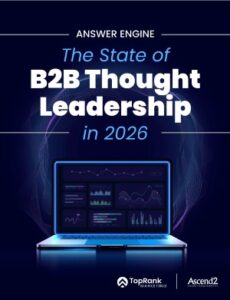
You can get a copy of The State of B2B Thought Leadership in 2026 here.
And if you want to take the next step in breaking free of boring B2B to become a Best Answer Brand, then check out the all new BAM Playbook.
To find the Beyond B2B Marketing podcast on your preferred podcast platform, check out the links below.