

Trust has become one of the hardest problems in B2B marketing to solve, being increasingly eroded by AI-driven content volume, opaque experiences, and tactics that prioritize capture over credibility. As buyers do more research independently and rely on third-party validation, even small mismatches between intent and experience can quietly disqualify a brand. So how can B2B marketers close the gap on trust and build authentic credibility to drive decision confidence?
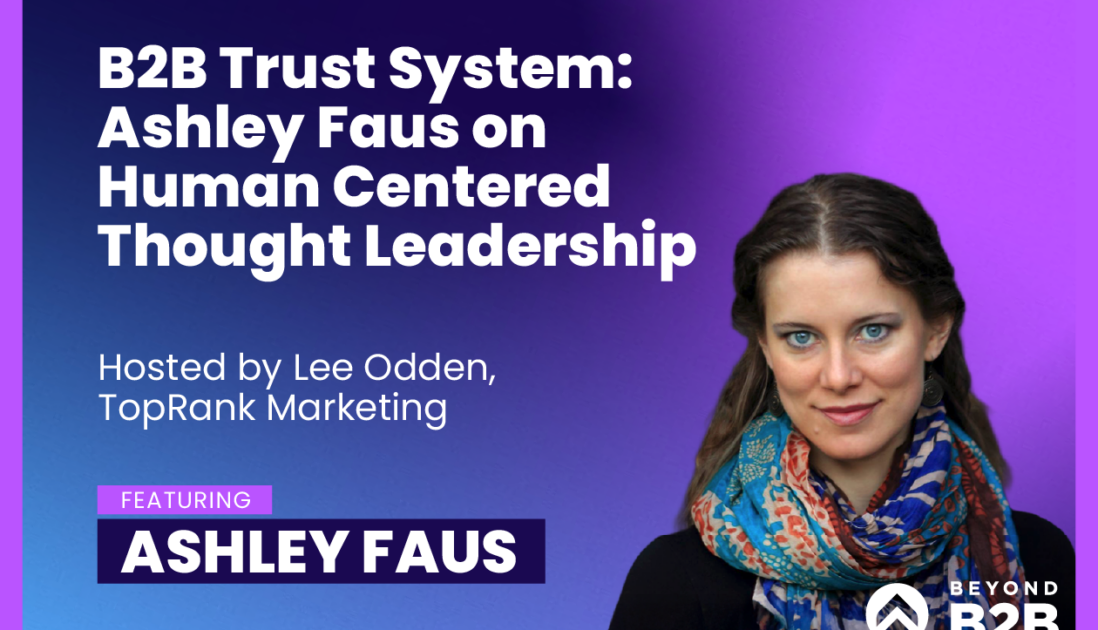
In this episode of Beyond B2B Marketing, host Lee Odden, CEO of TopRank Marketing, speaks with Ashley Faus, Head of Lifecycle Marketing Portfolio at Atlassian and author of Human-Centered Marketing: How to Connect with Audiences in the Age of AI. Their conversation drills down into why traditional funnel thinking no longer reflects how B2B buyers actually behave and how a more human, non-linear approach is needed to earn confidence over time.
During their conversation, Ashley breaks down her four pillars of thought leadership, clarifies the distinct roles of thought leaders, influencers, and subject-matter experts, and explains why innovation, not contrarianism or titles, is the foundation of real authority. She also shares practical advice on rebuilding trust through intent-aligned content, honest CTAs, credible human voices, and research-driven insights that help buyers think and act differently.
Listen to the full conversation with Ashley here:
Key Takeaways:
- Trust is built in micro-moments, not brand statements-misleading CTAs, gated “value,” and broken expectations quietly erode credibility.
- The B2B funnel no longer reflects buyer reality; modern buyers move non-linearly, self-direct research, and engage on their own terms.
- Thought leadership is not lead generation, its role is to help buyers think differently, not to capture contacts or accelerate pipeline.
- Contrarian opinions alone do not equal thought leadership; innovation must be tested, rigorous, and useful to earn authority.
- Companies don’t have thoughts, people do; credible human voices are essential to making brand thought leadership believable.
- AI accelerates content volume but amplifies trust risk when efficiency is prioritized over intent, accuracy, and lived experience.
- Attribution models break down in complex B2B decisions; no single touchpoint “causes” conversion-outcomes emerge from systems.
- Different creators/influencers serve different roles: thought leaders, influencers, and subject-matter experts each contribute distinct value in the marketing mix.
- Original and proprietary research is essential to credible thought leadership, but only when driven by genuine curiosity, not demand gen bias.
- Human-centered marketing requires integration, aligning content, lifecycle, trust, and experience across channels rather than optimizing in silos.
Watch the interview on YouTube:
Here’s a transcript of the conversation between Lee Odden and Ashley Faus:
Lee: Hello and welcome to the Beyond B2B Marketing Podcast. I’m your host, Lee Odden, CEO of TopRank Marketing. Today our guest is someone that I’ve known about for quite a few years. In fact, we’ve got something like 230 connections in common on LinkedIn. Our universes collide, but we just met for the very first time last month at MarketingProfs B2B Forum. The person I’m talking with today is literally a Renaissance woman with many talents: a marketer, a writer, a speaker, a singer, an actor, and, as she says, a self-proclaimed fitness fiend by night. Of course, I’m talking about Ashley Faus, Head of Lifecycle Marketing Portfolio at Atlassian and author of the new book, Human-Centered Marketing: How to Connect with Audiences in the Age of AI. Welcome to the show, Ashley.
Ashley: Lee, I want to take you around to introduce me everywhere. I’m also surprised we just met so recently. The Venn diagram of our circles is almost a circle. The overlap is crazy. I’m super excited to finally sit down and hang out with you virtually as well as in person.
Lee: It’s a time of change, transformation, and disruption right now. I appreciate the clarity and source of truth you’re providing, and your book is timely. I’m excited. For folks who don’t know you yet, or who know you but don’t know how you got to where you are, can we start with your origin story as it relates to B2B marketing?
Ashley: Before we get into the B2B marketing origin story, we have to go back. I started college as a musical theater major. The plan was Broadway. It turns out I’m not talented enough to be on Broadway, which is fine. I still get to perform in community theater shows, which is awesome.
Freshman year I had a medical issue with my vocal cords. I missed my juries and that forced me to take a step back and ask what I was going to do if I wasn’t going to sing for a living. I didn’t want to teach, and I stumbled into a Marketing 101 class. I opened the textbook and the first line said marketing is about people. I closed the book and I was like, done. This is who I am now. I’m a marketer.
Marketing is about matching problems with solutions for people. I’ve always said I never want to sell anything to anyone, which is counterintuitive given that I’m a marketer and I have been my entire career. But that curiosity about humans and the ability to fall in love with the audience is the crossover from musical theater-stepping into a character’s shoes-to stepping into the audience’s shoes and understanding them enough to solve their problems. The overlap between my passion for performing and my passion for matching problems with solutions in marketing goes really well together.
Lee: That’s fantastic. It makes me think about the empathy required to provide a great performance and the crossover to empathizing with customers and the experiences we’re trying to create for them.
What about your role at Atlassian? Talk about the work you’re doing there and lifecycle marketing.
Ashley: Atlassian is a collaboration software maker on a mission to unleash the potential of every team. For anyone in tech, people know us for Jira, Confluence, Trello, Loom. Our products are quite beloved. We work across technical and IT folks as well as business and marketing users.
A lot of people ask what portfolio means in my title. It means I work across the entire product line at Atlassian. I’m not focused on a single product. I’ve been at Atlassian for just over eight years. I’ve worked across multiple teams: content and brand, product marketing, and now lifecycle and demand gen marketing. I work across content, campaigns, events, and at the intersection of different points across Atlassian marketing teams for the whole lifecycle of the audience. That includes acquisition, adoption, retention, and growth-cross-sell, up-sell, expansion.
My team has a mix of folks across content marketing, demand gen, social media marketing, content creation, and different skills. The common thread is I tend to be a jack of all trades and I want to work at the intersection. I believe marketing is integrated. I’ve ended up in these roles because I connect the dots across disciplines.
Lee: A holistic view of marketing is a strategic view of marketing. It’s a superpower to bring solutions into situations where others aren’t privy to that step-back perspective.
This podcast has had an ongoing narrative: elevating B2B marketing from mechanical and transactional to meaningful. You’re focused on finding the human in the marketing experience. Your book is timely, especially with AI adoption and AI fatigue. What motivated you to write it?
Ashley: It was born out of frustration with trying to solve problems in a way that wasn’t working anymore. I’d been talking about the frameworks and concepts for years. People ask how I wrote the book so fast. It’s: wrestle with the problem for ten years, talk about how you’ve been solving it for six years, write the book in six months.
The initial spark was around the funnel-awareness, consideration, decision, and then a retention phase that drops you back into awareness, like I’m treating you like you don’t know me even though we’ve been working together for months or years. And somehow I, as the marketer, decide what phase you’re in. That makes no sense.
When I was at Duarte, I brought in Marketo. It was early stages when marketing automation was in the hype cycle. I remember seeing anonymous IP tracking, then someone filled out a form and I had their email, and I could see all the pages they visited. I thought it was the coolest thing ever. Then I realized what that said about me.
I was responsible for setting up the scoring model. At the time it wasn’t sophisticated: assign points, and when people get to 100 points, they’re a lead. I was randomly assigning points-20 points, 10 points-and then it was, let it run for a quarter and see whether those were the right scores. It broke my brain. Just because someone filled out a form or downloaded eBooks doesn’t make them a lead. Sales was saying these are terrible: they don’t have budget, authority, need, timeline.
That made me realize it wasn’t about a more sophisticated scoring model. It didn’t make sense for me as the marketer to imply what the audience wants and force them into a path I want. I started thinking about a playground model. People go up the slide instead of down the slide. People need pricing before they can kick off a buying discussion, even though pricing is traditionally “bottom of funnel.” Same thing with thought leadership.
At Duarte we had Nancy Duarte, who is a thought leader. But it’s not scalable for it to just be her. We wanted to build more thought leaders. What does that mean? How do we measure progress? What activities do we need? How do we find the right people? That was before the current iteration of influencer marketing and employee advocacy programs.
When I came to Atlassian, bigger company, same question. The book came from solving my own problems and explaining my approach in a scalable, repeatable way that colleagues could understand, not just something that lived in my head.
Lee: The playground model makes the buyer experience feel more choose-your-own-adventure than linear. Customers don’t come into a store asking where the top of the funnel is.
Ashley: The buyer’s journey has gotten more complicated. Buyers have done a lot of their own research before they reach out to sales. A lot of queries are shifting into LLMs instead of Google search. People feel search results are biased-sponsored spots, SEO gaming. They feel brands haven’t figured out how to game LLMs yet, even though traditional techniques work well for LLMs, and PR matters too.
It’s coming full circle. Earned media and social-PESO-matter. We leaned into owned for so long, but LLM is about the PES portion, not just the O portion. People are trying to find an unbiased third party.
Lee: Trust is such a big part of this, and earning it seems harder than ever. What obstacles are at the industry level, and what obstacles are brands creating themselves?
Ashley: At the systemic level, AI makes it faster and cheaper to churn out quantity, and faster and cheaper to churn out misinformation or disinformation. You’ve got deep fakes. You’ve got AI hallucinating sources, and it sounds right because it cites something. If you don’t dig in, you won’t know. There was a case where someone provided a case citation and it didn’t exist. They never fact checked it.
Everything online could be fake. To counter that, we’ll see more importance of in-person one-to-one and one-to-few interactions because you know someone is real if they’re standing in front of you. Even audio and video can be faked. Tools can add vocal fillers in a cadence a normal human wouldn’t have.
On the brand side, we can fix this today: our CTAs. We’re self-interested. We talk about capturing leads, locking down deals, tricking people. That’s not a place of trust.
We put CTAs like “learn more” and it goes to a form to contact sales. “Try for free” requires a credit card and tiny fine print. Pricing pages with no pricing unless you fill out a form. “Watch a video” and it pops up a form. If the CTA says watch a video, it should let you watch a video. If it says read a blog post, you should read a blog post. If it says contact sales, great-someone should contact you quickly. We break trust with every CTA that doesn’t do what it says.
Lee: That’s setting expectations and following through. AI also amplifies what you already are: crap in, crap out. What are practical ways brands can build trust as part of how they go to market?
Ashley: One easy thing: go to your website and make sure your CTAs have a verb and that verb lands you where it says it will. It should match the explicit next action for the audience.
Marketers love buy intent and use intent. Buy intent is contact sales, activated trial, request a proposal. Use intent is log in, book office hours-getting value from what you already have.
We forget other intents. One is trust or affinity intent: rapport, perception the brand can solve your problem, authenticity, transparency. It’s about changing how people feel. Another is help or remediation intent: when something goes wrong-support, customer success, documentation, community forums. That makes or breaks retention. Finally, learn intent content helps the audience work better.
At Atlassian, we have the Atlassian team playbook: free, ungated exercises to improve project kickoffs, remove dependencies, improve communication. Our mission is to help teams work better together. That includes people and process, not just tools. That builds trust.
The second piece is showing the humans behind the ideas: thought leadership, influencers, subject matter experts. They do different things in the marketing mix. The best type depends on your goals.
Tactically, attribute a name to a byline, and it needs to be the right person-not just slapping a senior title on it. Don’t ghostwrite something and slap the CEO’s name on it if they don’t have credibility on the topic. The byline has to connect to lived experience and a unique point of view.
Lee: There’s an intersection between thought leadership and influence: building trust and relationships. Talk about the difference between building individual thought leaders and building thought leadership for the brand.
Ashley: Companies don’t have thoughts. People have thoughts. So thought leadership for a company means there are people driving it.
Consulting firms put out research and are considered thought leaders, but the research lists who did it-someone in the practice area. There’s interplay between the brand and specific individuals.
A big brand can hold more weight than a five-person startup, even with a big title. But small companies can be thought leaders too. Thought leadership is innovation-helping your audience think and act in a new direction. It’s not lofty ideas, not fake predictions. It’s testing, discovery, codifying what you learn so other people can use it and take action.
Thought leadership is not contrarian for the sake of contrarian. Quality content alone doesn’t make thought leadership. Executive content doesn’t automatically make it thought leadership. A big title or being good at your job doesn’t mean you’re a thought leader. Leading a company is different than thought leadership. You can be great at your job and make money, but if you’re solving the same problem in the same way, that doesn’t make you a thought leader.
Lee: You outline four pillars. Can you share them?
Ashley: The four pillars of thought leadership are credibility, profile, being prolific, and depth of ideas.
Credibility is: do you know what you’re talking about? How often are you asked to cite your sources versus being cited as the source?
Profile is visibility: followers on a platform, podcasts, top-tier outlets, recognition, showing up with other well-known peers.
Being prolific is how much you create and share. This is 100% in your control. Are you writing, speaking, making videos, posting, being on podcasts, speaking at conferences?
Depth of ideas is the nature of the ideas: new tactics, connecting adjacent fields, testing and discovering new things. This model has to be adapted to your industry.
Subject matter experts often have high credibility and depth of ideas, but low prolific and profile because they focus internally and one-to-one with customers. They need to be more prolific.
Influencers are highest in profile, often on one platform. They tend to be lower on depth of ideas because they focus on existing solutions. If they want to become thought leaders, they need to build depth of ideas and expand how they share.
All the pillars work together in tandem.
Lee: In our research on thought leadership, original research-based content was seen as effective. What’s your view on the role of original research or proprietary data in thought leadership initiatives?
Ashley: Original research or proprietary information is essential for thought leadership. The kicker is it cannot be done from a demand gen mindset. Thought leadership is not “top of funnel.” Top of funnel implies a buy intent process. Thought leadership is not about buying.
If your goal is to generate leads this quarter, that makes no sense for thought leadership. It has to come from genuine curiosity and helping the audience uncover something they wouldn’t otherwise know. It has to help them take action.
If I read a state of thought leadership report, what am I going to do? It should help me prioritize content mix and budget allocation, or evaluate a channel mix. If the only takeaway is that people who work with a company have better outcomes, that helps the company, not the audience.
Lee: With our research report, we ungated it. There’s an interactive version freely available. There’s no nurture after download. No case studies in the report. It’s the data and a framework to understand what it might mean. The follow-on is a playbook that’s more tactical.
We’re approaching it as frictionless distribution. People can consume it and come to their own conclusions.
As 2026 is here, what changes would you love to see in B2B marketing?
Ashley: Showcasing the humans. Elevating people who have credibility and unique ideas because they’re in the trenches, not because they have a big title. Amplify the people who actually have the ideas.
I think we’ll see less focus on going viral just because you have the right structure, especially with AI-generated posts and comments. Ideas grounded in lived experience will matter more.
The second change is more intimate in-person conversations-dinners, roundtables-and seeing that reflected in marketing metrics. We still judge event success with volume: speaking on a stage, booth scans, badge scans. Attendees are shifting toward smaller gatherings: the right ten people for one goal and one conversation. Marketing metrics need to shift from volume to intention.
Lee: Let’s go beyond B2B as we wind down. You’re continuing to sing and act. Can you share more?
Ashley: I’ve managed to do at least one show a year, basically every year except COVID. I did Brigadoon in 2025, and I’m cast for Sister Act in early 2026.
What I do for my soul is as important as what I do for money. I’m a better version of myself personally and professionally when I’m performing. It brings structure. I have to be focused. At rehearsal I’m singing, dancing, doing physical things. I have to be fueled mentally and physically.
There’s something about being in person. When you’re singing harmony and it’s tuned perfectly and it locks in, you can feel it. That adaptability and being in the moment has crossover with marketing-public speaking, audience empathy. The creative outlet makes me better.
Lee: You’re also passionate about fitness, and you’re kiteboarding. What parallels do you see between fitness and success in marketing?
Ashley: Fitness is my go-to example for mapping content depth-conceptual, strategic, tactical. What it means to be healthy and fit is diet and exercise, but Runner’s World versus Muscle & Fitness versus Yoga Journal would answer differently. The language and audience matter.
In kiteboarding there’s a concept called getting yarded. That jargon signals you’re part of the audience. A horse rider wouldn’t say that.
From an attribution standpoint: which mile made you lose 60 pounds? That’s absurd. You didn’t lose 60 pounds because of one mile. You don’t get strong because of one rep. Yet that’s what we do in marketing-what’s the one touchpoint? It has to be the last touch. That’s not how it works.
I was chasing a one plate bench. I had advice from a powerlifter, a karate sensei, and my husband who’s a bodybuilder. One said go hard, one said focus on technique, one said focus on accessories, supplementation, sleep. The reality is you need all of it.
It’s the same in marketing. Disciplines don’t exist in isolation. Organic and paid go together. It’s an ecosystem, and you have to put in the work and pull in specialties.
Lee: Let’s wrap up with a dream career question. If you could be doing anything else as a career option, what would it be?
Ashley: Broadway star. Playing Christine Daaé in Phantom of the Opera on Broadway would be freaking cool.
Lee: This has been a great conversation. I appreciate the insights you shared. What’s the best place for people to connect with you?
Ashley: On LinkedIn. I spend quite a bit of time there posting and engaging in the comments.
Lee: You are a high-quality poster on LinkedIn, and that’s reflected by how much engagement you get there. Definitely follow Ashley on LinkedIn. We’ll include a link in the notes. Thank you, Ashley.
Ashley: Thank you. Thanks for having me.
Lee: I want to thank you for tuning in to the Beyond B2B Marketing Podcast. Make sure you subscribe and stay tuned for our next guest. Remember, there’s no better time than now to break free of boring B2B.
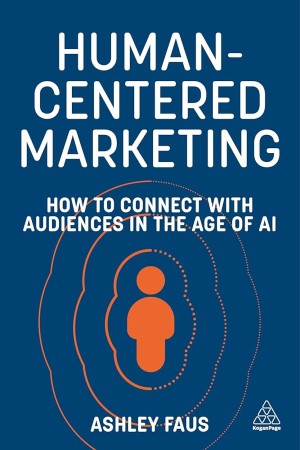
Be sure to grab your copy of Human-Centered Marketing: How to Connect with Audiences in the Age of AI here and follow Ashley on LinkedIn.
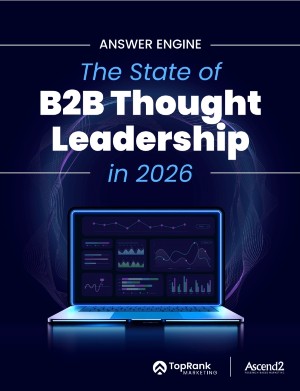
Also, if you’d like more data on B2B thought leadership for 2026, check out our new research report in partnership with Ascend2 (ungated).
To find the Beyond B2B Marketing podcast on your preferred podcast platform, check out the links below.