

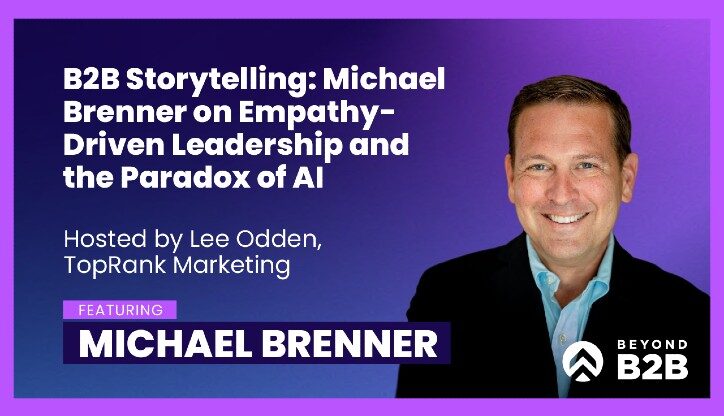
In this episode of Beyond B2B Marketing, Michael Brenner, VP of Thought Leadership and Customer Advocacy at Workday has emerged from a 2 year podcast hiatus to join host Lee Odden and talk about all things B2B marketing, storytelling, thought leadership, influence and the importance of being the best answer for buyers who are searching.
Michael argues that marketing’s true role is to help – consistently, empathetically, and strategically. Drawing from his experience leading Thought Leadership and Customer Advocacy at Workday, he explains how brands earn trust by showing up with insight, storytelling, and customer-centered value. When asked to define thought leadership, he characterized it as disciplined consistency that answers real questions, in useful formats, over time.
A central theme of the conversation is the connection between storytelling and measurable business outcomes. Brenner outlines four core marketing objectives: reach, engage, convert, and retain. And he emphasizes that retention is the most overlooked and highest-leverage opportunity for growth. By integrating thought leadership with customer advocacy, marketers can create a full-funnel system where customer stories build credibility with prospects while reinforcing loyalty with existing clients. He also talked about the role of influencer collaboration and experiential content, and how borrowing credibility and creating meaningful engagement significantly outperforms brand messaging by itself.
The discussion also tackles AI head-on, introducing the “productivity paradox”, where time saved by AI is often offset by rework and unclear strategy. Brenner positions AI as more of a leadership challenge than one about technology. Organizations must define the problem first, redesign roles thoughtfully, and communicate strategy clearly to avoid talent erosion and confusion. His closing message to marketers is direct and practical: stop being order-takers, think like a business, and build marketing strategies that tie storytelling, trust, and customer outcomes together.
Listen to the full conversation with Michael here:
Key Takeaways from this episode:
- Marketing that helps people is more effective than marketing that tries to sell.
- Thought leadership is not about originality – it is about consistently showing up with useful insights.
- Retention is the most overlooked and highest-leverage growth opportunity in B2B marketing.
- Customer advocacy and thought leadership should work together to drive both acquisition and loyalty.
- Influencer collaboration significantly increases marketing effectiveness by borrowing trust and credibility.
- Experiential and interactive content drives deeper engagement than static promotional assets.
- AI adoption is a leadership challenge, not just a technology implementation issue.
- Productivity gains from AI require clear problem definition and outcome measurement.
- Great B2B storytelling requires owning the pain before delivering the solution.
- Marketers must stop being order-takers and start thinking like business leaders tied to measurable outcomes.
Watch the full interview on YouTube:
If you prefer to read, here’s a transcript of the conversation between Lee Odden and Michael Brenner:
Lee: Welcome to the Beyond B2B Marketing podcast. Today I’m joined by Michael Brenner, VP of Thought Leadership and Customer Advocacy at Workday. Michael, let’s start with your marketing origin story. How did you first get into marketing?
Michael: My first job was actually in sales. I was an English Literature major and landed at Nielsen in a sales role. I did what I thought salespeople were supposed to do: talk and sell. It didn’t work. One day, I put a contract in front of a customer and simply stayed quiet. He talked himself into signing it. That moment taught me that listening is a better way of selling than talking.
I became successful in sales, but I was frustrated with the marketing support we received. We were given brochures and product specs, but customers wanted education and insight. That realization led me into marketing. I wanted to enable sales teams with helpful content, better storytelling, and a focus on outcomes. That’s how my marketing career began.
Lee: Tell us about your role at Workday. What are you focused on now?
Michael: I joined Workday to lead Thought Leadership, and later added Customer Advocacy. When I arrived, the team was trying to support the business but often defaulted to product promotion. I believe propaganda seeps into content because everyone wants to sell. True thought leadership must be intentionally helpful and audience-focused. There needs to be a clear separation between thought leadership and product messaging.
“My goals were simple: think like a business, create consistently, and focus on storytelling.”
My goals were simple: think like a business, create consistently, and focus on storytelling. We can’t publish one blog post per month and expect to win in a noisy environment. We need consistent, valuable content that people actually want to read. Adding Customer Advocacy strengthened that mission. Our best stories come from customers. Instead of telling people why they should buy Workday, we tell stories about real customers and the problems they solve.
Lee: How do you define thought leadership?
“Marketing has a marketing problem. When most people think of marketing, they think of ads. But no one wakes up wanting an ad. People want help.”
Michael: Marketing has a marketing problem. When most people think of marketing, they think of ads. But no one wakes up wanting an ad. People want help. Marketing that helps people is more effective than marketing that tries to sell. Research from the Advertising Research Foundation shows that after 40 exposures to a brand ad, people are less likely to buy from that brand.
Thought leadership is often defined as having a unique idea no one has ever said before. I disagree. It’s about showing up consistently and being helpful. It’s about answering real questions and delivering value regularly. Consistency is what drives credibility. In an AI-driven world, consistently helpful content builds trust with both algorithms and humans.
“Consistency is what drives credibility. In an AI-driven world, consistently helpful content builds trust with both algorithms and humans.”
Lee: Our research found that 97% of marketers say thought leadership is critical, but less than half use it to engage existing customers. What do you think about that?
Michael: Marketing has four goals: reach, engage, convert, and retain. Retention is the most overlooked objective. Everyone wants net-new acquisition because it feels more exciting. But investing in retention generates outsized returns. It’s often the easiest way to drive ROI. Thought leadership and customer advocacy together create a full-funnel system. We use thought leadership to support customers, and we use customer stories to attract new prospects. When you place valuable content next to conversion elements, conversions increase. Being helpful improves performance at every stage.
Lee: Our research also found that 74% of marketers that frequently collaborate with influencers are very effective compared to 29% of all others. What’s holding B2B brands back from collaborating with influencers?
“Having others speak about you builds credibility and influencers bring their own audience and authority.”
Michael: Many B2B brands want to control the message and promote how great they are. Handing that responsibility to someone outside the organization feels risky. However, having others speak about you builds credibility and influencers bring their own audience and authority. The challenge is that marketing often defaults to self-promotion. We need to start with what the audience wants, not what we want to say.
Lee: Another finding from the State of B2B Thought Leadership report was that 78% of B2B marketers say interactive or experiential content increases engagement but only 33% regularly build it into their campaigns. What do you think about publishing experiential elements in thought leadership content like video, podcasts, interactive tools and events?
Michael: Storytelling was our foundation. The next step was telling stories in formats people engage with-short, visual, educational content. That includes video, influencer collaborations, interactive research, and even printed materials at events. Experiences matter.
We’re experimenting with documentary-style storytelling and immersive formats. The goal is to meet audiences where they consume content and deliver value in meaningful ways.
Lee: You’ve written about the AI productivity paradox. How can leaders avoid the productivity trap?
“AI creates a productivity paradox. It saves time, but it also creates rework. The solution isn’t pushing more AI, it’s leadership.”
Michael: AI creates a productivity paradox. It saves time, but it also creates rework. The solution isn’t pushing more AI, it’s leadership. Leaders must identify the problem first and define measurable outcomes. They need to reinvest productivity gains into skills and training. Roles are changing. Writers are no longer just writers-they’re editors and collaborators with AI. Organizations must redefine roles and communicate AI strategy clearly. This is a leadership issue, not a technology issue.
Lee: With everyone using AI, how does anyone differentiate?
Michael: Trust differentiates. Google’s EEAT framework-expertise, experience, authority, and trust-still applies. You earn trust by sharing real experience and human perspective. The only way to stand out in a world of AI-generated content is to be deeply human. Personal stories, authentic perspectives, and real expertise cut through noise.
Lee: What does great B2B storytelling look like?
Michael: I have an informal goal for my team: make people feel something. We need to own the pain and marinate in it before delivering the solution. If a story is two minutes long, most of it should focus on the problem and emotional tension. Delay the gratification of the answer. When people feel understood, they’re more receptive to the solution.
Lee: How important is being the “best answer” in today’s AI-driven discovery environment?
“We balance two approaches: SEO-driven helpful content and narrative storytelling. Both are necessary. One builds visibility; the other builds emotional connection.”
Michael: Being the best answer is essential, even if it’s sometimes less exciting. Some of our highest-performing content is structured, question-and-answer style content. It may not be emotional, but it’s useful. That format performs well in search and AI environments. We balance two approaches: SEO-driven helpful content and narrative storytelling. Both are necessary. One builds visibility; the other builds emotional connection.
Lee: Many marketers feel stuck in status quo campaigns. What advice would you give them?
“The status quo trap in marketing is order-taking. Behind every piece of bad content is an executive who asked for it.”
Michael: The status quo trap in marketing is order-taking. Behind every piece of bad content is an executive who asked for it. But marketers need to stop simply executing requests. Think like a business. Build the business case. Tie your strategy to customer outcomes. Measure results. Marketing must move from order-taking to strategic leadership.
Lee: If you could be doing anything else, what would it be?
Michael: I genuinely love what I’m doing. I sold my agency and could have stepped away, but I enjoy being in the corporate environment and shaping storytelling strategy. I believe in what we’re building. I’m fortunate to work with a leader who trusts me. That trust makes a difference. For now, I’m exactly where I want to be.
“I’m exactly where I want to be.”
Lee: Thank you so much Michael. Where can people connect with you?
Michael: Connect with me on LinkedIn. I’d love to hear examples of great B2B storytelling and continue the conversation.
Resources mentioned in this episode:
- Workday Perspectives & Thought Leadership: Hub of thought leadership content, including AI, strategy, and customer insights.
- Workday AI ROI Research: Beyond Productivity: How Leaders Can Drive Real ROI With AI.
- Workday’s AI Skills Report: Elevating Human Potential: The AI Skills Revolution.
- Advertising Research Foundation (ARF) “How Advertising Works Today”.
- Harvard Business Review: The Value of Keeping the Right Customers.
- Explainer on E-E-A-T and Search Quality Rater Guidelines
- Jay Acunzo Video Series: Against the Grain
- Tim Washer Cisco Valentine’s Day Video
If you’d like more data on B2B thought leadership for 2026, check out our new research report in partnership with Ascend2 (ungated).

Be sure to like and subscribe to the Beyond B2B Marketing podcast on your preferred podcast platform. Reviews are appreciated!