

B2B organizations are navigating new levels of pressure from every direction: AI-powered buyer autonomy, expanding buying networks, fragmented tech stacks, and declining visibility into early-stage buying behavior. So how can B2B marketers adjust and adapt?
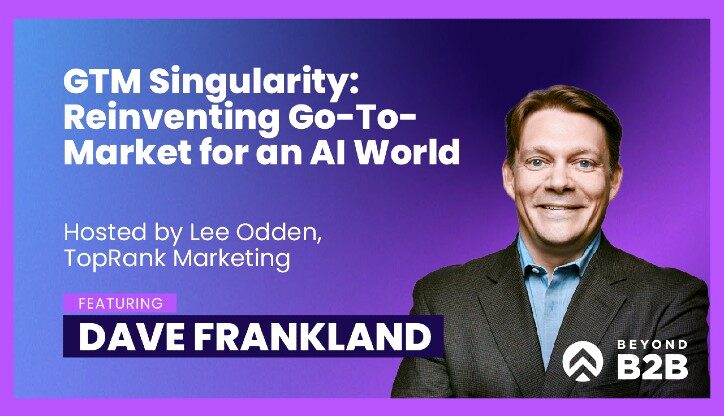
In this episode of the Beyond B2B marketing, podcast, Dave Frankland, VP and Research Director at Forrester, joins host Lee Odden for a discussion that centers on what Forrester calls the “GTM Singularity” – a moment when the norms of go-to-market collapse and entirely new models emerge. In this context, Dave defines singularity as an inevitable, profound shift in how sales, marketing, customer success, and product teams must operate together.
As they discuss this period of change, there are several shifts occurring including with buyer behavior. Dave shared that “buying has become an act of confirmation, not selection”. Buyers increasingly enter the process with preferred vendors in mind, informed by AI search, peer influence, and expanded buying networks long before a sales conversation begins. That shift creates what Dave describes as a visibility vacuum, where traditional funnel metrics and MQL-driven approaches no longer reflect how decisions are actually made.
To compete, B2B companies must rethink trusted discovery, align brand and demand, and design content and experiences not only for humans but for answer engines and AI-driven environments. Of course this perspective lines up well with our Best Answer Marketing framework of building trusted, multi-channel content experiences that drive impact across brand, demand and revenue outcomes.
Dave is expanding on these themes with a keynote presentation, The GTM Singularity, at B2B Summit North America, where the focus is on helping leaders pivot toward unified, resilient GTM models. The Summit’s broader theme of immersive, hands-on transformation reflects this same urgency: strategy must fuse with execution, AI must be orchestrated across functions, and organizations must move beyond siloed optimization toward systemic reinvention. For senior B2B marketers, the singularity moment is already unfolding and the opportunity lies in leaning into change before the collapse of legacy models forces that change.
Listen to the full conversation with Dave here:
Top ten takeaways on reinventing GTM include:
- B2B organizations are approaching a “GTM Singularity,” a moment when mounting pressures from AI, buyer behavior shifts, and internal fragmentation force legacy go-to-market models to collapse and new ones to emerge.
- The GTM Singularity is about profound structural change in how marketing, sales, customer success, and product teams align and operate together.
- Buying has become “an act of confirmation, not selection,” meaning more than half of buyers enter a purchasing process with a preferred vendor already in mind.
- AI-powered buyer autonomy is expanding buying networks and reducing seller visibility into early-stage decision-making, creating what Dave describes as a “visibility vacuum.”
- Traditional funnel metrics and MQL-driven approaches are increasingly disconnected from how buyers actually make decisions in an AI-mediated environment.
- Trusted discovery now requires brands to design content and experiences for answer engines, AI search, and machine-driven environments as well as humans.
- Organizations must avoid siloed AI implementation across marketing, sales, and customer success, as this only deepens fragmentation rather than driving true GTM transformation.
- Strategy-to-execution alignment is one of the most critical shifts B2B leaders must make, ensuring that documented GTM strategy is directly connected to how teams execute across functions.
- 75% of B2B enterprises are expected to increase budgets for influencer relations, according to Forrester’s research, reflecting the growing importance of peer voices, customer advocacy, and influential third-party validation in buying decisions.T
- To get the most out of the upcoming B2B Summit North America, Dave advises attendees to bring an open mind, think beyond their specific role, and attend sessions outside their primary function to better understand the interconnected nature of modern go-to-market strategy.
Here’s a transcript of the conversation between Lee Odden and Dave Frankland:
Lee: Hello and welcome to the Beyond B2B Marketing Podcast. I’m your host, Lee Odden, CEO of TopRank Marketing. Today, our guest is a leader whose work has helped so many companies think about customer strategy, intelligence, and growth. He’s a global keynote speaker, a published author, and a contributor to influential research and business thinking. In his current role, he guides research on customer retention, growth, advocacy, content strategy, and operations. He’s also delivering a keynote at Forrester’s upcoming B2B Summit North America on the go-to-market singularity, which we’re going to dig into during our conversation today. Of course, I’m talking about Vice President and Director of Research at Forrester, Dave Frankland. Welcome to the show, Dave!
Dave: Thanks, Lee. Thanks for having me; I’m excited to be here.
Lee: Let’s kick things off with one of my favorite questions to ask people, and that is your marketing origin story. Tell us a little bit about your background. I know you were at Forrester before, and you were at eMarketer and other roles, but give us a glimpse into how you got into marketing in the first place.
Dave: Sure. I actually started my career in PR in London. I was working for one of the WPP global PR agencies, Hill and Knowlton. I joined a graduate trainee program where we were supposed to rotate between departments every three months over the course of a year, so you got exposed to different aspects of PR from crisis to corporate to consumer. I started out in the corporate communications group, which I was devastated about because it sounded really dull.
Then I was put in the tech group, which I was even more upset about because I didn’t know the first thing about technology. They were the two best things that ever could have happened to me because the world put tech at the center of everything we do. I moved to the States through H&K. My main account was British Telecom and they created a joint venture with AT&T. BT asked if I would move over to the States; I was mid-20s and single, and someone was offering to pay my way to New York, so I’ve been in the States ever since.
I joined a tech specialist PR firm and then went in-house, eventually leading corporate communications at DoubleClick when they were bought by Hellman and Friedman before the sale to Google. I was there for about six years. We naturally did a lot of analyst relations, which is how I got to know Forrester.
A Forrester analyst reached out to me to see if I was interested in applying there, and it was a “poacher turned gamekeeper” opportunity. I joined to cover marketing services, and eventually, myself and a colleague realized we were in a direct marketing group but weren’t really writing about traditional direct marketing. We surveyed people, naval-gazed for a long time, and created the Customer Intelligence group. I led that for a few years and then left to run strategy at a Martech vendor. I did management consulting at Winterberry Group, worked for eMarketer, wrote a book, and did my own consulting. After ten years in the “wilderness,” I realized nothing had been as fulfilling as my time at Forrester, so I came back about three and a half years ago.
Lee: Fantastic. What are you focused on now?
Dave: My day job involves leading two teams. The first is Customer Retention, Growth, and Advocacy. This covers customer marketing, advocacy, success, and the B2B component of customer service and support.
The other team is Content Strategy and Operations. Content is so central to everything an organization does, so we look at who produces it, how it remains consistent, and how the right thing appears in the right place. I think of myself as supporting the team more than leading it; my job is to help them survive, thrive, and deliver great work to our clients. These teams are on the phone all day with practitioners, helping them think through their strategy and adopt our frameworks. It can be broad strategy or “in the weeds” questions like compensation or first 90-day plans.
I also work collaboratively with my peers across all B2B services. This includes the Marketing Executive service for CMOs, the Demand and ABM team, Portfolio Marketing (our term for product marketing), and the Revenue Operations team. A big part of my job is figuring out how we are collaborating to ensure we are not saying one thing in one place and something else in another. Our biggest currency at Forrester is our ideas and how to bring them to life.
“Everything is changing both for the buyer and the selling organization. We believe we are on the brink of a major shift in the market right now, which is both exciting and terrifying.”
Lee: Well, it’s an interesting thing you said, that you’re not leading, you’re supporting. Of course, the irony is that the best leaders are supporters, so you’re clearly in the right spot. You have a front-row seat to the B2B marketing industry. Marketers are facing a lot of disruption and transformation. What are some of the big changes you’re seeing based on your recent research?
Dave: I completely agree with the premise of your question. When you look at the volatility of the past several years, we can point to the pandemic, geopolitical tensions, and economic uncertainty. These external forces are forcing us to rethink everything we do. Then there are new work models like hybrid and work-from-home.
We also see major systemic shifts in buyer behavior. We conduct a massive business insights survey every year with 16,000 to 19,000 B2B buyers. Buyers are younger and they are bringing the provider or seller into the discussion much later. In some cases, they are taking longer because of the consensus nature of buying groups and buying networks. Everything is changing both for the buyer and the selling organization. We believe we are on the brink of a major shift in the market right now, which is both exciting and terrifying.
“We bring our Forrester ideas to the stage, but people don’t just want to hear from us. We’ve shifted to learning from peers and rolling up our sleeves.”
Lee: It seems like those challenges also spell opportunity for those folks who find out how to adjust and navigate that new reality most effectively. One of the places marketers are finding answers is at events, like the B2B Summit Forrester hosts. What are you looking forward to most with the summit?
Dave: Broadly, it’s just human interaction-the energy and sharing of ideas. We bring our Forrester ideas to the stage, but people don’t just want to hear from us. We’ve shifted to learning from peers and rolling up our sleeves. We’ll do analyst-led workshops where you actually do real work with a pen and paper or laptop. Last year we had creative things like an evidence board that looked like a crime scene for digging into processes. We are not in a “PDF world” anymore where you just download a report. This year in North America, we’re introducing immersive experiences-almost like an “escape room meets B2B thinking”. Small groups will go through a GTM-focused journey where they start as a buyer and then literally turn a corner to become the selling organization.
We also facilitate roundtables where peers can learn from each other. We have special programs like our Executive Leadership Exchange for CMOs, Forrester Women, and a new program called Future Leaders for those six to eight years into their careers. We also offer summit-specific certifications, like one on activating the modern GTM. When you get on the show floor, you feel that crackle of energy from bringing people together.
Lee: That sounds very robust. You mentioned go-to-market is a big part of the conversation. You said recently that B2B marketers are facing a GTM crisis right now. Can you elaborate on what you meant by that?
Dave: It goes back to the volatility I mentioned. Those market forces should have compelled B2B firms to change how they engage with buyers, but most firms are stuck. They can’t get off ineffective and sometimes abusive practices, like spamming customers, ignoring relevance, staying stuck in an MQL world rather than looking at buying groups, and still gating information.
Internally, we are still siloed, incentives aren’t aligned, and data is fragmented. We’ve been papering over this for years. We’re at a point of “slowly, then all at once”. We are at the event horizon. AI in the mix means that old, broken approach won’t work anymore. It’s expanding buying networks and potentially giving agents part of that network, giving buyers even greater control. We can’t keep doing what we’ve been doing and expect the same result.
“We see this unavoidable GTM singularity… a moment of urgent, inevitable, profound change in the norms and practices that sales, marketing, customer success, and product teams have long relied on… we think we’re at or very close to this point of no return for most companies.”
Lee: You mentioned “agents,” and it reminded me of Forrester research about B2A-Business to Agent. Drill down into the go-to-market singularity. Give us the “one-minute version” of your keynote.
Dave: A lot of people associate singularity with AI overtaking human intelligence, but we’re going back to the math and physics definition. In that world, singularity describes a point where new and mounting pressures cause existing rules and models to collapse and entirely new ones to emerge. We see an unavoidable GTM singularity-a moment of urgent, inevitable change in the norms that sales, marketing, success, and product teams have long relied on. We are at the point of no return for most companies. This is an opportunity for early mover advantage to lean into new ways of doing things.
“Buying has become an act of confirmation, not selection… more than 50% of buyers come into a buying process with a preferred vendor in mind and more than 50% of the time, they’re selecting that vendor.”
Lee: Let’s talk about AI-powered autonomy and what that means in a B2B marketing context. What are the challenges and opportunities there?
Dave: GTM teams have been obsessing over the minutia of journey maps, but buyers aren’t playing the game with us. Buying has become an act of confirmation, not selection. More than 50% of buyers come into a process with a preferred vendor in mind, and more than half the time, they select that vendor. Buyers are richly informed, self-directed, and decisive-they are making decisions long before a provider knows they are “in market”. They are turning to AI search and agents. Inside an organization, there are about nine members in a buying group. But there are 13 people outside the organization affecting that sale, from partners to influencers to competitors. All of this gives the buyer greater autonomy. They’ll bring you in when they need you, but it’s on their terms.
“Continuing to gatekeep information just sitting out there is just a total fool’s errand… companies are going to have to design and think about this for humans, buyer engines, and answer engines in order to meet that rising demand for more granular personalized information.”
Lee: That lines up well with our “best answer marketing” architecture-becoming the best answer where buyers are looking. You’ve talked about a connected go-to-market approach that calibrates brand and demand while aligning the human experience with AI. What is your advice on how brands can improve “trusted discovery”?
Dave: Those are actually our keynote topics. John Buten will be looking at bridging the “visibility vacuum” that leads to trusted discovery. Since 94% of people use AI to inform decisions but we can’t always see that, we have to rethink the buyer journey. Continuing to gatekeep information is just a fool’s errand. Companies will have to design for answer engines in order to meet the demand for granular, personalized information delivered at scale. We have to think of machines as an audience for the content we’re creating. Content must be consistent and authoritative to gain trust and be found.
“Thinking about machines as an audience for the information and the content we’re creating… it has to be consistent, it has to be authoritative. That’s really hard to do, but that’s what’s going to be required to gain trust and be found.”
Lee: Let’s keep pulling the thread on human and AI alignment. What are you seeing in terms of what works as organizations think about this?
Dave: We’re past the experimentation phase and into practical planning for the long term. There’s a big focus on the hybrid human-AI model: who does what, where the guardrails are, and decision ownership. We don’t want marketing creating their own agents and workflows while sales and customer success do the same separately, just making our silos even more extreme. Human team members are going to remain the greatest asset within GTM functions. It’s about calibration to maximize human capacity to impact business results. We have to decide: do we think of agents as colleagues? If so, how are we onboarding them or putting them on a PIP? We need a responsible AI practice and change management for humans, including “AI Q” or AI readiness. It’s not going to happen if you just buy an enterprise license and say “go”.
Lee: There’s no AI solution yet for human taste, imagination, or curiosity. The transition from subject matter expert to orchestration expert brings in that human experience.
Dave: Exactly. Lisa Gately on my team wrote about how everyone in the organization is now a creator. How do we manage that content? You don’t want rigid rules, but you need guidelines and guardrails or it’s just going to be utter chaos.
“Employees outside centralized content teams will create two-thirds of content… share of B2B organizations in which centralized content teams lead content creation and production will fall from 45% to 30%.”
Lee: Let’s pull back and crack open Dave’s crystal ball. What are some of your predictions for B2B marketing and sales in 2026?
Dave: We publish predictions every winter for the following year. We want to ground these in data but also push the envelope. First, we predict that employees outside of centralized content teams will create two-thirds of all content. Currently, the share of organizations where centralized teams lead content production will fall from 45% to 30%. AI has put so much power in everyone’s hands. We can do more localization and translation, but if we don’t pay attention to nuances, we can destroy goodwill. If a silo creates content that isn’t consistent with the rest of the organization, it’s less likely to show up in an answer engine.
Second, we predict that 50% more B2B Fortune 500 companies will prioritize patriotism in promotions. This depends on geopolitical volatility, so we’ll see if it holds.
Lastly, we predict that 75% of B2B enterprises will increase budgets for influencer relations. This includes review sites and customers; it’s not just “big I” influencers. It’s about managing relationships between a company and its publics. It’s come full circle since our early days in PR.
Lee: That’s amazing. My company has been involved with B2B influencer marketing since 2012, and we’re seeing more demand now than ever. People want to hear from peers, not brands. So, I’ll be attending the B2B Summit for the first time this year. What advice do you have for me or any first-timer?
Dave: First, bring an open mind. We try to look far down the road while being practical. It may not affect your company today, but it will down the road. Second, think outside your role. We make curated agendas for different roles like revenue ops or brand, but we are unique in looking across the entire GTM function. I spoke to heads of sales last year who went to marketing sessions and said it completely changed how they view their job. That opportunity to understand the interdependency is great.
Lee: That’s fantastic advice-look outside your role. Let’s wrap up with a “dream career” question. If you weren’t doing what you’re doing now, what would you be doing?
Dave: If every job paid the same, my answer would be working in a bar. I’ve worked in bars in four or five different countries and loved the human psychology and conversation. But today, I’d probably say a scuba diving instructor. My son and daughter are both certified, and watching that excitement and wonder the first time they were in the ocean was incredible. There’s a teaching element to what we do at Forrester, so I think I’d enjoy that-ideally somewhere warm.
Lee: Exactly, somewhere warm and beautiful. Where is the best place for people to connect with you?
Dave: LinkedIn. I’m easy to find as Dave Frankland. I’ve abandoned all other social media for my mental health.
Lee: Thank you so much, Dave. I’m excited to attend the summit and meet you in person. This has been great.
Dave: For me too, I really enjoyed it. Thank you.
Lee: I want to thank you for tuning into the Beyond B2B Marketing podcast. Subscribe so you can stay tuned to our next exciting guest. And remember, there’s no better time than now to become a Best Answer brand.

Be sure to check out the full agenda and register for the Forrester B2B Summit North America here.

Be sure to like and subscribe to the Beyond B2B Marketing podcast on your preferred podcast platform. Reviews are great too!