

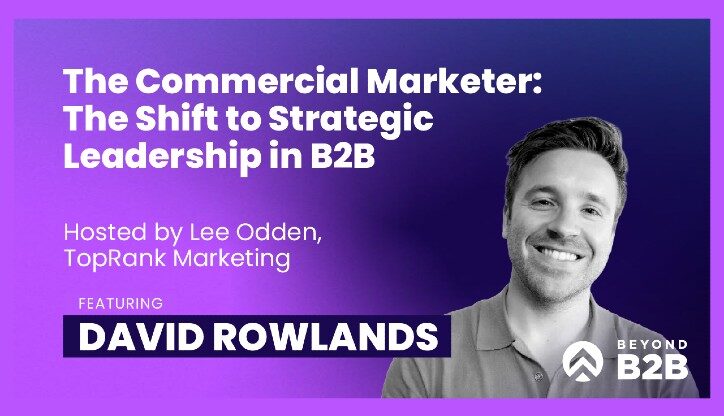
Most B2B marketers are feeling it: more pressure than ever to prove impact, tighter alignment with revenue, and a growing expectation to influence decisions long before a sales conversation ever begins. Yet many marketers are still operating with campaign-first thinking which is often disconnected from the broader business strategy. The result is a credibility gap where marketing is busy, but not always seen as essential. In this episode of the Beyond B2B Marketing podcast, host Lee Odden sits down with David Rowlands, Head of Product at B2B Marketing & Propolis to talk about that challenge and what a path forward might be.
At the center of their conversation is an important shift: moving from “promotional marketing” to what Rowlands calls the Commercial Marketer. Instead of exclusively focusing on campaigns, channels, and MQLs, this approach reframes marketing as a strategic, revenue-driving function that is deeply integrated with sales, product, and customer success – not unlike the Go to Market strategies that have emerged since COVID. As buyer behavior evolves and self-directed research replaces traditional sales motions, marketers are now in the best position to influence growth. But taking advantage of that opportunity means adjustments, a new mindset with new skills, and a stronger connection to business outcomes.
Their discussion also explores the forces accelerating this shift-from AI changing how buyers discover information to the rising importance of data-driven, differentiated content and influencer-led credibility. For B2B marketers that are navigating uncertainty, this episode offers both clarity and direction: align with the business, understand the customer at a deeper level, and build marketing strategies that don’t just generate activity-but drive measurable impact.
Listen to the full conversation with David Rowlands here:
Key B2B marketing takeaways from this episode:
- The shift from “promotional marketer” to commercial marketer reflects a broader evolution from campaign execution to owning measurable business outcomes like pipeline and revenue.
- Modern B2B buyer behavior has fundamentally changed, placing more responsibility on marketing to influence decisions before prospects ever engage with sales.
- Marketing teams that align closely with sales, product, and finance are better positioned to drive impact, as cross-functional collaboration is now essential to effective go-to-market execution.
- The growing influence of AI and large language models is changing how marketers work and how buyers discover and consume information, which requires a rethinking of content strategy.
- In a world where “everyone is a publisher,” generic content is losing effectiveness, and data-informed, differentiated content has become essential for standing out.
- Original research and proprietary insights are increasingly critical for creating authoritative content that can influence both human buyers and AI-driven discovery systems.
- The rise of influencer and advocate participation in B2B marketing reflects a shift toward trusted, third-party voices.
- Emotional factors play a significant role in B2B buying decisions, especially when buyers are making high-stakes choices that impact their careers, reinforcing the importance of storytelling, trust, and human connection.
- High-performing marketing teams are integrating AI across their entire workflow, from data analysis to personalization, rather than treating it as a tactical add-on.
- To become more commercially effective, marketers should start by understanding broader business objectives and actively engaging other departments, enabling them to design strategies that contribute directly to growth instead of isolated marketing metrics.
You can also watch the interview on YouTube:
Here’s a transcript of the conversation between Lee Odden and David Rowlands
Lee: Hello and welcome to the Beyond B2B Marketing Podcast. I’m your host, Lee Odden, CEO of TopRank Marketing. Today our guest is someone based in the UK but working at the center of B2B marketing content and community globally. With an editorial background, he’s advanced over the last six years to Head of Content and Head of Product at B2BMarketing.net and their B2B marketing community, Propolis. Plus, he’s host of the B2B Marketing Podcast, which not too long ago passed 200 episodes. Of course, I’m talking about David Rowlands. Welcome to the show, David.
David: Thank you for having me, Lee. Pleasure to be here.
Lee: Let’s kick things off with an origin story-your marketing origin story. How did you get into marketing, and specifically B2B?
David: Really good question. I think like a lot of marketers, my background is not marketing at all. It’s one of those industries where people seem to have come from all walks of life, and I think that’s actually what makes it such an interesting profession. You’re always meeting people with slightly different perspectives and different origin stories. From my own point of view, I graduated with a history degree. Very simply, I wanted to get into something around writing-newspapers, journalism. That was my entry into the working world. My first role was at an oil and gas publication for the liquefied natural gas industry. So it was lots of magazines and blogs about what was happening in Texas at the time, shipping gas all around the world.
After a certain point, I found that really interesting, but I wanted to be more involved in the revenue-facing side of things. Content obviously has a huge role in any business, but it can often feel quite removed from the commercial side. The natural step for me was, well, how do I get there? Marketing is all about driving revenue for a business. Eventually, right at the beginning of COVID, I saw a role at B2B Marketing and it was for an editor. So it was a perfect blend of the two worlds I was in. That’s how I got into it, and I’ve been there ever since.
Lee: What a great place to mature your knowledge around the discipline, somewhere like B2B Marketing. I’ve had some exposure to the organization through speaking at events and contributing to reports over time, and it’s really at the center of advancing what’s important for B2B marketing. Not just in Europe, but obviously in the US because you have a US event as well. And the podcast reaches here too. I’ve enjoyed many episodes of your podcast while running. As I mentioned, your podcast passed over 200 episodes, and I think we’re at number 16 with this podcast. Do you have any advice for running a podcast in the B2B marketing space?
David: The first thing I’ll say is that we’ve got a lot to learn ourselves. As a media, events, and community business, we do so much that I think we could certainly spend more effort on the podcast. That’s one thing we’re really looking to do this year.
For me, the main thing is speaking to people with a different perspective and something interesting to say. I know that sounds quite obvious, but there’s so much sameness out on LinkedIn, which is where a lot of these clips are seen and where people access podcasts. Actually having someone who’s not afraid to challenge the status quo-albeit with a reasonable view, I’m not encouraging lunacy on the airwaves-but someone with something a bit different to say always goes down well.
And this is something we’re looking to do as well: speaking to people who aren’t in marketing. I think we can fall foul of only speaking to marketers. Obviously marketers have an interesting perspective because we’re in the marketing industry, but it can become a bit of an echo chamber. Speaking to people from sales or product or legal or finance-those people actually have a really interesting view of what they expect from marketing. Just flipping that perspective makes for a really interesting conversation and stands out from that sameness I mentioned.
Lee: That’s great advice. So how does that differentiation make its way into your role at B2B Marketing and Propolis? Unwrap a little bit about what those responsibilities are. Explain to folks who may not know. What is B2B Marketing, the company? Because in the US, when we hear that, we think of a category, not a company name. And then the community as well.
David: Sure. So I’ll tell a little bit of a story. B2B Marketing the company started in the early 2000s in the UK. We started as a print magazine and that very quickly expanded into events, many of which are still running. B2B Ignite is our flagship event in the UK. We have award ceremonies-the B2B Marketing Awards in the UK and the Elevation Awards in the US. That’s really how we got started.
What we started to do, somewhat inadvertently, was build this latent community. We were speaking to senior B2B marketers at round tables we were running. They were helping to judge at our awards. They were speaking on stage at our conferences. This was all going quite well in the background. And then COVID happened. What happened to us is the same thing that happened to businesses all over the world-our events were essentially put on indefinite hold. It could have been six months, a year, two years. At that stage, no one really knew.
Speaking to our clients, what they told us was that they still wanted the ability to connect with their peers, but they also wanted trusted advice. During that time, because events were shut down and direct mail sort of came to an end as well-you couldn’t send things to people’s offices-everyone went into the digital space. Suddenly all of these channels were flooded. Not just media outlets acting like publishers, but every single company became a publisher as well. Which had some benefits, but plenty of drawbacks.
So Propolis came about as a place for marketers to come together in a bit of a safe space to share ideas, but also a place where they knew the content they were reading was high value and trustworthy. It wasn’t just something someone had said on LinkedIn. That’s really what Propolis is all about. And my role in that is shaping the roadmap behind Propolis as well as the content strategy itself.
Lee: That’s really great. I think there’s a lot of hunger for community in marketing and all over the business world. Some of it’s born out of the effect of remote work that occurred during COVID. There are remnants of that hybrid work environment. There’s a lot going on in the world and the business world as well. I have a fully remote team here in the US, but we have scheduled in-person get-togethers for the folks who are able to make it. And it’s priceless, that connection. Whether it’s connecting virtually or in a structured, thoughtful way-but also spontaneously-it creates a lot of value. It sounds like that’s what Propolis is doing.
Because you’ve been there for almost six years now, what’s changed in terms of the focus as it relates to B2B marketing?
David: It’s an interesting one. Essentially, the marketers we speak to, there’s so many things that have changed in the last three years. Trying to boil that all down to one thing is really hard. But I think the marketers we speak to are busier than ever. They’re under pressure like they’ve never been before. And they need to prove the value of what they’re doing.
If you cast your mind back ten years, it’s not to say marketing was easy, it absolutely wasn’t and never has been. But the traditional sales model was a lot more effective. People expected a cold call. Sales really bore the brunt of the pressure in terms of driving revenue. What’s happened is that buyer behavior has changed. People don’t want to pick up a phone to a cold call. They want to do their own research. They want to speak to their peers. They want to learn from other people in the industry and essentially make their own decision on their own time.
That’s put the ball very much in marketing’s court. On the one hand, that’s obviously a really good thing because it means marketers are now in this place where they’re the most influential people in how effective a business can be at driving revenue. On the other hand, there’s this huge bridge to gap because marketers are quite often still using traditional marketing techniques-essentially trying to generate lots of MQLs and translate some of those into sales. But what they actually need to be is much more strategic in their approach, working cross-functionally and building entirely new marketing strategies and operating models for how they’re going to drive revenue.
What’s changed for us is that if you go back three years, there was a lot more focus on creativity and brand. Now, that stuff isn’t less important-it’s actually more important than ever because you still have to cut through to people. But in addition to all that creativity and brand work, there’s a lot of conversation around how do you prove the value of marketing. It’s all around creating dashboards, creating processes with sales so you’re working together-not a handover, but working in lockstep along the way. So it’s become a much more technical world, which can be quite overwhelming at times, but I think it’s a huge opportunity as well.
Lee: I appreciate what you’re saying about the updated B2B marketing operating system, as it were, and this intersection of creativity and accountability. We’ve built up something called Best Answer Marketing Architecture, which accounts for data-informed creativity, a trust element, multi-channel distribution, and unified analytics to tie it all together. It’s still new and evolving, but I think what you’re speaking to is definitely a reflection of what the moment calls for in our industry. Marketing needs to be able to justify its existence because it is under more of a microscope.
So I want to ask a little more about Propolis. What are some of the practical things people value? How does that manifest in terms of interactions, events, content-what are the formats that Propolis is creating value through?
David: Good question. Over the past couple of years, a big job I’ve had to work on personally is actually linking all of these different elements. We still had awards, conferences, round tables, expert consultants, and digital content, but they were all quite disconnected. It was like, let’s just use all of these formats in different ways and try to deliver value. They did do that-that’s why it’s working successfully and we have a good business. But what we’ve had to do is really link a lot of those things together so that the membership experience makes a lot more sense.
Essentially, as a Propolis member, you join the community. We speak to your team leader. We learn about your challenges, your objectives, your tech stack, where marketing sits within the business. We run a skill survey on your team so we learn where they’re stronger and weaker as a commercial marketing unit. We break that into six key skills. Then we design a program of expert consultancy, training, and content for each account. It’s not bespoke, but it’s tailoring the experience to different clients.
One of the things we do is hold round tables each quarter. We bring leaders together and discuss a big issue at that moment in time. That’s how we bring the community together in person. We capture all of that insight-what people are saying, what they want to focus on, and what they’re struggling with. Then we share that with the wider community. That translates into training courses and guidance on how to overcome some of the issues that have been raised.
What sets Propolis apart is that there are loads of great white papers and training courses out there. A lot of this material already exists. But what Propolis does is give you a plan for putting those learnings in place. It’s not just a 200-page PDF. It’s a case of, let’s learn about this together and give you the skills to actually execute a working strategy.
Lee: I can imagine a lot of value in a team going through that together as opposed to self-directed learning, which happens a lot because of people’s crazy schedules. A system that people can tap into like that sounds very intriguing. So you and the team have introduced the concept of the “commercial marketer.” Can you explore that a little bit? What does it mean exactly? Because it’s not as common an expression here in the US as it may be from your perspective.
The opposite of a commercial marketer as a promotional marketer…someone who is basically given a product or service and told, “promote that.” It’s not really about understanding the market.”
David: I think before we look at what a commercial marketer is, it makes sense to think about what’s the opposite. This isn’t necessarily an official term we use, but I like to think of the opposite of a commercial marketer as a promotional marketer. That’s someone who is basically given a product or service and told, “promote that.” It’s not really about understanding the market. It’s not about getting under the skin of clients. It’s just about promotion-campaigns, ads, automation, all that stuff. And let’s be fair, it still plays a really important part in marketing.
The problem is that, as we were alluding to earlier, with this change in buyer behavior, it’s less effective. Marketers are generating leads. A tiny percentage of those leads now convert into a sale. It’s very difficult to prove any kind of science behind which leads converted and why and when. Marketing doesn’t really gain the respect as the strategic revenue function that it should be. So the cycle completes and they’re given another product and another service to promote. The status of marketing is just relegated.
“There’s a massive opportunity for marketers to step up and transform the whole way marketing operates.”
The shame in all that is that because buyer behavior has changed and all these journeys are happening in very digital ways, there’s a massive opportunity for marketers to step up and transform the whole way marketing operates within the business, moving away from being a promotion team and into a commercially effective function.
A commercial marketer, we believe, is someone who does that. They’re in contact with the product team, the sales team, the customer success team. They think about business objectives first and foremost and how to build a strategy that helps deliver those. They’re not thinking through shares, likes, number of posts, or webinar attendees. They’re thinking through the lens of how is this activity going to drive our pipeline and close-won deals. That’s what a commercial marketer is all about.
Lee: That lines up really well with go-to-market principles that have become quite popular here-a perspective that integrates disciplines, working hand-in-hand with sales and product, being accountable, creating methodologies and structures that allow for repeatable success. There’s a utility that’s missing in promotional marketing, right? It’s very egocentric from the brand perspective to just push something out as opposed to, with empathy, understanding the triggers, category entry points, and pain points that buyer is trying to solve for-and then strategically being the solution for that problem through marketing activities.
David: Yeah, exactly. And marketing is in such a good place to lead that because fundamentally they’re the ones that have a lot of this data on the customer. That’s what a lot of this boils down to.
Lee: So what do you think some of the biggest structural changes are in B2B marketing right now? We talked about buyer behavior changes. Could be revenue models. Obviously tech stacks are different. What’s standing out as far as the changes your Propolis members need to make to become more effective commercial marketers?
David: There’s lots to unpack there. AI is the big one, for lots of reasons. The interesting thing is that quite often it comes up as a topic in conversation and people think about how they can use AI to be more effective. And sure, we should definitely be doing that. But I think there’s a bigger question around how AI fundamentally changes what works in marketing.
If I put my content hat on as an editor, I think about the role of content. What used to happen is that if you had a question about a specific thing, B2B marketing, for example, you would come to a website like B2BMarketing.net and search for the answer. Then you’d hopefully get on some kind of mailing list, be contacted, come to events, and so on.
“In this world where everyone is now a publisher, people aren’t necessarily going to those (web) sites for the same reasons they used to. They’re going straight to ChatGPT for their answer.”
What we’re seeing more and more is that people don’t want to waste their time with that. They want to get straight to the point. They go to LLMs, they go to ChatGPT. They ask the question they have and they actually get a pretty good answer. So one of the things marketers are struggling with is that in this world where everyone is now a publisher, people aren’t necessarily going to those sites for the same reasons they used to. They’re going straight to ChatGPT for their answer. There’s a lot of things happening all at once that are changing how marketing works. But certainly from my perspective, LLMs are the big disruptor at the moment.
Lee: It begs an interesting question. I was just talking with someone yesterday at a pretty big organization, like a Fortune 100. They had put a pause on their blogs and made quite substantial staffing changes in the content area. However, a couple of months later, now they’re thinking about, well, what’s the role of content like a blog platform in an age of AI? Certainly, the answers have to come from somewhere, right? They’re not manufactured-they’re predicted. It’s a probabilistic function of taking content from disparate sources and kind of bringing together what it predicts is the best answer for what someone is looking for. So is there still utility outside of that direct consumer-to-content exchange in this age of AI? Are you seeing that come up in conversation with your customers, with your community?
David: Yeah, definitely. The good thing for anyone in content is that I personally think content is still hugely valuable. I just think it’s the type of content that’s changed. Previously-even ourselves as a business-we used to publish tons of blogs on just about anything. A new campaign that’s come out, how a new technology is going to change the game, whatever it may be. It’s not that content isn’t good or valuable to someone reading it. It is.
“The content we find that’s really valuable is the content based in proprietary data that has a really strong foundation for saying something different.”
It’s just that because we’re now in a world where every agency, every vendor, every individual on LinkedIn is a publisher in their own right, you writing a blog on ABM, for instance, is going to really struggle to say something different that hasn’t already been said, in my opinion. The content we find that’s really valuable is the content based in proprietary data that has a really strong foundation for saying something different. The sort of bloggy, newsy content isn’t going to die out, but I think it will become less important. The stuff that’s going to be really valuable is content based in data, surveys, and customer data-because that’s what provides something unique that you can’t just get from ChatGPT.
Lee: A lot of that sameness or perceived sameness is really in the realm of average, and nobody wins by being average. I absolutely agree with you on using data. Amazingly, that’s the first pillar of our Best Answer Marketing Architecture-data-informed. You’ve got to find data, whether that’s original research, proprietary data from your CRM, SEO data, or LLM data if you can capture it, to inform you about what’s important to buyers and how that reconciles with the solutions you offer. Then you can use that strategically to architect marketing programs or community engagement.
The interestingness of content plays a big role too. You talked earlier about how people used to lean in on brand and creativity all by itself, and now they need to be accountable for performance. You did say those things are still important, and I absolutely agree. They’re even more important in some ways, given the sheer volume of information out there. You’ve got to stand out. It’s one thing for a brand to have a differentiated point of view. If that can be data-informed, great. But when other people are articulating and advocating about the things that are important about your brand, that’s interesting too.
I’m talking about content co-creation, collaboration with partners, influencers or creators, employees, and customers. There’s a lot of collaboration opportunity to tap into the voices of folks who are actually on the front lines being faced with these problems. Inviting them to be participants in the very content that ultimately you’re using to create awareness and sell. I think you’re in a great spot to take advantage of that because you’ve got both B2B Marketing and the Propolis community. You’re already doing it with those round tables that spawn other content.
David: Yeah, for sure. Actually, grounding this in data, since that’s what I’ve just been saying everyone should do, we were looking at our awards recently. What we do is compare all the entries from the previous year to the current year to see what’s changed. Obviously a lot of stuff is similar. Account-based marketing as an approach is just getting more and more popular. But one of the things that jumped out was the much heavier focus on using influencers and advocates. That speaks to what you’re saying, people aren’t just using the traditional channels in B2B like email and LinkedIn. They’re taking these more social approaches, finding people who have a name for themselves in a space and leaning on them as a channel. It’s something that’s becoming more and more effective.
“Creativity and brand…are more important than ever. It’s not about being a commercial marketer instead of a brand marketer. You kind of have to be both. The marketers that are really winning are the ones who have both.”
And back to your point about creativity and brand still being important, totally agree. Just to reiterate, those two things are more important than ever. It’s not about being a commercial marketer instead of a brand marketer. You kind of have to be both. The marketers that are really winning are the ones who have both. They understand exactly what they need to do and why and how that drives revenue. But they also have that ability to come up with ideas that resonate and stand out from the crowd. And quite often those ideas are very un-B2B-they’re quite consumer-like. And it works. Long may it continue.
Lee: It’s like the role of storytelling. It is such an important thing for connecting in a less mechanical, more meaningful way with B2B audiences and those larger buying groups. There’s an expression: it’s no longer enough to inform B2B buyers-you’ve got to help them feel something. That creativity and storytelling and consumerization of B2B messaging speaks to that quite a bit.
“What’s a more emotional decision, buying a new pair of shoes for fifty or a hundred dollars? Or putting your career on the line by investing $300,000 in a certain piece of technology?”
David: And the emotional side that you’ve alluded to-I think in some ways it’s more important in B2B than it is in B2C. For a long time-and this isn’t necessarily new, people have been saying this for years, but it’s always good to reiterate-B2B was always seen as a rational, logical purchase because it all makes sense in a spreadsheet. To an extent there’s a bit of truth in that. But what’s a more emotional decision, buying a new pair of shoes for fifty or a hundred dollars? Or putting your career on the line by investing $300,000 in a certain piece of technology? I would say it’s the latter.
Lee: Yeah, absolutely. They say you buy based on emotion and defend with logic. It’s almost like that silly argument about brand and demand-it’s both. Clearly both.
So you mentioned the awards, the B2B Marketing Awards and the US Elevation Awards. I’m curious, as you mentioned some things that are emerging like ABM and influencers, what kind of work are you seeing that’s really making an impact? What’s emerging in terms of where people are focusing and where you’re seeing demonstrated results?
David: There are about ten things, which I’ll try my best to remember off the top of my head. One is being more human with your communications, which we’ve alluded to. One is more visually creative branding, which ties into that first one-it’s about standing out. Those are the two more creative-leaning ones.
“The campaigns doing really well are ones integrating AI into the entire team, the entire function of marketing and sales.”
The two that are probably more interesting to this conversation are, first, AI integration across everything. If you looked two years ago, when AI came up in awards entries, it was very much a gimmick. It was a way of saying, “Look, we’ve used AI to do this cool thing,” and that made them look impressive when talking to their clients. For a period of time, that was enough and it sort of worked. Now, the campaigns doing really well are ones integrating AI into the entire team, the entire function of marketing and sales. Everything from collecting and analyzing data, to tailoring communications, to being better at predicting churn or when you’re going to win a new deal. The people doing really well are not just using AI on the side. It’s almost part of the fabric of their team.
The second one is this increasing focus on account-based marketing. Over the years, we’ve had ABM, account-based experience, account-based growth, account-based sales and marketing-so many variants. But it’s all a similar thing. It’s about treating accounts as a market unto themselves. We’re seeing that increasingly become the status quo. It’s very rare now that we see a marketing strategy that’s done exceedingly well where it hasn’t had some aspect of account focus. I’m saying ABM, but actually it’s just become the way we market.
Lee: It’s marketing. That’s great and really useful. I think it lines up with what a lot of folks are seeing here. I’m wondering about the commercial marketer concept again. How does adopting this commercial marketer perspective change someone’s value as a person inside the marketing organization or even inside the broader business?
David: Good question. I think you can look at it two ways: what’s the value for your business, and what’s the value for yourself from a slightly more selfish, career point of view.
If you look at what happens if you don’t become a commercial marketer, it’s easy to be a bit doom and gloom about it. But I do think marketing has already been squeezed out of strategic conversations and become that promotional marketer we spoke about earlier. That’s not good for the business because they fundamentally need marketing to help grow the business, especially now that buyer behavior has changed and the traditional B2B sales model doesn’t work. They need B2B marketers involved in the overall revenue strategy. Otherwise they’re not going to do as well as they could.
The second thing is your role in the business. You go from essentially being a cost center into a growth driver. That means your role is more effective because you’re not just promoting and creating more content to put out there. You’re having a clear line to revenue and you can prove that to the whole team. Your role becomes more crucial to the company. You become seen as a must-have, not a nice-to-have when times are good.
“The people who are going to do really well are the ones who can clearly state, with no fluff, the impact they’ve had on the bottom line.”
And the good news from a career point of view is that if you’re able to demonstrate the impact you’re having on revenue, that’s only going to be a good thing for your career. It’s a lot harder to negotiate for bigger salaries and better jobs when you’re still talking in traditional marketing terms like awareness and reputation-as important as those things are. The people who are going to do really well are the ones who can clearly state, with no fluff, the impact they’ve had on the bottom line.
Lee: It sounds like it’s not just value for the individual. Obviously it’s valuable for the business. It’s strategic. It’s accountability. Clearly it wouldn’t make sense for just one person to do this within a marketing team. It makes sense for a team to go through this process. If a marketing team wanted to move towards more of this commercial marketer model, where do they start?
David: It’s a complicated process because every team is different. Every team has different strengths and weaknesses and they need to focus their time in different areas. The short, salesy answer is they should join Propolis and we’ll help guide them through that.
What we do is look at their strengths and weaknesses, look at their objectives, and help them become commercial marketers by directing them in the right ways. But take Propolis out of it for a moment. If I’m just thinking about what a marketer listening today should do to take a step towards being a commercial marketer, I would just start by talking to other teams.
“Marketers don’t always speak enough to other colleagues…they should talk to product:..they should talk to content…they should talk to finance…they should talk to all departments and really get a sense of what the company is trying to achieve.”
Whether it’s a work-from-home thing or just some kind of silo we’ve found ourselves in, I think marketers don’t always speak enough to other colleagues. There’s been a huge focus on speaking to sales in the last few years because we’ve been talking about marketing-sales alignment forever. But it’s not just sales. They should talk to product: What’s coming up? Why are you building that? How can I help our customers understand the value of that? They should talk to content, if content is a separate department. They should talk to finance: What exactly do you need to see in the numbers? They should talk to all departments and really get a sense of what the company is trying to achieve and how marketing can tie all that together.
I think if they do that and really listen to what everyone’s trying to achieve, you almost can’t help but become a commercial marketer. It’s almost harder not to become one than to become one.
Lee: Great. And obviously there’s content to help. I think I saw the Commercial Marketer Skills Guide on your site and there’s other content to help people drill down into what’s involved.
David: Yeah, precisely. We have a Commercial Marketer Guide that helps you understand the six key skills you need to be a commercial marketer. It helps you benchmark yourself against the masses as well, which is always a good starting point. Then it gives you a starting point for how you can get better in all of those areas.
Lee: So here we are a couple of months into 2026. What changes in B2B marketing would you most like to see this year?
David: Nothing surprising based on what I’ve been talking about in this conversation, but I’d like to see marketers really get back to asking, “What is it that the business is trying to achieve?” I would get them speaking to more people on the team and really rebuilding the marketing function. Not thinking about what campaigns should we do this year, but really thinking about what is it we need to do and figuring out new processes and ways of generating revenue.
AI is likely to be a huge part of that. But the critical thing is that AI shouldn’t be seen as a shiny toy that’s dumped in at the end. It should be central to the whole piece. You can almost see AI as a member of the team. I would like to see marketers be a bit bolder. Rather than thinking about what they can tweak this year, really think about what does this need to look like in order for us to be successful-and not be afraid to completely rebuild it if need be.
Lee: Let’s wrap up with a dream career question. If you could be doing anything else as a career, what would it be?
David: Ooh, good question. The obvious answer is I’d be playing as a winger at Liverpool Football Club. But I think that dream is probably long gone. Assuming that’s the case, I honestly do like the B2B world and I would like to stay in this space. What’s exciting about B2B is that you’re really at the coalface of how deals get done and how companies make money. I find that whole area really interesting. So for me, it’s less about moving into a different industry or career and more about staying in this space and seeing how it evolves over time. I love the fact that it’s less about any one function-product, content, customer success, or sales. I like looking at the whole go-to-market side of things. That’s the direction I’d like to go, if I can’t play professional football, obviously.
Lee: I thought it was going to be something about music, but okay. Where’s the best place for people to connect with you?
David: Yeah, well that too! Rock star, I’ll take that. The usual, it’s LinkedIn. You can find me there. I’m always posting about new podcasts, our reports, and blogs. And Propolis as well. If anyone listening is a Propolis member, always free to reach out. And you can hear my own ramblings and musings on the B2B Marketing Podcast, which is on Spotify and Apple Podcasts.
Lee: Excellent. I do highly recommend the B2B Marketing Podcast because, like I said, I am a listener and a subscriber. All right, great. Thank you, David.
David: Thanks, Lee. Thanks for having me. It’s been a real pleasure. Thank you very much.
Lee: I want to thank you for tuning into the Beyond B2B Marketing Podcast. Make sure you subscribe so you can stay tuned for our next guest. And remember, there’s no better time than now to break free of boring B2B.

Be sure to check out the the B2B Marketing website and Propolis community here.
Be sure to like and subscribe to the Beyond B2B Marketing podcast on your preferred podcast platform. Reviews are great too!