

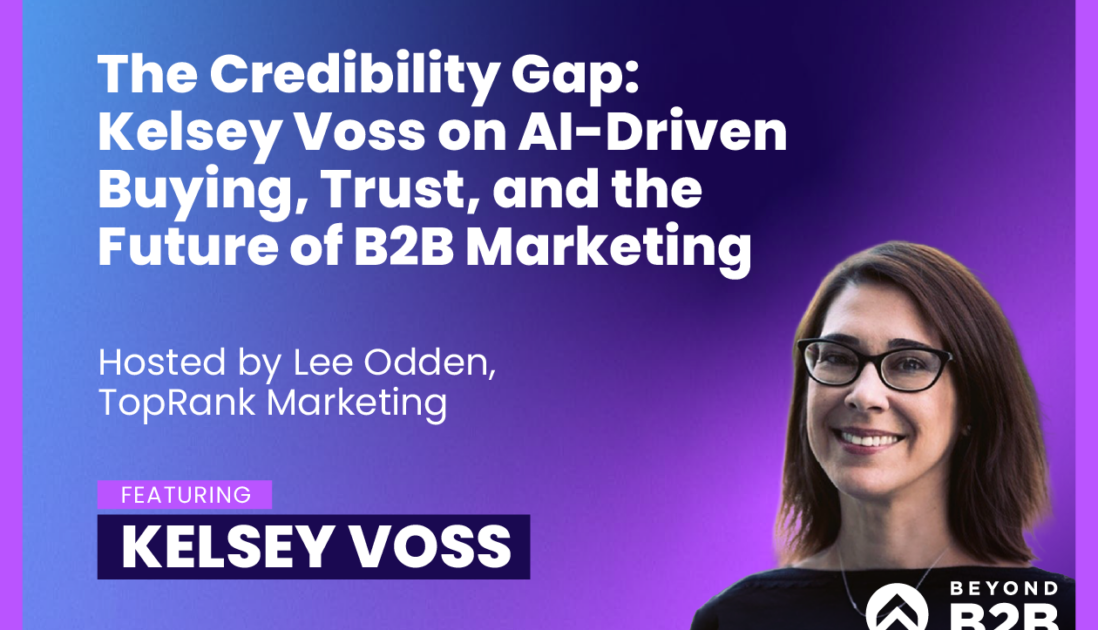
B2B marketing is experiencing a moment of compression. Buyers are moving faster, expectations for relevance are higher, and the margin for error in building trust is disappearing. At the same time, AI is accelerating access to information while increasing skepticism about its quality. The result is a more efficient, but more fragile, buyer journey where credibility is more important than ever.
In this episode of the Beyond B2B Marketing podcast, host Lee Odden sits down with Kelsey Voss, Principal Marketing Analyst at eMarketer to talk about how AI is changing buyer behavior, why trust is becoming the most valuable currency in B2B, and what marketing leaders need to do now to stay relevant in an increasingly fragmented discovery environment.
Drawing on more than two decades of experience leading B2B marketing teams, Kelsey brings a wealth of perspective to her research, one grounded in pipeline accountability, real-world execution, and a healthy skepticism of hype .
The conversation explores how AI is compressing the window that brands have to influence decisions, why buyers are rejecting low-value, AI-generated content, and how leading marketers are responding. From B2B influencer marketing as a trust mechanism to the growing importance of structured, credible content and strong data governance, Kelsey outlines what it takes to build meaningful visibility that converts into confidence and ultimately, action.
Listen to the full conversation with Lee and Kelsey Voss here:
10 most important B2B Marketing questions answered in this episode:
- Is AI actually making the B2B buying cycle faster?
No, it is “compressing the window” that brands have to influence the cycle rather than necessarily accelerating the entire process. - Why do buyers feel “AI fatigue”?
It is caused by “low-value output”-generic, repetitive content that lacks a distinct human point of view. - How has B2B influencer marketing changed recently?
It is no longer just a “nice-to-have” awareness tactic; it is now a structured part of performance marketing with dedicated, growing budgets. - What is the “crisis of credibility” in B2B?
Buyers are overwhelmed and skeptical, meaning visibility is useless if the information found cannot be trusted. - What should B2B brands do to be “visible” to AI search engines?
Focus on brand differentiation, structured data, credible authorship, and clear value propositions. - Does traditional SEO still matter in the age of AI?
Yes; AI-powered discovery (GEO) builds on great SEO tactics rather than replacing them. - Why is data governance considered a “front-end” problem now?
AI surfaces data directly to the buyer in real-time, making bad or inconsistent data a visible trust issue. - What is a “Human Checkpoint”?
A mandatory stage in the workflow where a person ensures AI-generated content is authentic and reflects the brand’s unique judgment. - How can marketers use AI strategically without eroding trust?
Use it to stay closer to customer conversations and pull insights that can be turned into content in the “customer’s own language”. - What differentiates a successful CMO in 2026?
The ability to move quickly and adapt in real-time without losing the human connection to the buyer.
You can also watch the full interview on YouTube:
Read the transcript of the conversation with Kelsey Voss here:
Lee: Hello and welcome to the Beyond B2B Marketing podcast. I’m your host, Lee Odden, CEO of TopRank Marketing. Today our guest is someone with deep B2B marketing experience. Having served in senior marketing leader roles at multiple B2B companies over the years, for the last four years, she’s been at eMarketer as a principal analyst where she leads B2B marketing analysis and research, as well as the eMarketer CMO series, Leading with Confidence. I’m talking about Kelsey Voss. Welcome to the show, Kelsey!
Kelsey: Thank you, it’s great to be here.
Lee: The first thing I want to ask you is a tradition on our show, and that is to ask you about your marketing origin story. How did you get into marketing in the first place?
Kelsey: It goes back to when I lived in New York. I was in New York theater starting in college and I was also a bartender. Neither of those professions generated much income.
To earn money not found in either of those fields, I took a part-time position as a sales and marketing associate for a B2B trade publication. I was there for about a year when one day the circulation manager of the magazine turned in his chair, looked at me and said, “Kelsey, you could be really good at this. Do you want my job?”. He was in fact leaving the company. I thought about it and was like, “I think I can, I’ve watched him for a year.”. Half flattered, half stunned, I started my marketing career in B2B magazine publishing as a circulation manager. The core of the job was to get qualified recipients to subscribe and renew their subscription. But it also meant connecting with subscribers around the world and making sure they were getting value from the publication.
I really appreciated the rigor of the BPA audit process. You had to have and prove every six months complete, accurate, qualified audience data. It reinforced for me how important data quality is and how that data quality was linked to the credibility of the publication.
Lee: I’m wondering with that breadth and depth of experience, are there certain learnings or things about that practical experience that have influenced the lens through which you’re doing the work you’re doing today?.
“I look at trends through a practical lens because I myself have been accountable for making marketing work, not just marketing, but making it work for sales, for the pipeline, and for revenue.”
Kelsey: It really influences everything that I do. I look at trends through a practical lens because I myself have been accountable for making marketing work, not just marketing, but making it work for sales, for the pipeline, and for revenue. I know how marketers think, and I know the pressures that they’re under.
When I look at a new technology or a shift in buyer behavior, I am asking what marketers need to understand right now? I tend to look at things through three lenses: What’s actually changing? What successful marketers are doing in practice? But also where leadership or marketers may be overreacting.
My background makes me very skeptical of hype. Vendors have come to me to try to sell me so many things and I have to see somehow that it’s going to be useful. A lot of things are compelling in theory, but the real question is: Will it work when teams have to integrate it, use it, and have the resources for it?. My favorite type of report that I do is called “How to Respond.”. These are the most useful for practitioners to know what to do next.
Lee: I’m sure there’s a lot of hunger for the signal out of all the hype and the noise. Is there anything more hyped than AI right now?. You have a report on the impact of AI accelerating buying cycles. I think it’s 43% of B2B buyers are using AI tools during the consideration phase. How exactly do you see AI changing this speed of buying cycle?
“AI is not necessarily accelerating the buying cycle; it’s compressing the window that brands have to influence that cycle.”
Kelsey: Since I wrote that report, there’s been a tad of confusion when I say AI is speeding things up. What I really mean is [AI] is not necessarily accelerating the buying cycle; it’s compressing the window that brands have to influence that cycle. It seems like it’s accelerating because there’s less time for marketers and a vendor to prove their worth because buyers are doing so much more of the evaluation and consideration on their own.By the time a vendor and sales get involved, their shortlist is already formed.
For example, a buyer looking at different marketing automation platforms may ask Claude or ChatGPT to compare vendors, get pricing, info on integration, and get use cases summarized instantly. If your brand’s value prop isn’t clear within that environment, you’ll be filtered out before you even know you were considered. You’re no longer competing for ranks and clicks; you’re competing to be quickly interpreted correctly.
Lee: When AI content is identified as AI content, there’s a bit of skepticism and it impacts whether there’s trust present or not. I’m wondering what your data tells us about how buyers are interacting and reacting to what some describe as a flood of AI generated content?
“The fatigue isn’t about AI per se; it’s about low-value output.”
Kelsey: Buyers are getting faster access to more information, but they are also definitely more sensitive to anything that feels generic or repetitive. The fatigue isn’t about AI per se; it’s about low-value output. Buyers aren’t necessarily rejecting AI; they are going directly to AI to look for things. They’re rejecting content that feels like no one’s actually thought about it, that it’s just this generic information they could find anywhere. That’s why credibility, clarity, and a real point of view are carrying more weight and can build more trust.
Lee: How would you say the most successful B2B marketing leaders that you talk to are creating credibility for their brands?.
“CMOs that are really creating credibility are focused on consistency of their messaging and connections along the buyer journey.”
Kelsey: The CMOs that are really creating this credibility are really focused on consistency of their messaging and those connections along the buyer journey. Credibility breaks when marketing messaging does not match what buyers actually experience or find before they get to that marketing messaging.
Marketing will set up initial expectations about a product or service, and if those expectations don’t hold up and stay consistent throughout their journey, that trust erodes before the relationship can be solidified.Successful CMOs make sure that what shows up in marketing content aligns with what product is saying, what sales is saying, and then what the customer experience is like. The most credible CMOs aren’t the loudest; they are the ones who are the strongest integrators across buyer touchpoints.
Lee: I want to ask you about influence because one of the reports that you’ve done talks about how CMOs are using influencer marketing to build trust. What is it that stands out to you when it comes to influence and how B2B brands can best capitalize on it?.
Kelsey: What definitely stands out is your research with Ascend2 and the data saying that 81% of B2B marketers now have dedicated influencer budgets. This has become a core part of marketing.
“Influencer content often performs really well because it brings that outside credibility into the conversation. Influencer marketing is no longer being treated as a ‘nice to have.'”
A big part of what drives that is trust. Decision-makers trust experts more than they trust brand messaging. Influencer content often performs really well because it brings that outside credibility into the conversation. Influencer marketing is no longer being treated as a “nice to have.” It’s increasingly being used as a structured way to build confidence in a brand. As long as influencers can be seen as a part of performance marketing and not just brand awareness, that’s a big step in validating long-term relationships with these influencers.
Lee: I’m wondering about your advice for B2B marketers that are trying to balance the efficiency gains of AI tools and the need for authenticity and human expertise that’s required to genuinely build trust?.
“Humans still own judgment and positioning and anything that affects trust. That human checkpoint is non-negotiable.”
Kelsey: It’s a balance and it’s not an either-or. The best teams that I see are really strategically deciding where AI is doing the work and where human expertise belongs in that process. AI can handle the scale, the speed, the drafting, and the analysis. But humans still own judgment and positioning and anything that affects trust. That human checkpoint is non-negotiable.
Someone still has to decide if that content being put out there actually says something authentic and reflects the brand. Creativity becomes even more important. Differentiation comes from creativity, but also fresh ideas and innovative perspectives, the things that AI cannot reliably replicate.
Lee: What does a brand need to do to make sure they are recognized in this AI discovery environment?.
Kelsey: First is brand differentiation; that has to be clear and immediately apparent.
Secondly, the fundamentals really still matter. GEO builds on great SEO tactics; it does not replace it. Structure, clear answers, and credible authorship make content easier for systems to extract information and reuse that. It’s no longer about ranking first; it’s about being the most usable for a system to pull and put in the output.
Third is consistency. If what AI surfaces doesn’t match what buyers find on your site or hear from sales, it creates that friction at exactly the wrong moment.
Lee: You listed data governance as a defining factor for 2026. Why is data as a foundation so much more important now?.
Kelsey: Data governance in with AI amplifies how important that is. In the past, bad data might show up mainly in mistargeting or messy reporting. Now it shows up much more directly to the buyer and their experience. AI is using the data you have to generate content, shape messaging, and inform decisions many times in real-time. If the inputs are off, the output is visibly wrong, visibly inconsistent, and it’s really hard to trust.
Data governance has shifted from a back-end issue to a front-end and front-of-buyer issue. If that foundation isn’t there, that weak foundation is a glaring trust problem and it is a deal-breaker.
Lee: How do you think marketing leaders should be thinking or rethinking how they’re looking at marketing through the rest of this year into next year?.
Kelsey: Based on what I hear the successful CMOs saying, it is just have a little more fun. The CMOs that are really thinking about this in the right way know they need to move quickly and adapt in real-time without losing that human connection to the customer.
“The risk, especially with AI, is that if they just optimize for output, they’re missing the piece on relevance, and that will erode trust.”
The risk, especially with AI, is that if they just optimize for output, they’re missing the piece on relevance, and that will erode trust. The CMOs gaining ground are using AI strategically with an eye for these connections. They can use AI to stay closer to what buyers and customers are actually saying or pull insights from conversations. But the teams that maybe aren’t doing so well are probably chasing efficiency with AI at the expense of that customer relationship.
Lee: If you could be working in any other field besides what you do today, what would it be?.
Kelsey: I most likely would go back to the arts. I love theater and there’s just something electric about live performances in front of a live audience. I like helping marketers establish and maintain real relationships with their audience, listening to their feedback, and delighting them with something that can make their lives a little better or a little easier.
Lee: This has been great, Kelsey. Where is the best place for people to connect with you?.
Kelsey: I think any B2B person will tell you it’s LinkedIn. LinkedIn is the best place to connect with me, to follow what I do, and that’s where I share my thinking and my research around B2B marketing and CMO leadership.
Lee: I want to thank you for tuning into the Beyond B2B Marketing Podcast. Make sure you subscribe so you can stay tuned for our next guest. And remember, there’s no better time than now to break free of boring B2B.

Be sure to like and subscribe to the Beyond B2B Marketing podcast on your preferred podcast platform. Reviews are great too!