

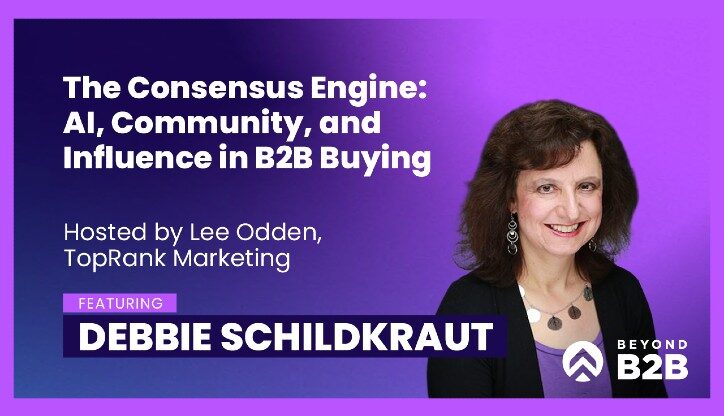
B2B marketing is no longer a linear journey. Buyers are navigating a fragmented landscape of AI-driven discovery, peer validation, and self-directed research across numerous channels. As buying groups grow and decisions become harder to justify, the challenge for B2B marketers is shifting from simply being visible to building trust, consensus, and confidence over time.
In this episode of the Beyond B2B Marketing podcast, host Lee Odden talks with Debbie Kestin Schildkraut, VP, Global B2B Program Lead and CMO Global Growth Council at the Association of National Advertisers, to explore how leading CMOs and marketing executives are navigating this new reality. From AI adoption and governance to the rise of community, influence, and experiential engagement, Debbie shares a front-row perspective on the priorities that are evolving B2B marketing today.
With more than two decades of experience spanning global leadership roles at IBM and industry-wide initiatives at ANA, Debbie brings a unique combination of strategic insight and practical execution. Her career has been defined by building ecosystems, connecting partners, communities, and emerging technologies to drive growth and innovation at scale.
Their conversation explores how AI is transforming content and insight generation, why consensus within buying groups has become the new battleground, and how marketers can use community, data, and influencer collaboration to build credibility. From experiential marketing that creates lasting impact to the evolving role of brand in driving business value, Debbie outlines what it takes to lead in a B2B environment where trust is earned both collectively and continuously.
Listen to the full conversation with Debbie here:
Watch the full interview between Debbie and Lee on YouTube:
10 most important B2B Marketing questions answered in this episode:
1. How is AI changing the role of B2B marketing today?
AI is transforming content, insights, and operations, but its real impact depends on governance, human oversight, and reinvestment in capabilities.
2. What is the biggest challenge CMOs face with AI right now?
The primary challenge is not adoption, but determining ownership, governance, and how to scale AI effectively across the organization.
3. How has buyer discovery changed in B2B marketing?
Discovery is now fragmented and networked, driven by AI, peer validation, and self-directed research across multiple channels.
4. Why are traditional funnel-based strategies becoming less effective?
Because buyers no longer follow linear journeys and instead rely on ongoing, multi-channel validation over extended periods.
5. How should marketers adapt to larger, more complex buying groups?
They must shift from targeting individuals to enabling group consensus through trust, relevance, and continuous engagement.
6. What role does trust play in modern B2B decision-making?
Trust is the central currency that enables buyers to feel confident in decisions and defend them internally.
7. How can B2B brands build trust and credibility at scale?
By combining data, customer validation, influencer voices, and consistent engagement across channels and communities.
8. What skills do modern B2B marketing teams need most?
AI fluency, data literacy, storytelling, and the ability to translate insights into meaningful, human-centered narratives.
9. Why are community and peer networks becoming more important?
Because peer influence and shared experiences often carry more weight than brand messaging in validating decisions.
10. How do influencer and creator strategies drive B2B marketing success?
They amplify credibility by delivering trusted, relevant perspectives that resonate more authentically than brand-led communication.
Read the transcript of the conversation with Debbie here:
Lee:
Hello and welcome to the Beyond B2B Marketing podcast. I’m your host, Lee Odden, CEO of TopRank Marketing. And today our guest is a force of nature in the B2B marketing world. Beyond her 26 years in marketing leadership roles at IBM, she’s a community builder, a board member, an advocate, and according to LinkedIn, also a cabaret singer.
For the past few years, she’s worked at the ANA, the Association of National Advertisers, where she was recently promoted to VP Global B2B Program Lead and CMO Global Growth Council. Of course, I’m talking about Debbie Kestin Schildkraut. Welcome to the show, Debbie.
Debbie:
Thank you, Lee. So excited to be here.
Lee:
Great, it’s great to have you. What an intro, right? And it doesn’t even scratch the surface of the depth and breadth of your experience in the industry and the things that you’re making happen. So I’m really excited to have you on the show.
Let’s kick things off with one of my favorite questions. Way back in the beginning, what is your marketing origin story? How did you get into B2B marketing in the first place?
Debbie:
Yeah, it’s an interesting journey. I originally was going to study music therapy, being a musician. You already revealed that I’m a cabaret singer. My parents, of course, wanted me to do something more practical where I would earn money and have a consistent income and really encouraged me to have a business degree.
They were pushing me toward accounting, which I could do but found terribly boring-sorry, accountants, we need you. I was talking to a classmate who was a year older than me, and she was a marketing student. She said, if you are really into people and wanted to do music therapy to help others, marketing is really understanding people. So I took all the core requirements, got into the business school, and ended up double majoring in music and marketing. Not a lot of overlap, but I had some really fun internships at places like MTV.
I got involved in the American Marketing Association chapter, became vice president, and was part of a pre-MBA honors program where we built a business plan. My first jobs were on the agency side in New York City, working on brands like SAP, IBM, and Sony. That led me to IBM, where I worked both B2C and B2B before the PC division was sold and I focused fully on B2B.
Lee:
Wow, fantastic. We’ve talked before, and you described yourself as an intra-preneur. Can you drill down into what that means in your experience?
Debbie:
Yeah. It’s interesting because I didn’t really think about it that way for a long time. But a few years ago, I realized that even though I worked at IBM for so long, it was a very atypical experience. Almost every role I had, except one, was newly created. I realized that what I was doing was operating in unstructured environments, understanding pain points, asking questions, and bringing people together to solve problems.
“Ultimately, it’s about being a change agent, a problem solver, and a community builder.”
For example, in channel marketing, IBM sold direct but also had partners selling to customers, and there was conflict. I worked on addressing that, building trust, and creating programs to align everyone. That led to launching innovation centers globally, building distributor communities, and creating programs to support partners. Ultimately, it’s about being a change agent, a problem solver, and a community builder.
Lee:
If there was ever a time for change agents, it’s now. How do you think those skills are important for people in the middle of their careers today?
“We get caught up in how things are done and don’t always step back to ask if there’s a better way. Being curious and asking questions is critical.”
Debbie:
I absolutely think they are. We get caught up in how things are done and don’t always step back to ask if there’s a better way. Being curious and asking questions is critical. People are often afraid of looking foolish, but that’s a barrier. If you see something that can be improved, bring it forward. Propose ideas, test them, start small, and scale. That’s how many of my programs grew.
Lee:
There’s a lot of change happening right now, especially with AI. In your role with the CMO Global Growth Council, what are some of the top challenges CMOs are dealing with?
“The challenge isn’t whether to use AI, it’s how to govern it and implement it.”
Debbie:
AI is front and center in almost every conversation. The challenge isn’t whether to use AI, it’s how to govern it and implement it. AI touches every part of marketing. Companies are figuring out whether to start small or scale across the organization. There’s also a confidence gap.
We’re seeing a mix. Some companies are experimenting, others are diving in deeply. We’re also partnering with organizations like PwC and Infosys to research this space. AI is transforming content lifecycle management and insight generation. But there’s also a need to reinvest savings into creative quality, governance, and team capabilities.
Lee:
There’s definitely a need for orchestration. Discovery is also more fragmented now. What are the impacts of that fragmentation?
“Marketers need to play the long game and build trust over time across multiple channels.”
Debbie:
Traditionally, marketers approached audiences in a linear way. That’s no longer the case. Discovery is networked. People talk to peers, engage in communities, and validate information socially. Companies that struggle are still targeting individual buyers with rational proof points. They need to think about the full buying group and the emotional component. Buyers are doing a lot of self-discovery online, and only a small percentage are ready to buy at any moment. So marketers need to play the long game and build trust over time across multiple channels.
Lee:
How are marketing leaders helping buyers feel confident and build consensus?
Debbie:
It’s a combination of things. You need to look at the full influential team, not just individuals. It’s about understanding personas deeply, maintaining engagement across the journey, and building trust through peer opportunities.
Influencers, partners, and peer networks all play a role. There are aligned values, proven trust, and expertise that help buyers feel confident.
Lee:
What skills should CMOs be prioritizing right now?
“Soft skills matter too – understanding cultural influence, storytelling, and translating data into narratives.”
Debbie:
AI fluency is critical. Data fluency is also important. But soft skills matter too – understanding cultural influence, storytelling, and translating data into narratives. We’re also seeing organizational changes, like bringing IT talent into marketing to support AI and data initiatives.
Lee:
You’ve built communities throughout your career. Why are they so important?
“Community is incredibly powerful.”
Debbie:
Community is incredibly powerful. It brings people together around shared challenges and creates opportunities for learning and influence. Peer influence often carries more weight than brand messaging. Communities provide shared experiences, meaningful conversations, and real-time insights.
Lee:
We’ve found that 93% of marketers say original research is effective, but fewer invest in it consistently. How should data and insights differentiate brands?
Debbie:
Research is critical, but it has to be done right. You need to ask the right questions and gather both qualitative and quantitative insights. Synthetic research is valuable, but it shouldn’t stand alone. You need real human input and ongoing validation to refine your positioning.
Lee:
What role do experiences play in B2B marketing?
“Whether it’s live events or interactive elements, experiential marketing helps differentiate and engage audiences.”
Debbie:
Experiences are memorable and impactful. People remember what they experience. Whether it’s live events or interactive elements, experiential marketing helps differentiate and engage audiences.
Lee:
Your influencer marketing report highlights credibility. What’s unique about influencer and creator collaborations?
“Authenticity is key. It starts with trust, then credibility through validation, then relevance.”
Debbie:
You need alignment first. Values and mission have to match. There are many types of influencers: SMEs, customers, employees. Authenticity is key. It starts with trust, then credibility through validation, then relevance. Only then can you amplify effectively.
Lee:
As we wrap up, how are CMOs improving measurement and proving marketing’s contribution?
Debbie:
They’re focusing on aligning with business metrics and speaking the language of the C-suite. There’s a growing focus on brand valuation and connecting marketing to financial impact.
Lee:
Final question: what would your dream job be if not this?
Debbie:
Something in social impact, bringing people together to solve meaningful problems like sustainability or economic empowerment. Using partnerships and marketing to create impact at scale is what energizes me most.
Lee:
That’s powerful. Debbie, thank you so much for sharing your insights.
Debbie:
Thank you so much for having me. It’s always fun to talk to you.
Lee:
Thank you for tuning into the Beyond B2B Marketing podcast. Be sure to subscribe so you can stay tuned for our next guest. And remember, there’s no better time than now, to become a best answer brand.

Be sure to like and subscribe to the Beyond B2B Marketing podcast on your preferred podcast platform. Reviews are great too!