

According to recent research from McKinsey, 71% of consumers now expect personalized interactions from brands and 76% become frustrated when those experiences fail to happen. At the same time, B2B buyer journeys are increasingly fragmented and driven by AI in a time where relevance, timing, and trust matter more than ever.
These changes are driving B2B marketers to evaluate what actually powers meaningful personalization, trusted experiences, and effective AI-driven marketing? The answer is not more AI tools or more content. It is customer context.
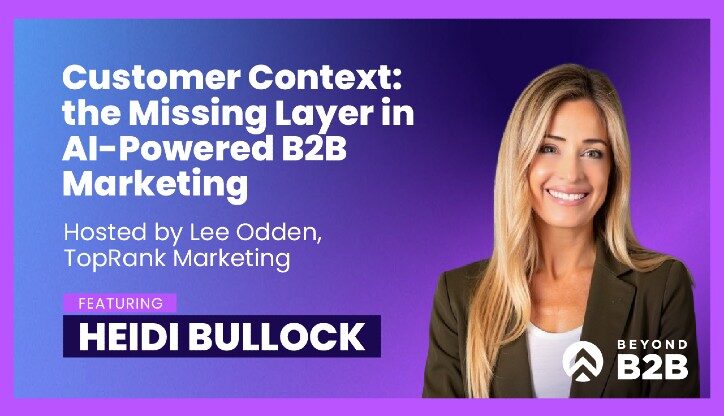
In this episode of Beyond B2B Marketing, host Lee Odden, CEO of TopRank Marketing, speaks with Heidi Bullock, Chief Marketing Officer at Tealium about why customer context is the missing layer in AI-powered B2B marketing and how real-time data, behavioral signals, and shared customer intelligence are reshaping personalization, ABM, and buyer experiences. This interview covers the intersection of AI, customer data platforms, trust, sales and marketing alignment, and Best Answer Marketing in a world of fragmented discovery and increasingly AI-mediated buying journeys.
The conversation strongly aligns with TopRank Marketing’s Best Answer Marketing framework, especially the role of data-informed strategy in helping brands become the most trusted and discoverable answer wherever buyers search, ask, and evaluate solutions. As Heidi says during the interview, customer context is now “critical and essential” not only for buyers, but for AI systems that drive visibility, relevance, and decision confidence for B2B brands.
Listen to the full conversation with Lee and Heidi Bullock here:
10 most important B2B Marketing questions answered in this episode:
Why is customer context becoming a competitive advantage in AI-powered B2B marketing?
Customer context gives AI systems the real-time behavioral and intent data needed to create relevant, trusted, and differentiated buyer experiences instead of generic outputs.
What role does real-time customer data play in modern B2B marketing?
Real-time customer data helps marketers respond to current buyer behavior and signals, making personalization, orchestration, and engagement far more accurate and effective.
Why are many B2B companies struggling with AI implementation?
Many organizations are adopting AI tools before building a strong customer data foundation, resulting in siloed systems, poor data quality, and disconnected experiences.
How has personalization evolved in B2B marketing?
Personalization has shifted from static, rules-based workflows to AI-driven orchestration powered by real-time behavioral signals and contextual customer intelligence.
What is the biggest misconception about customer data platforms (CDPs)?
Many marketers still think CDPs are only marketing tools when they actually provide critical customer intelligence across marketing, sales, customer success, product, and operations.
How can B2B brands improve AI search visibility and discoverability?
Brands need to understand where buyers seek information across AI tools, communities, YouTube, review platforms, Reddit, and search, then create credible, context-rich content experiences in those channels.
Why is consented first-party data so important in AI-driven marketing?
Consented data builds trust, improves targeting accuracy, reduces legal risk, and ensures AI systems are operating with reliable and permission-based customer information.
How should sales and marketing alignment evolve in the AI era?
Sales, marketing, customer success, and RevOps need shared visibility into customer signals and behavioral data so they can coordinate faster and reduce friction across the buyer journey.
What role does human judgment still play in AI-powered marketing?
AI can improve speed and efficiency, but human expertise is still essential for strategy, creativity, governance, differentiation, and validating output quality.
What foundational capabilities do modern CMOs need to build now?
CMOs need strong customer data infrastructure, AI-curious and adaptable teams, cross-functional revenue alignment, and the ability to move quickly in rapidly changing markets.
You can also watch the full interview about customer context on YouTube:
Read the transcript of the conversation with Heidi here:
Lee: Hello and welcome to the Beyond B2B Marketing podcast. I’m your host, Lee Odden, CEO of TopRank Marketing. Today our guest is someone who has worked in the B2B marketing space for nearly 25 years, having served in VP and CMO roles at Marketo and Engagio. She was recently named to the B2B CMO 100 list by the new B2B CMO Project, co-led by our previous guest, John Miller.
Today, she is Chief Marketing Officer at real-time customer data platform Tealium. Of course, I’m talking about Heidi Bullock. Welcome to the show, Heidi!
Heidi: Thanks for having me, Lee. This will be a lot of fun.
Lee: I agree. The theme of this episode is all about customer context, but let’s kick things off with your B2B marketing origin story. How did you first get into marketing?
Heidi: It’s a really interesting journey. A lot of people don’t know this, but I actually started in research, specifically molecular biology, so very much on the product and development side of things.
Something that really crossed teams was people saying, “You have a way of explaining things that makes sense and you don’t use too much technical jargon. You make people understand the value.” That led me into product marketing and eventually broader marketing roles, especially on the B2B side.
What was interesting to me was the importance of translating information in a way people understand. That’s something I’ve always tried to do, and it’s really what moved me from more of a product role into marketing.
Lee: The translation capability is super important. It requires empathy and a real understanding of what buyers need to know. There’s usually a difference between how a brand thinks about something and how buyers think about it.
For many years, B2B marketers optimized around channels, campaigns, and content. Do you think customer context has become more of a competitive advantage when it comes to AI discovery and AI-powered marketing?
“AI tools and models are becoming commoditized. The thing that’s unique and powerful is the context.”
Heidi: I definitely think it has. Historically, B2B marketers thought a lot about channels. Now we’re shifting toward thinking about the customer first. Customers don’t think in channels. They just go about their day.
What I’m seeing is that AI tools and models are becoming commoditized. The thing that’s unique and powerful is the context. That’s where companies should spend their time and energy.
We see new models constantly entering the market. You might prefer one model today and another tomorrow, but the context you put into those models is what’s unique and what companies need to focus on.
Lee: That’s so true. Everyone is rushing to implement AI tools right now. Do you think most organizations actually have the maturity they need around customer data to make AI useful, not just from an efficiency standpoint, but from an impact standpoint?
“In B2B….there’s still a lot of siloed data, data quality issues, identity problems, consent challenges, and difficulty collecting signals across systems into a unified view.”
Heidi: I think some companies are ahead and doing it really well. In retail and B2C, for example, many organizations are more advanced with their customer data foundations. They’re thinking carefully about how they collect data, from point-of-sale systems to behavioral data, and creating a single view of the customer.
B2B companies in some cases are ahead with AI adoption because there may be fewer legal concerns, but their data foundations are often weaker. There’s still a lot of siloed data, data quality issues, identity problems, consent challenges, and difficulty collecting signals across systems into a unified view. I see many companies jumping to AI tools before thinking about the data. In B2B, even the concept of building a data foundation is new for many organizations.
Lee: Can you give us a high-level overview of what Tealium does and how it relates to customer context and identity?
“You can have the best tools and the best MarTech stack, but if your data is inaccurate, broken, or not consented, you can’t create effective experiences.”
Heidi: Historically, we’ve thought of Tealium as a data supply chain. We help companies collect data in real time and with consent. That could include behavioral data from websites or mobile devices, point-of-sale data, IoT data, and more. Then we make sure the data is consented, structured, organized, and unified.
For example, someone might have multiple email addresses. We bring all of that together with the proper context so it can be activated in real time. We integrate with platforms like Braze and Marketo to ensure the data is accurate and actionable. We also work closely with data cloud providers like Snowflake and Databricks to make sure data remains fresh and up to date.
The reality is you can have the best tools and the best MarTech stack, but if your data is inaccurate, broken, or not consented, you can’t create effective experiences.
Lee: You’ve said that AI without context produces generic experiences. What kinds of customer insights or context stand out as the biggest opportunities for B2B marketers right now?
“The real unlock (for B2B marketers) is having real-time signals that reduce guesswork.”
Heidi: For B2B marketers, real-time behavior is incredibly important. The ability to use real-time website behavior, zero-party and first-party data, understanding someone’s role and buying group, consent, intent, and where someone is in their journey are all critical.
Historically, RevOps and marketing operations teams tried to architect these experiences manually. The real unlock now is having real-time signals that reduce guesswork.
Lee: You’ve worked with some major brands and platforms over the years. How has personalization changed since the early marketing automation days?
“With AI and real-time data, marketers can finally create the kind of personalized experiences they always envisioned.”
Heidi: Historically, personalization was very aspirational. People thought using a first name or serving financial services content to someone in that industry counted as personalization. It was very rules-based and dependent on smart marketing operations people manually architecting workflows.
The biggest change now is real-time data. Instead of guessing, we can use actual behavioral signals to create orchestrated experiences that make sense for individual buyers. With AI and real-time data, marketers can finally create the kind of personalized experiences they always envisioned.
There’s no single buyer journey anymore. One person may need extensive information before making a decision, while another only needs one piece of information because they already know your product. AI tools now allow us to generate highly relevant messaging and content in the moment based on real-time signals, and it performs dramatically better.
Lee: As personalization becomes more sophisticated, it seems buyer expectations are rising too.
“If you don’t create relevant experiences, you’ll simply lose people because everything is moving faster and patience is lower.”
Heidi: Absolutely. Buyers are people, and they compare B2B experiences to consumer experiences. If someone is used to Amazon delivering highly personalized experiences and same-day delivery, the expectation bar becomes very high.
What’s exciting is that these capabilities are achievable in B2B now. The tools and technology exist. Marketers just need curiosity and a willingness to experiment. If you don’t create relevant experiences, you’ll simply lose people because everything is moving faster and patience is lower.
Lee: At TopRank Marketing, we’ve built a framework called Best Answer Marketing focused on helping brands become the most trusted and discoverable answer wherever buyers are searching or asking questions. How important is customer context in creating experiences that both humans and AI systems see as relevant?
“The more relevant and timely the experience is, the more trust you create.”
Heidi: Critical and essential. Customer context enables AI systems to produce relevant, timely, and specific answers. It also helps buyers feel understood, which builds trust and preference. The more relevant and timely the experience is, the more trust you create.
Lee: Search and discovery have become incredibly fragmented. Buyers move between AI tools, search engines, industry communities, YouTube, Reddit, podcasts, and more. How should marketers rethink customer insights in this environment?
“We use tools like Profound along with GA4 to help understand visibility and engagement, but not every signal is easy to track.”
Heidi: This is one of the most important and difficult challenges. The first step is identifying where your buyer communities actually exist. That could be events like Dreamforce, YouTube channels, Reddit, review sites, communities, or content syndication channels. The second step is making sure you’re present in those conversations in a thoughtful way. The third challenge is measurement. You need to understand whether you’re showing up credibly and effectively across these channels.
We use tools like Profound along with GA4 to help understand visibility and engagement, but not every signal is easy to track.
Lee: Many ABM programs still focus on static account targeting. It seems like the future is more about orchestrating evolving customer signals in real time.
“There’s no single perfect buyer journey…the goal is understanding those signals in real time so programs can adapt accordingly.”
Heidi: I completely agree. There’s no single perfect buyer journey. Even within the same account, individual buyers behave differently and require different experiences. The goal is understanding those signals in real time so programs can adapt accordingly.
One customer shared data showing that 15 seconds of real-time behavioral data was more valuable than much larger sets of historical data. Historical data still matters, but combining it with real-time signals is critical.
Lee: Our research consistently shows that trust, expertise, and credibility are becoming more important in B2B buying decisions, especially in AI-driven environments. How does customer context contribute to building trust throughout the buying journey?
“Customer context helps reduce friction and creates experiences people expect”
Heidi: Context is fundamentally about knowing your buyer. If I buy a pair of shoes and the site recommends matching shorts in real time, that creates a useful, relevant experience.
If I buy the shorts and continue getting ads for them afterward, that creates friction and wastes marketing spend. Customer context helps reduce friction and creates experiences people expect. It also matters for consent preferences. If someone opts out of text messages and your systems fail to update quickly, that damages trust.
Lee: Sales and marketing alignment has always been important in B2B. How should that evolve as AI systems play a larger role in discovery and evaluation?
Heidi: Alignment becomes even more important. The key is having a shared set of customer signals and data across marketing, sales, SDRs, customer success, and RevOps. Organizations struggle when teams operate from different views of the customer.
At Tealium, we’ve built unified signal dashboards so everyone sees the same information in one place. That reduces friction and helps teams move faster.
Lee: We’re hearing more marketers talk about AI agents, autonomous workflows, and machine-led customer interactions. What role does human judgment still play in B2B marketing?
“AI is incredibly powerful, but people still need to guide strategy, define guardrails, and ensure quality.”
Heidi: AI is incredibly powerful, but people still need to guide strategy, define guardrails, and ensure quality. AI is only as good as your thought process and prompts.
You also need humans to maintain brand stewardship, differentiation, creativity, and expertise. AI helps scale work and improve efficiency, but people still need to be in the loop.
Lee: What do marketers misunderstand most about customer data platforms?
“Customer data platforms help the entire organization because they provide the real-time, consented, enriched customer data needed for marketing, sales, customer success, product insights, and operations.”
Heidi: One of the biggest misconceptions is thinking of a CDP as only a marketing tool. In reality, customer data platforms help the entire organization because they provide the real-time, consented, enriched customer data needed for marketing, sales, customer success, product insights, and operations. Organizations with strong data foundations move much faster because they understand their customers better.
Lee: If you were advising a new CMO today, what foundational capabilities would you prioritize?
Heidi: First, get your data infrastructure right. Without clean, consented, fresh data, nothing else works effectively.
Second, build curious and adaptable teams. Everyone needs to be willing to learn and experiment with new AI tools.
Third, create strong alignment across revenue teams by sharing data, systems, and customer signals.
Finally, prioritize speed. Perfection is often the enemy in modern marketing environments.
Lee: Fantastic advice. Heidi, this has been a masterclass on customer context. Thanks so much for joining us!
Heidi: Thanks, Lee. This was great.
Lee: Thanks everyone for tuning into the Beyond B2B Marketing podcast. Be sure to subscribe, and remember: there’s no better time than now to become a Best Answer Brand.
Find Heidi Bullock on LinkedIn
Get more information about Tealium

Be sure to like and subscribe to the Beyond B2B Marketing podcast on your preferred podcast platform. Reviews are great too!