

TopRank Marketing’s B2B Influencer Marketing research found that 64% of B2B marketers say unique content is one of the biggest differentiators in successful influencer programs, while 61% point to creative campaigns specifically. In a space that is increasingly flooded with AI-generated content and similar messaging, creativity is no longer a nice-to-have. It’s a competitive advantage.
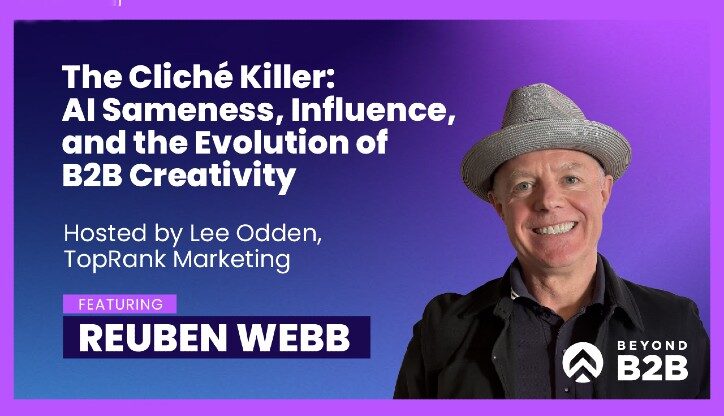
In this episode of Beyond B2B Marketing, host Lee Odden, CEO of TopRank Marketing, speaks with Reuben Webb, B2B Editorial Lead at The Drum. and former Chief Creative Officer at Stein IAS, to explore the evolution of B2B creativity and why originality matters more than ever in the age of AI.
Listen to the full conversation with Lee and Reuben Webb here:
Drawing on more than 25 years of experience helping shape creative thinking in B2B marketing, Reuben shares his perspective on the industry’s ongoing battle against “boring-to-boring” marketing, the lessons marketers can still learn from his influential book 101 Clichés, and why creativity remains one of the most powerful drivers of brand growth, demand generation, and differentiation.
Their conversation explores how AI is changing the economics of content creation, why originality and strategic thinking are becoming increasingly valuable, and how brands can avoid a race to the middle as automation becomes more common. Lee and Reuben also discuss the growing importance of influencers, creators, trusted experts, and authentic human voices, along with the role they play in building trust and creating memorable marketing experiences.
From brand versus demand and the future of B2B influence to regional differences in creativity across the US, UK, and Europe, this episode offers practical insights for marketers looking to create work that stands out, earns attention, and delivers results. Because in a world where average content is becoming easier to create, creativity may be the ultimate differentiator.
10 most important B2B Marketing questions answered in this episode:
1. Why does creativity matter more than ever in B2B marketing?
As AI makes average content easier to produce, originality becomes one of the few sustainable ways to stand out.
2. Has B2B marketing overcome its “boring-to-boring” reputation?
Progress has been made, but many brands still rely on safe, repetitive approaches that fail to earn attention.
3. What role does creativity play in the brand versus demand generation debate?
Strong creative ideas can connect brand and demand efforts by creating a consistent narrative across the entire buyer journey.
4. How is AI changing the value of human creativity?
AI increases the value of human creativity by automating execution while making original ideas more important.
5. Are marketers at risk of creating a sea of sameness with AI?
The greater risk is continuing the industry’s long-standing tendency toward average marketing rather than the technology itself.
6. What is one of the biggest marketing shifts happening right now?
The transition from search-driven discovery to AI-powered answer engines is forcing marketers to rethink visibility and measurement.
7. Why are trust and authenticity becoming more important in B2B?
As AI-generated content proliferates, buyers increasingly rely on credible human voices and expert perspectives.
8. What makes B2B influencer marketing effective?
The most successful programs allow creators and experts to contribute their own authentic perspectives rather than repeating brand talking points.
9. How do B2B creativity approaches differ around the world?
European campaigns tend to be visually led, American campaigns are often driven by exceptional copywriting, and British campaigns frequently lean into humor.
10. What advice would Reuben give to the next generation of B2B marketers?
Develop strategic thinking skills and become fluent with AI tools while focusing on the uniquely human ability to create original ideas.
You can watch the full interview about creativity in B2B marketing on YouTube:
Read the transcript of the conversation with Lee and Reuben here:
Lee: You’ve had an impressive career in B2B marketing over the last 25 years, including your time at Stein IAS. I’d love to start at the beginning, and this is something I like to ask everyone who comes on the show. What’s your B2B marketing origin story? How did you get into marketing in the first place?
Reuben: Like all the best stories, it’s about a girl. I met this lovely girl at university, we went traveling the world together, and when we got back, her dad, a guy named Tim Hazelhurst, wanted us to settle down. She was far too proud to take a job at her father’s company, but I wasn’t. He offered me a job there as a junior copywriter. What I had was an English literature degree, and that kind of qualified me. I’ve spoken to a lot of people since, and that kind of qualified them to get into copywriting as well.
He was running an agency called IAS in Macclesfield, and here’s an interesting bit of B2B history: IAS stands for Industrial Art Services. That was Tim’s articulation of B2B marketing before the term B2B marketing had even been invented. He started that agency in 1973, the year I was born, and I started working there as a junior copywriter in the year 2000.
So it was an accident. It was a very generous act from an absolute B2B marketing legend, Tim Hazelhurst. He’s got an incredible pedigree, and he taught me many of the things I still espouse today.
Lee: That’s a great story. Now fast forward to today, and you’re B2B Editorial Lead at The Drum. Could you share a little about the publication, your current role, and how you made the decision to go from the agency side, where you were quite successful, over to editorial?
Reuben: The Drum is a media platform that has always covered marketing, and it’s still a family run company to this day. They started off as a small startup in Scotland, part of the Scottish advertising universe, which is small, everybody knows each other, and it’s great fun.
The success of The Drum is due to their, for want of a better word, slightly punky attitude to journalism and media. They’ve built a really good reputation as people who are happy to say yes to ideas that others might not. That’s what drew me to it. I’m preparing a presentation for the company right now, and I’m going to tell them the reason I joined is because they have always, across their history, let B2B be what it wants to be.
We’re investing heavily in our B2B offering now, taking it up a level, and I’m getting loads of good pitches from people who want to be in The Drum. People come to us because they know they can say things they traditionally couldn’t elsewhere in B2B, given other editorial approaches and attitudes to creativity.
Lee: I want to ask an industry-level question. B2B marketing has spent years fighting this boring-to-boring stereotype. You recognized early in your career that B2B was a much bigger creative opportunity than many people did. From your perspective, what creative principles or concepts in B2B marketing have you found to be timeless?
Reuben: When I started, I didn’t know what B2B marketing was. I didn’t really appreciate what B2C marketing was either. I was a literature student who’d just arrived from traveling in Asia for years, thinking, what is all this stuff?
But as I started to appreciate how B2B was different from consumer marketing, the reason I stayed is the principle that it’s all about the fabric of society. I liked exploring that, stitching together all the things that make up a civilized world: the bricks, the cables, the roads, the technology, the waterways. I felt like I was part of something noble and making a positive contribution.
I felt it especially as I realized I’m being advertised at all the time, and some of that advertising I don’t agree with. I don’t want to get up in the morning and sell sugary cereals to young people. There’s so much gambling advertising in the UK, and I don’t want to sell gambling to people who might develop a problem. I’m not saying it’s holier than thou, because every B2C company has a B2B angle. But I felt enough distance from things I didn’t want to be involved with, and I felt proud to be a B2B marketer.
Lee: We should talk about your book. In 2008 you published *101 Clichés*, which called out the industry’s safe and repetitive habits. How much progress do you think B2B marketing has really made creatively in that time, especially in the context of AI?
Reuben: I grabbed the copy off my shelf because I knew you’d ask. It’s 101 B2B marketing clichés. Number one is the light bulb, which stands for an idea, and you still see that in every PowerPoint presentation around the world. It goes on to the baton, which I still see out there today. I wrote it in 2008 because I was getting annoyed at how cliched B2B marketing can be.
Have we made progress? It’s an interesting question, and I would say we have. There was a key moment everyone in B2B was aware of when the B2B Lions were introduced at the Cannes Festival, about three or four years ago. I went to Cannes for the first time because of that, with my great friend Tom Stein, and we had the best week. For me it was a real key moment. However, I think it was a sugar rush, because people started talking like a renaissance was actually happening, like B2B would now be as creative a force as B2C and we’d never look back.
The truth is that big business, the institution that is B2B, doesn’t change overnight. It’s like a country trying to get new policies through. It’s an oil tanker, and it takes a while to turn around. The idea that everybody will be celebrating B2B creativity forevermore is naive, frankly. We are fighting the good fight, and my message is don’t stop, because this fight is way from won. We need to keep campaigning until the message starts to stick.
Lee: In B2B, there’s this brand-versus-demand conversation that continues to occur, and I’m wondering where creativity fits in that equation. Can’t great creative drive both?
Reuben: The short answer is yes, it absolutely can. Let’s start at the easy end, the end you’ve heard from lots of people. Good creative brand work engages people, highlights the meaningful difference of your company, and helps people recall you at the point when they start to look for a product in your category. In other words, brand is future demand. That’s true, but it’s not new, and there are a lot of people talking about it. I back them all.
Now the difficulty: taking a strong brand idea and weaving it seamlessly into the content at the demand end of the funnel. Can you make your brand idea manifest in a sales calculator, a comparison tool, your white papers, your case studies? I think the answer is yes, but it’s a very hard thing to do from an organizational point of view. It takes the vision and will to make all those touchpoints ladder up to what the brand is about.
This is what I called the big long idea, my original theory about uniting brand and demand. I’ve been talking about it for nearly 20 years. People love the theory, but the times I actually got to implement one were few. It was easy to sell theoretically and very hard to deliver in reality. The brand-and-demand debate is the right one to be having, but right now it’s an easy theoretical debate that’s much harder to do in practice.
Lee: We’re in this age where AI can generate content, images, video, and with agentic systems, even campaigns at scale. How do you think that AI-powered movement on the creation side changes the value of human creativity? I’m thinking originality and creative thinking are even more important right now.
Reuben: I think that’s absolutely true, and I don’t just think it, I know it, because I’m practicing it and I’m in close contact with B2B creative directors who are too. People have become much more independent because they were the strategic idea person, and now they’re empowered with tools that can create very persuasive work. Take pitch decks, the lifeblood of the B2B agency universe. Five years ago, that was still done pretty much the way it was 25 years ago: you came up with the idea, decided on tactics, and worked with a team where some could draw, some worked the Mac like a whirling dervish, some would write.
Now I know creative directors who can do all of that on their own. They’ve had the idea, and they can work with a machine to write the copy for the event stand, place the client’s logo where it needs to be, and bang, it’s done. It’s incredible. So which is the valuable part? It’s the part where you have the idea. I’m trying to get Claude and ChatGPT to have really good ideas, but the thing they can’t replicate for me is the unexpected. A good idea is unexpected. If you break a B2B category and people go, “That’s great, I never thought of that, but it’s kind of obvious and kind of isn’t,” that’s what makes a great idea.
The human mind is really good at being random when you need it to be: connecting two worlds that aren’t connected. People are still better at that than the machines. Originality is probably the most important thing in the creative and strategic space. I have warnings for B2B about some of this, but I agree with your premise.
Lee: As I’ve experimented with AI for a long time, I’ve come to think AI makes you more of what you are. A creative person gets very different outputs than someone who doesn’t know much about a thing, who at best gets an average output, and no one wins with average. A lot of marketers are getting laid off in the US, and companies are investing in agentic systems to automate. There are tells with AI-generated content, like ripples in the matrix, or it just blends in. As someone who’s spent your career pushing creative boundaries, do you think we’re at risk of over-automating, of creating a filter bubble where there’s never any new data to generate original ideas?
Reuben: I’m less worried about this than some people, because having spent my whole career trying to persuade people to be above average and often failing, I think B2B already has an average problem. The race to the middle has been on for decades. Agentic AI driving us toward an average middle is a worry, but we’ve been there for 25, 30, 40 years. If you aggregated B2B communication over the last 20 years, you’d look at it and say some average robot did that, picking one from here, one from there, changing the hard hat to a nurse’s hat.
So from a creative point of view, it’s actually a fantastic opportunity for people who want to be original. But it’s happening rather cynically too. There are cynical people who don’t care about creativity, going, “I used to employ people to do very average work, now I can employ a machine to do it, and I’ve always been fine with that.”
This is why we need to fight for creativity, because we’re fighting for humans. B2B has no one to blame but itself that there’s now a race of agent robots that can do our job just as well as we could, because what we were doing was so average. If that isn’t a wake-up call to fight for creativity in B2B, I don’t know what is. Learn to be more creative, fight for your place against these machines. That’s the terrible truth I believe.
Lee: In your role at The Drum, you’ve got a front-row seat to what’s happening globally. What themes or trends are getting your attention in B2B marketing most right now?
Reuben: The one that keeps surfacing, and rightly so, is in the effectiveness and measurement community. They’re facing the arrival of the LLM, going from what used to be a search journey to the answer journey era, because everybody entering a buying process has found this magical tool that takes so much of the pain away, and it’s good at it.
For the B2B measurement community, it’s like an alien species has landed in the middle of it. Everybody’s asking, what does the machine want, how does the machine think? People are having to completely rethink how they measure B2B marketing success. I just did a webinar with LinkedIn about it, and everybody’s got a different view. No one seems to have the whole answer worked out.
It’s a space we really need to keep an eye on, because the challenge is this: we’re no longer just marketing to people, we’re also marketing to intelligent machines. What do they want from us?
Lee: The age of the answer resonates, because the entire marketing OS we operate off of is called Best Answer Marketing. It’s about how to architect information and experiences across all the channels that matter, to resonate with humans but also with those agents. One of the pillars is a unified analytics approach to help measure across all those surfaces.
Reuben: You’re going to have to tell me more about your approach. Bring it to my editorial party, by all means. That’s an open invitation.
Lee: Is there a recent B2B campaign that really made you stop and think, “We need to see more of this”?
Reuben: Yes. There aren’t enough of them, but let me do a little pitch as editorial lead: if you’ve got a brilliant B2B campaign you want me to celebrate on The Drum, send it to me. I’m crying out for this.
Here’s a campaign I did just that with, because I thought it was brilliant: a campaign for Fiverr, the freelancer gig economy platform. They launched a new hub full of AI film directors, directors who work purely in AI. To announce it, they put up a sign in the Hollywood Hills as big as the Hollywood sign, and their sign said “Billy Bowman,” who is one of their AI directors. You could check out his work, and honestly, it’s far out. Put the real thing and that thing in front of me and ask which is which, and I’m just not sure.
The campaign called out Hollywood, saying its days are numbered, railing against how expensive and wasteful it is to make advertising the old way: massive production crews, all your sets going in the bin afterward, versus one person who can make an incredible film that’s hard to tell apart from the real thing. The argument is strong. It’s not popular, and it’s not one I’m all in on. I value traditional production methods because people bring a certain magic and unexpectedness to a film set.
Why was it good? Not just because it was bold to pull off, but because the bravery was in coming down on one side of an argument. B2B isn’t good at that. B2B likes to hedge its bets and keep everybody happy, which mostly means no one notices you. Fiverr also have plenty of people you can hire using traditional methods, so it was a mature approach: “We’re happy to start this conversation.” That’s what brave looks like. People talk about being brave in B2B; this means coming down on the side of an argument and defending it.
Lee: That notion of bravery is like, if you don’t stand for something, you stand for nothing. How will you ever stand out?
Reuben: Exactly. You summed up what I just said in three or four words. You should be a copywriter.
Lee: A blunt instrument of a copywriter, maybe, but I’m still practicing. Switching gears: at TopRank Marketing we’ve been building influencer programs for B2B brands for 14 years, and we’ve published multiple research reports on the topic. We’re seeing greater acceleration of interest in B2B influence, creators, communities, and collaborating with trusted experts. Do you think this shift toward more human voices and personalities is connected to a growing hunger for authenticity and creativity?
Reuben: Yes, I do, and I’m really pleased about it. Kudos to you guys for being front-runners, because a lot of people are turning on to this now. There’s a lot of debate in the market about trust, and trust is back on the menu big time in B2B.
What’s driving it? The proliferation of decent-quality content of all kinds produced by our friend AI. Good quality average content is no longer enough. Five or six years ago it was, because it was about consistency and presence with content that sounded credible, and that wasn’t easy to produce. You had to think about it, write it, grab subject matter experts and get them to sit down and do it, and they didn’t want to, they wanted to do their actual jobs. Now you can tell Claude or ChatGPT to be a subject matter expert in food ingredients and take the Pepsi challenge with most people in the organization. I’d start there, then put my little expert layer on top, and that’s exactly what’s happening.
So we’ve got a ton of content out there that’s very good and credible, plus all the AI imagery on top, and people are going, “What should I trust here?” Back to basics: people trust people. That’s being recognized by brands and creators alike, and people are seeing the opportunity to come into B2B as genuine creators. You’ve got the funny ones, the subject matter experts, the employee advocates, all more valuable than ever. It’s a fantastic consequence of the AI revolution, because people trust people and want to hear from them. If you’re wondering what to do next in your career, my advice is to become a B2B content creator.
Lee: There’s an interesting intersection between influencers, creators, and creativity. Our last research report found 64% of B2B marketers said unique content is one of the biggest differentiators in successful influencer programs, and 61% pointed to creative influencer campaigns specifically. Do you think creativity plays a role in B2B creator collaborations? It’s one thing to have a credible person say nice things about your brand; it’s another if they do it creatively.
Reuben: I’m glad you’ve got data on it. The lesson I learned quickly working with influencers was: don’t try to influence them too much on what your brand is. Don’t make them swallow the Kool-Aid, and don’t dictate what to say. Give them the brief, tell them what you’re trying to get across, your message and your story, and let them deliver it the way they want, because that’s why they got to where they are. They’re good at being original and creative. The worst thing you can do is try to manipulate that side of them.
These people are called creators for a reason. Whether it’s thought leadership or somebody doing a comedy skit, which I encourage, get that into your B2B campaign. Bring in thought leaders and let them give you their leading thoughts, not your leading thoughts, especially if you haven’t actually got any, because that might be why you’re employing this person.
Lee: Having people parrot brand talking points is the blandest thing ever. The whole reason to engage someone with their own perspective is to contextualize and validate original ideas. That’s the authenticity that makes them influential. They interpret what’s valuable about your category to their audience and translate for them, and that’s why distribution, engagement, and trust can be so effective.
Reuben: Absolutely. I see a lot of editorial content come through about the same topics in the same way, and I’m like, all you need to do is find your own personal way of expressing this topic, and suddenly it becomes interesting. Use a story or an analogy. You used to go horse riding as a kid? Tell me how that relates to truth and the rise of authenticity. You’ve got to make it interesting.
Lee: It reminds me of the old sales adage: facts tell, but stories sell. You can’t go wrong with stories.
Reuben: Absolutely. These idioms need to be bubbled back up, repurposed, and repackaged.
Lee: In your career you’ve had visibility across UK, European, and global markets. From a creative and B2B marketing perspective, are there any meaningful differences in how B2B creativity is approached in the UK or Europe versus the US?
Reuben: Definitely. I’ll apologize in advance, because I’m going to have to make generalizations. There’s no other way to compare national behavior to national behavior, so let me off the hook here.
Let’s start with Europe. Over the years, and I think it’s still true, marketing campaigns there are very visually led. Visual expression is really important, and design and aesthetics are super important, from Northern to Southern Europe. There’s so much rich cultural visual expression that it’s ingrained. I spent a lot of time at an agency in Italy with fantastic people, and I was struck by how passionate they were about art direction: very few words, but everything had to be perfect. I think that comes from a rich cultural history going back centuries, where aesthetics matter enormously.
Now over to the other side of the pond. The majority of patterns I see in American campaigns are very verbally led. I’ve never seen better headlines in B2B marketing, or marketing per se, than in America. The craft of writing the cute, cool headline is immaculate. No one on earth does it better, which hurts me as a Brit and as a copywriter. There’s less attention to visual detail, but I’ll be on the subway seeing some of the best copy I’ve ever seen, and the radio ads are outstanding. As for Britain, I think the tolerance for humor in B2B is best here. We produce some of the funniest campaigns that touch that emotion. So who’s best at what? Europe, visuals. Britain, funny. The Americans, the best words in the world.
Lee: Let’s wind down with some advice. If you were advising a younger B2B marketer coming into the industry right now, what skills or habits would you encourage for long-term success?
Reuben: First, to anybody joining: welcome, come in, it’s fun. Now’s the moment to get involved, because it’s your brain we need, so come bring it.
My advice is to develop your strategic brain. It doesn’t matter which area you’re getting into. If you’re on the strategic side, that’s obvious, but even as a junior account manager, project manager, or creative, develop your appreciation for the transfer of business strategy to brand strategy. Everybody’s allowed to do this, and you’ve got an LLM buddy right now that can teach you the principles. Go do it with Claude, go do it with ChatGPT, it’ll be really good and start to help you understand it. If you don’t do that early on, you won’t be able to be part of the most important conversations in B2B marketing, which are the strategic ones at any level. Get good at it now, because after a while it becomes intimidating, and you’ll find those conversations above your head. It’s not rocket science. It’s like chess: once you understand how to play, suddenly you can play. Strategy is always going to be the realm of humans, and the best bits of strategy come from humanity, because those are the little twists of originality you need to make a difference.
Number two: get on the tools. Get involved with AI tools right now in every way you possibly can. If you haven’t vibe coded yet, vibe code. I’ve only done one vibe coding project, and I’m at the end of my career, in a place where I don’t know if I’ll ever need to vibe code something before I’m too old to write another article. But I advocate that these tools are there and you’ve got to use them, have fun with them, and explore the possibilities, because then you’ll be part of the evolving conversation that is by far the most important, probably in the history of B2B marketing.
Lee: Can you imagine if we were in our 20s and had vibe coding available as a resource?
Reuben: Unbelievable. Get involved and really explore what’s possible. So there you go, that’s my advice.
Lee: Great advice. Here’s our final question, and I ask everyone this. If you weren’t doing this, if marketing never happened for you, what would your dream job be?
Reuben: This was the one question I didn’t think about. Just so everybody knows, I was sent a previous set of questions and could think about the answers, which is how you should do a podcast, by the way. But I’m going to go with two things. I love the outdoors, so a park ranger would be one of my top jobs. I’d love to look after the national parks of Britain, and I’d love to come over and help consult on how to keep Yellowstone pristine.
The other is one of the hardest jobs in the world, which I still might try one day: a novelist. I don’t know a B2B copywriter who doesn’t dream of being a novelist one day. I’m inspired by my dad, who funnily enough started out as a B2B copywriter. You don’t know what your dad did growing up because you weren’t interested. I only realized what he was when I became one myself.
The inspirational part is that in his mid-fifties, which I’m now approaching, he stopped being a B2B copywriter and became a screenwriter and playwright. He’s had successful plays and films made. It was his second career, a big roll of the dice, and fair play, it came off. So I have that as inspiration. I followed in his footsteps by accident into B2B copywriting, and I may yet follow him as a creative writer at some point.
Lee: I can’t wait to see what you come up with for your novel. You’re on the hook now, Reuben. This has been fantastic. I love this conversation, and there’s not enough that can be said about the importance of creativity in marketing, and B2B especially. Where’s the best place for people to connect with you?
Reuben: You can find me on LinkedIn. Search “Reuben Webb at The Drum” and you’ll definitely find me. Reach out and message me if you’ve got B2B campaigns you think are awesome. Send them to me, because if I agree, it’s going to be up on The Drum platform in a flash. I’m easy to find. Just make sure you spell my name correctly: R-E-U-B-E-N. That’s what catches everybody out.
Lee: Excellent. Thank you so much, I appreciate it. And to everyone tuning in to the Beyond B2B Marketing podcast, make sure you subscribe so you can stay tuned for our next guest. Remember, there’s no better time than now to break free of boring B2B.
Thanks Reuben!
Find Reuben Webb on LinkedIn
Check out B2B content on The Drum here
Be sure to like and subscribe to the Beyond B2B Marketing podcast on your preferred podcast platform. Reviews are great too!