

According to research from Profound analyzing more than 10 billion AI citations, roughly 50% of the content most frequently cited by leading AI platforms was published within the previous 13 weeks.
That finding challenges one of the longest-held assumptions in SEO: that evergreen content alone is enough to maintain search visibility. As ChatGPT, Perplexity, Google AI Overviews, and other AI search experiences increasingly synthesize information instead of just ranking webpages, B2B marketers are facing a new challenge. It’s not enough for your B2B brand to be visible. AI systems are actively interpreting, comparing, and influencing trust about companies before buyers ever visit a website.
This is an important insight because AI systems don’t just serve up answers, they form opinions. And that means B2B brands must go beyond AI visibility to ensure accuracy, inspire trust and create decision confidence.
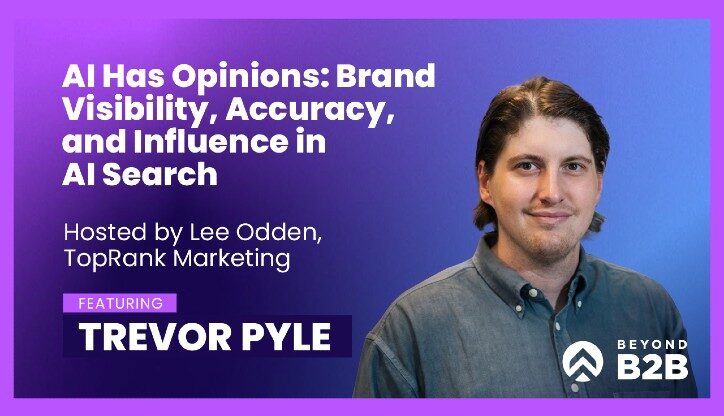
In this episode of Beyond B2B Marketing, host Lee Odden, CEO of TopRank Marketing, speaks with Trevor Pyle, Head of Marketing at GenAI marketing intelligence platform Profound, about what it takes to earn visibility, trust, and accurate representation across AI-powered search platforms. Drawing on Profound’s analysis of billions of AI citations and conversations, Trevor explains how B2B marketers can move beyond traditional search optimization to influence how AI systems understand and recommend their B2B brands.
Listen to the full conversation with Lee and Trevor here:
Lee and Trevor’s conversation explores why AI-generated answers compress the buyer journey, how inaccuracies and sentiment can shape customer perception, why original research and proprietary expertise outperform commodity content, and whether marketers should think in terms of SEO, AEO, GEO, or simply modern search optimization. They also discuss the growing importance of influencer and third-party content, the emergence of the “marketing engineer,” and practical steps B2B organizations can take today to improve visibility across ChatGPT, Perplexity, Claude, Gemini, and Google AI Overviews.
Whether you’re responsible for SEO, content strategy, demand generation, thought leadership, or digital marketing for your B2B brand, this conversation offers a practical roadmap for adapting to a world where AI doesn’t just find information. It increasingly decides how your brand is understood, considered and chosen for the short list.
10 most important B2B Marketing questions answered in this episode with Trevor Pyle:
1. How should B2B marketers optimize for AI search platforms like ChatGPT, Perplexity, Claude, Gemini, and Google AI Overviews?
AI search optimization starts with creating content that AI systems can confidently understand, cite, and summarize. Brands should focus on accurate, structured, original content that demonstrates expertise rather than relying solely on traditional SEO tactics.
“The things that still matter are technical crawlability, high-quality content that’s easy for a human to read, but easy for a machine to parse out. It’s actually original, it’s non-commodity, it has specific facts and details, and it isn’t fluffy.”
2. Do B2B marketers need to choose between optimizing for Google Search and optimizing for AI search?
No. Google’s AI Overviews and traditional search increasingly rely on many of the same quality signals. The strongest strategy is to build authoritative content that performs well across both search engines and AI-powered answer engines.
“Marketers just have to kind of do everything all at once now… you kind of just have to do both across all channels.”
3. Why is AI search visibility different from traditional SEO rankings?
Appearing in an AI answer is only the first step. AI platforms also summarize, compare, and editorialize about brands, making accuracy, sentiment, and context just as important as visibility.
“Now it’s just making sure that you’re cited, that you’re present, and that the verdict is something that you like.”
4. How can B2B marketers improve their brand’s visibility in AI-generated answers?
Brands should publish original research, proprietary insights, first-party data, and clearly structured content that provides unique value. AI models are more likely to cite content that contributes something distinctive rather than repeating widely available information.
“If you’re not basing your entire measurement structure and practice on what your customers are actually asking… you can be in a dangerous position of building measurement around the wrong infrastructure.”
5. Why are original research and proprietary data becoming more valuable for AI search optimization?
Large language models can generate commodity content themselves, so they place greater value on information they cannot invent. Original research, customer data, expert analysis, and unique perspectives create stronger reasons for AI systems to reference a brand.
“LLMs are trying to be authoritative and credible. They want to make sure everything they’re providing is very fresh… and they want detailed rationale that justifies the answer.”
6. How do influencers, analysts, and third-party publications affect AI search visibility?
AI systems frequently rely on trusted third-party sources when generating answers. Positive coverage from respected publications, industry experts, creators, and influencers can strengthen both a brand’s visibility and credibility in AI-generated responses.
“Your own domain is very important, but that’s not always the answer you’re trying to drive people to. Sometimes it’s a third-party mention, a media article, G2 reviews, your partners… influencers are huge.”
7. How can marketers identify and correct inaccurate AI-generated information about their brand?
Organizations should actively monitor AI responses across multiple platforms, compare them against verified company information, and identify the external sources contributing to inaccuracies. Improving authoritative content and updating influential third-party sources can help improve future AI responses.
“Visibility is important, but the more important thing is that useful augmentation, or that opinion that’s injected into the answer. That comes from being accurate, and then from that accuracy, what type of sentiment and judgment the answer forms.”
8. What is the difference between SEO, Answer Engine Optimization (AEO), GEO, and AI Search Optimization?
While the terminology continues to evolve, they all reflect the same fundamental shift: optimizing content so AI systems can accurately retrieve, understand, and recommend it. The emphasis is moving from ranking pages to influencing AI-generated answers.
“SEO is the best steward for this shift… but now a lot of this matters off-site too.”
9. How is AI changing the role of the modern B2B marketer?
AI is creating demand for “marketing engineers” who combine marketing strategy with technical skills such as automation, AI agents, workflows, and content optimization. Future marketing organizations will increasingly blend creative expertise with AI-enabled execution.
“I actually think it’s a force multiplier to have somebody in-house who’s very, very good at building agents around marketing workflows.”
10. What should B2B marketing leaders prioritize first to prepare for the future of AI search?
Start by ensuring your brand is represented accurately across AI platforms, invest in original content and thought leadership, improve structured content on high-value pages, and build a repeatable process for monitoring AI visibility, citations, and brand perception over time.
“Understand what AI is saying about your brand. That’s the most important influencer in the world right now.”
You can watch the full interview about AI Search Visibility on YouTube:
Connect with Trevor Pyle on LinkedIn
Thanks Trevor!

Be sure to like and subscribe to the Beyond B2B Marketing podcast on your preferred podcast platform. Reviews are great too!