

Every B2B marketer knows the meeting: twenty minutes disappear into whose numbers are right and whose fault the miss is. Marketing points to lead follow-up, sales points to lead quality, and everyone leaves defending their own metrics instead of solving the problem. That friction is the expensive symptom of a go-to-market motion that runs as competing departments rather than one system.
According to Mutiny’s State of Sales and Marketing Alignment Report, 70% of B2B professionals believe their sales and marketing teams are aligned, yet misaligned teams are twice as likely to miss revenue targets, while truly aligned teams are 2.3 times more likely to exceed them. The alignment most companies believe they have on paper doesn’t hold up in execution.
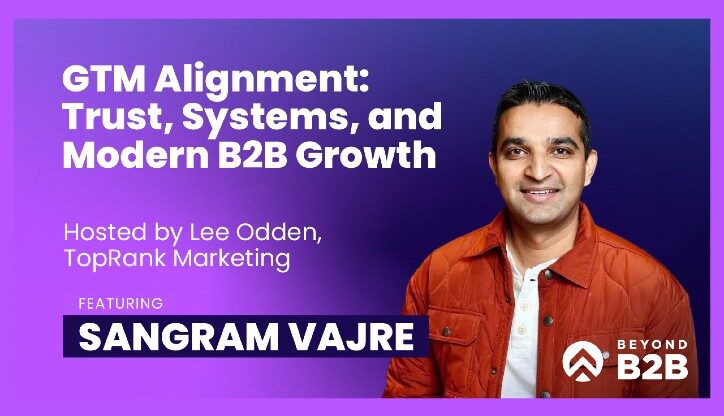
To help B2B marketers create true GTM alignment, this episode of Beyond B2B Marketing features Sangram Vajre, CEO of GTM Partners, Wall Street Journal bestselling author of MOVE, and one of the practitioners who pioneered account-based marketing at Pardot and Terminus. Sangram has built and exited two companies over $100 million and today he’s transforming GTM as an operating system.
Listen to the full conversation with Sangram and Lee:
In this conversation with host Lee Odden, Sangram talks about why most companies do not have a marketing problem, a sales problem, or a product problem, but a go-to-market problem. Sangram makes the case that it is the CEO that owns go-to-market as a transformational process rather than a campaign, shares GTM Partners research showing that 68% of executives name internal go-to-market clarity, not market conditions, as their biggest barrier to hitting the number, and explains why the revenue most companies chase through new-logo acquisition is already sitting inside their existing customer base, waiting to be earned through trust, systems, and retention.
You can watch the full interview with Sangram Vajre about modern B2B Growth on YouTube:
10 most important B2B GTM questions answered in this episode with Sangram Vajre:
1. Why do most B2B companies fail to hit their growth targets?
Most companies misdiagnose the problem as marketing, sales, or product execution, when the real barrier is a lack of go-to-market clarity on where to grow and which bets to make. GTM Partners’ research finds that internal clarity, not market conditions or competition, is what most often stops companies from hitting their number.
“It’s not market. It’s not competitive landscape, it’s not even AI. It’s the go-to-market clarity of what bets they should take.”
2. Who actually owns go-to-market inside a B2B company?
The CEO owns go-to-market, because it isn’t a department or a campaign, it’s every decision that transforms the business, and only the CEO can make those calls across functions. Marketing, sales, and customer success execute pieces of it, but ownership sits at the top.
“Everything that you do in your business that transforms your business is inevitably a go-to-market decision.”
3. How should B2B marketers reframe a “marketing problem” to actually solve it?
Labeling an issue a marketing problem, a sales problem, or a customer success problem gives every team a reason to defend itself instead of fixing the business. Naming it a shared go-to-market problem changes the posture of the whole room.
“They came to the meeting with a sense of purpose as opposed to a sense of defending themselves. And that changed everything.”
4. Why do systems matter more than goals in go-to-market execution?
Most companies share the same goals; what separates the ones that hit them is a repeatable system, not a bigger number on a spreadsheet. Frontline teams don’t need another target, they need a system that shows them how to get there.
“People do not rise to the level of their goals, they fall to the level of their systems.”
5. Why should B2B companies prioritize retention and expansion over new-logo acquisition?
The most predictable, profitable revenue already sits inside the existing customer base, yet most companies overspend chasing new logos while ignoring net revenue retention. A modest improvement in NRR compounds into dramatic revenue growth without adding a single new customer.
“Do you know that if your NRR is about 120%, you could double your revenue every 3.8 years without adding a single new customer?”
6. Does brand investment actually drive measurable demand?
Yes. In a G2-sourced study of two similar companies, the one that paused brand spending for a single quarter took four additional quarters to recover its cost of acquisition, because pulling back on brand pushed it out of buyers’ consideration.
“If you’re out of sight, you’re out of mind. And if you’re out of mind, you’re not in the top three list of companies.”
7. If product features can be copied instantly, what is a B2B company’s real competitive advantage?
When any capability can be replicated within days, product stops being a durable moat, and how well a company is distributed, integrated, and vouched for across the market becomes the real differentiator. That distribution is built through relationships and community, not features.
“Product is no longer the moat.”
8. How should B2B brands think about influencer marketing as a growth lever?
Influence built through trusted, category-relevant voices functions the way analyst rankings used to: it shapes which vendors buyers even consider before a sales conversation starts. Most B2B companies under-invest in it relative to how much it shapes perception.
“The new magic quadrant really is influencer marketing.”
9. Why are so many AI initiatives failing inside B2B marketing teams?
AI amplifies whatever system already exists, so applying it to unclear thinking and undefined problems produces mediocrity at scale instead of growth. Teams get into trouble when they use AI to think for them instead of using it to execute on thinking they’ve already done.
“If you use AI to do the thinking for you, then you have missed the point of AI.”
10. What should a B2B marketer do first when given a 90-day mandate to fix go-to-market performance?
Bring the full executive team together to align on a small set of foundational go-to-market questions, starting with where the company can grow most and what makes its point of view genuinely different. Alignment on those bets, not certainty about outcomes, is what actually moves a company forward.
“Clarity is what gets companies to move forward, not certainty.”
Connect with Sangram on LinkedIn
Thanks Sangram!
Best Answer Marketing and go-to-market alignment
Sangram’s central argument, that go-to-market is the business rather than a departmental function, is the same conviction behind TopRank Marketing’s Best Answer Marketing philosophy: brands earn trust and revenue when strategy is integrated across the full organization instead of optimized in silos. His research-backed case for brand as a driver of demand, and retention as the most reliable source of growth, reflects the same data-informed, trust-building approach that defines a Best Answer Brand, one that measures what actually moves revenue and treats go-to-market as a system the whole company owns, not a line item marketing defends alone.

Be sure to subscribe to the best new B2B marketing podcast, Beyond B2B Marketing on your preferred podcast platform. Reviews and shares are appreciated!