

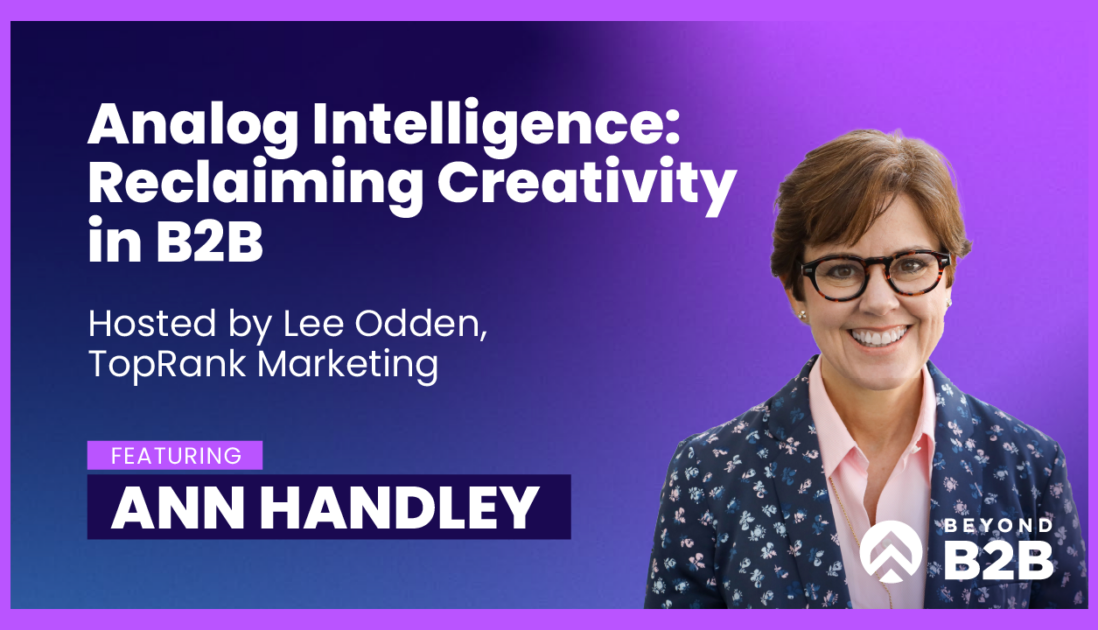
In this episode of Beyond B2B Marketing, TopRank Marketing CEO Lee Odden talks with Ann Handley, Chief Content Officer at MarketingProfs and one of the most influential voices in modern marketing. Ann introduces her concept of Analog Intelligence, a creative counterbalance to the hyper-efficiency of AI.
She shares how resisting the urge to use tools too early in the process helps preserve originality and sharp thinking, and how her upcoming book, ASAP: As Slow As Possible, is a call to reclaim our humanity in the age of automation.
Their conversation explores why vulnerability and authenticity are more essential than ever in B2B marketing, using Taylor Swift’s emotional storytelling as a surprising but insightful example. Ann breaks down what it really means to connect with audiences at scale – by showing up as yourself and writing in a way that resonates like a letter vs. a broadcast. She also highlights a few standout brands that are embracing creativity in unexpected places including a sewer district in Ohio to a well-timed t-shirt from Sprout Social.
Ann also shares her refreshingly minimalist approach to LinkedIn and newsletters: post when you have something valuable to say, speak directly to one person, and always engage with your audience. It’s a strategy that is grounded in trust instead of volume and one that shows a broader shift in how B2B marketers can build real relationships in a noisy AI world.
This is a conversation for anyone looking to slow down, think deeper, and bring more humanity back to B2B.
Listen to the full podcast with Ann here:
Key Takeaways:
- Analog Intelligence gives B2B marketers an edge by prioritizing original thinking before introducing AI into the creative process.
- Inviting AI into content creation too early leads to flattened ideas and mediocrity rather than differentiated insight.
- Vulnerability helps B2B brands stand out by creating authenticity and emotional connection in an increasingly automated content landscape.
- The most effective B2B marketing feels like a conversation with one person, not a broadcast to an audience.
- Posting less often on LinkedIn-but with more intention and value-drives deeper engagement than chasing frequency.
- Responding to comments and engaging in dialogue is a critical but overlooked way to build trust and long-term relationships.
- Content is most effective when it sounds so distinct that readers recognize the voice even without seeing the author’s name.
- Email newsletters should sit at the center of B2B marketing because they create high-trust, one-to-one relationships over time.
- Slowing down allows marketers to think more clearly, create better work, and resist the pressure of hyper-efficiency.
- Small, thoughtful actions-like unexpected follow-ups in influencer programs-can create outsized impact and lasting brand affinity.
Watch the interview on YouTube
Here’s a transcript of their conversation:
Lee: Hello and welcome to the Beyond B2B Marketing podcast. I’m your host, Lee Odden, CEO of TopRank Marketing. And today we have a familiar and marketing famous voice joining us, a legend in the B2B content and marketing world. Not only is she both a super fan of EB White and Taylor Swift, she’s an original LinkedIn top voice influencer with nearly half a million followers on LinkedIn. Of course, I’m talking about
Ann: Thanks so much for having me, Lee. It’s a delight to be here.
Lee: Do you think it’s possible to have a marketing podcast conversation and not talk about AI?
Ann: No, I think it’s impossible to talk about marketing without mentioning AI. The messaging from AI companies is that you can write faster and be more efficient, and that’s true. But it’s incumbent on all of us to be thoughtful about how we invite AI into our process. It’s not just whether you should use AI, but when.
Lee: I’ve always thought AI makes you more of what you are. If you put bad inputs into it, you get bad outputs. There’s mediocrity at scale happening, but the more creative and thoughtful people who invest in context get better results.
Ann: I agree. AI makes you more of what you are. That’s why I try to resist using it too soon. I start by thinking about what I want to say and jotting down notes, literally writing them down. Then I do a rough draft, the ugly first draft. That preserves my thinking and helps me avoid firing up AI too early.
Lee: I like the copilot idea, AI as a partner, not a replacement. Let’s talk about your new book. What can you share?
Ann: It’s not just about marketing, it’s bigger than that. It’s about how we show up creatively, how we innovate, and how we connect with other people, whether we’re marketers or in other roles. It’s a big swing for me because it’s outside my comfort zone, but I’m excited and I feel ready for it.
Lee: You’re a big Taylor Swift fan and a marketing leader. Are there lessons B2B marketers can learn from Taylor Swift?
Ann: Yes, there are lots. The biggest one for me is vulnerability. I think we need more of that in B2B marketing. Great entertainers have the ability to identify something uniquely human in each of us and connect it to others at scale. That’s incredibly inspiring as a marketer.
Lee: That one-to-one connection feels like a real differentiator right now. People are overwhelmed, and meaningful connection stands out.
Ann: We’ve talked for a long time about customer centricity and empathy, and that’s still true. But we’ve entered a new era where we need to show up differently too. Vulnerability is the missing piece. It’s no longer enough to communicate empathetically, we need to show up as humans.
Lee: B2B marketing has a reputation for being boring. Are there brands doing great work in storytelling and creativity right now?
Ann: One of my favorite examples is the Northeast Ohio Regional Sewer District. Their social presence is strong across platforms, and they do an incredible job humanizing what they do. The story they tell is about celebrating the unseen systems that make our lives easier. You only think about sewers when something goes wrong, but their work matters, and they show why.
They also highlight the people behind the work, which supports recruiting. They have strong social content, a newsletter, great website content, and community events. They operate on an outsized stage in a way that’s innovative and inspiring, even for B2B.
Lee: That’s great. I’ll include links in the notes.
Ann: Another example is Sprout Social. They asked me to help amplify a content marketing study. I shared it on LinkedIn and in my newsletter. Usually those influencer programs stop there, but they followed up with a thoughtful gesture that wasn’t transactional. It showed they were paying attention and willing to do something a little unexpected. It strengthened the relationship and made me more engaged with their content.
Lee: That’s a great example of moving beyond transactional influencer activations and building something more meaningful.
Lee: Instagram is starting to allow more content to be indexed by search engines. What impact do you think that will have?
Ann: It makes sense. They need to avoid being shut out of the generative AI search game. Traditional search is about links, but generative AI search is about mentions and showing up in conversations. Instagram has been walled off, so opening up more aligns them with platforms like TikTok and YouTube.
If brands do it right, it won’t feel different to users. It could actually make content stronger by bringing SEO and social teams together. The risk is teams do it badly and create a poor user experience, which won’t serve them long term.
Lee: With AI-driven search, platforms like Instagram could become stronger signals. It’s less about links and more about being mentioned in context across places that matter.
Lee: What’s your approach to LinkedIn? You don’t post often, but when you do, the response is huge.
Ann: I post when I have something to say, not because it’s a certain day or time. I focus on being useful and valuable. I tell stories because storytelling helps, and I try to make the content sound like it could only come from me.
I don’t follow advice about posting cadence just to grow an audience. No matter your audience size, the principles are the same: offer value, wrap it in a story, encourage discussion, and comment back. Too many people post and disappear. People want to be seen and heard.
Lee: I’m hearing relevance, thoughtfulness, storytelling, and engagement.
Ann: Commenting can be just as effective as posting. Even when I’m not posting, I’m engaging. LinkedIn is a great source of inspiration if you don’t treat it like a place to just promote yourself.
Lee: Your newsletter is one of the few I read. What advice do you have for B2B brands struggling with newsletters?
Ann: Email newsletters should be at the center of your strategy. Social media is discovery, but newsletters create a direct relationship. Once someone subscribes, that email address becomes a valuable asset and the relationship becomes much deeper.
Lee: With organic search becoming less reliable, subscribed audiences matter more than ever.
Lee: B2B Forum is coming up. What can people expect this year?
Ann: It’s in November, later than usual, the week before Thanksgiving. Gratitude is a theme this year, partly because of the timing. We’ll cover AI, automation, email, search, and how marketing is changing. What makes B2B Forum special is the personality, the risks speakers take, and the sense of community. It doesn’t feel like another marketing conference.
Lee: Thank you so much, Ann!
Ann: Thank you, Lee. It was a lot of fun!
To find the Beyond B2B Marketing podcast on your preferred podcast platform, check out the links below.