

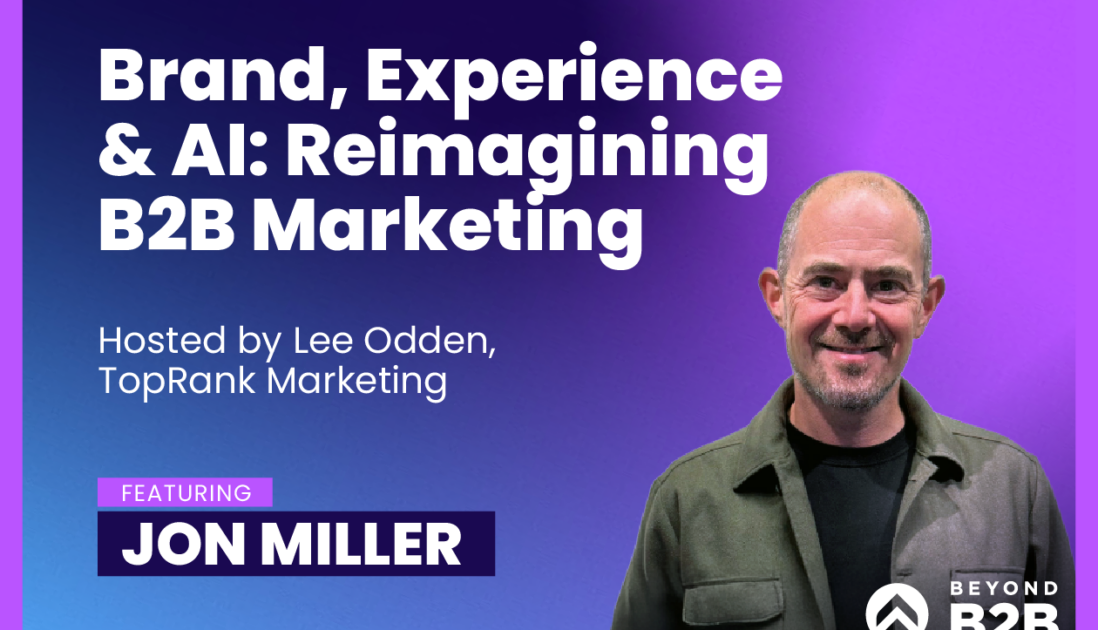
In this episode of Beyond B2B Marketing, TopRank Marketing CEO Lee Odden sits down with Jon Miller, co-founder of Marketo and Engagio, and current co-founder and CEO of a stealth AI start-up, to discuss why the traditional B2B marketing playbook is no longer delivering results.
From MQL-driven funnels to definitive guides and SDR outreach, Jon outlines how shifting buyer behavior, anonymous research journeys, and AI-powered disruption have rendered many legacy tactics ineffective-and why it’s time for a fundamental shift in strategy.
Jon makes the case for embracing brand less as a soft metric and more as a performance driver. He explains how emotional connection, memorable experiences, and trusted relationships are the keys to influencing today’s buyers before they ever fill out a form. He also challenges B2B marketers to reimagine the martech stack itself, calling out the limitations of first-gen marketing automation platforms and advocating for AI-native systems that can dynamically personalize engagement at scale while freeing marketers to focus on creativity and innovation.
One standout theme from the conversation: the increasing value of original research. Jon emphasizes that in a world flooded with AI-generated content, research rooted in proprietary data offers lasting differentiation. It builds credibility, earns citations in answer engines, and fuels a content flywheel across social, sales, and search. As he puts it, “AI can’t generate truly original research… and as a result, it gets cited, it gets shared, it gets remembered.”
Listen to the full podcast with Jon Miller here:
Key Takeaways:
- The old lead-gen playbook of MQLs, gated PDFs, and nurture emails-is no longer effective in a complex, anonymous, AI-driven buying journey.
- B2B marketers must shift from linear funnels to full-lifecycle strategies that prioritize post-sale growth, expansion, and advocacy.
- Brand is no longer optional-it’s a revenue engine that influences buyers before they raise their hands.
- Marketing automation platforms like Marketo and Eloqua are showing their age and constrained by technical debt and outdated logic systems.
- AI-native platforms will fundamentally reshape campaign orchestration by eliminating rules-based workflows and enabling true personalization at scale.
- Instead of chasing attribution precision, marketers should focus on emotional resonance and pre-pipeline influence.
- Experiences, relationships, and craftsmanship are the new differentiators in a market flooded with AI-generated content.
- AI shouldn’t just be bolted onto legacy systems-it should be embedded at the core of modern marketing technology.
- Founder-led content and authentic, high-effort creative will outperform faceless, algorithm-chasing brand content.
- Original research rooted in proprietary data is one of the most effective tools for building authority, earning trust, and sustaining visibility in AI-powered discovery.
Watch the interview on YouTube:
Here’s a transcript of the full conversation:
Lee: Hello and welcome to the Beyond B2B Marketing podcast. I’m your host, Lee Odden, the CEO of Top Rank Marketing. And today’s guest is someone I’ve known since the early days of Marketo when he brought my team on to help with blog content and SEO. John Miller is one of the true pioneers of B2B marketing technology, co-founder and CMO of Marketo, founder and CEO of Engagio, and now back in the lab building something new.
Jon: It’s really great to talk. We’ve worked together for so many years. Every time we connect, the conversation is really engaging. Looking forward to it.
Lee: We go way back, almost 18 years. Since that time, you’ve helped shape whole categories in B2B marketing. Now you’re working on something new. When you look back, what’s changed most in B2B content and how people are finding it?
Jon: In the early days, if we wanted to rank for a keyword, we could write a good blog post and show up. Now it’s not just about showing up on page one of Google. It’s about getting referenced inside of an AI answer.
That changes a lot. For CMOs, it changes how you get your brand story out there if the message gets reduced into a reference that an AI can pick up. Content discovery has changed a lot since our early days. The playbooks we used to use just don’t work anymore.
Lee: It’s become more about micro content, micro interactions, and cumulative experiences. That architecture is different than publishing a blog post, getting links, and ranking.
Jon: That’s foundational. The old playbook isn’t working anymore, and it’s more than the content playbook. At Marketo, we promoted a go-to-market model where content and webinars generate leads, those leads get nurtured, scored by behaviors, passed to sales, qualified, closed, and handed to customer success. It was highly measurable. MQLs ruled the day. CMOs talked about funnels constantly.
If I simplify what’s not working, there are a few key things. One is that the traditional model treated marketing like a simple linear process. Put budget in, get MQLs out. A gumball machine mentality. Being highly measurable pushed short-term behavior that was good for the quarter but bad for the long-term customer experience, including gating content and putting SDRs on everyone who downloaded something. Put it all together and the old playbook isn’t working anymore.
This new playbook has to figure out how to engage buyers before they want to raise their hand, in a world where buyers are actively trying to tune out unwanted marketing. There is a way to do that, and marketers have done it for decades, which is building a brand. Brands operate on emotions. Brands are how people talk about you when you’re not in the room.
It also means thinking beyond pipeline into things like customer success, advocacy, and adoption. I’m not saying it’s brand or demand. It’s both. But we clearly need a much more intentional focus on creating emotional connections in the marketplace.
Lee: It’s a full funnel experience. In B2B, it’s not enough to inform buyers anymore. You have to make them feel something, and that lines up with brand. There’s research coming out of LinkedIn’s marketing innovation group about brand’s contribution to revenue.
Jon: There’s also a tie between brand and answer engine optimization. The way you get cited by these engines isn’t whether you have the page with the most links. It’s whether people are talking about you. These ideas are connected.
Lee: That aligns with our best answer marketing framework. After data and strategy, it’s about building trust and signals of trust, then creating experiential content and multi-channel discovery. It’s about meaningful, not mechanical, marketing experiences. Influential voices like you and what’s coming out of LinkedIn are pushing this direction, and it’s a net positive. It’s better for buyers, and it’s more interesting for marketers to execute on.
Jon: It’s hard, and CMOs need help bringing the rest of the C-suite along, especially in environments like private equity. I personally spent years telling investors that marketing should be measured in MQLs. Now we need to change that because it’s exacerbating the problem.
Lee: In a previous interview, you talked about moving from a funnel to a bow tie, with growth after the sale. Why don’t more B2B companies, especially SaaS, expand their efforts that way?
Jon: It’s like training for the first mile of a marathon and walking the rest. There’s a glory of the deal that comes out of sales culture. You ring the gong when you close the deal, not when the customer goes live or renews. That ethos spreads. A lot of CMOs are measured on marketing-sourced new business pipeline, which biases companies toward net new business. That has to change.
Marketing shouldn’t be seen only as the group that creates new pipeline. It should drive adoption, renewals, expansion, and advocacy. That requires different metrics, investments, and ways of thinking.
Lee: You’ve used the phrase “marketing automation Stockholm syndrome,” where first-generation platforms hold teams back. What would a reimagined automation platform look like?
Jon: Marketo is about 19 years old. HubSpot is about 19 years old. Eloqua is about 25 years old. Those platforms aren’t really keeping up. Teams adapt to quirks, buy add-ons to fill gaps, and keep patching the legacy stack.
These tools also aren’t built natively around accounts and buying groups. They’re slaves to CRM data. Post-sale marketing needs signals like support tickets and product usage, but legacy marketing automation isn’t designed for that.
Another issue is they’re rules-based systems. Marketers have gotten used to managing complexity with endless “if this, then that” logic, suppression rules, and workarounds.
Lee: That raises the question of what humans should focus on as AI removes limitations. A tool is only as effective as the expertise of the people using it, and the ability to craft context matters.
Jon: Chatbots are just one application of LLM technology. The bigger question is what happens when you build a marketing automation application from the ground up assuming AI exists. How would you build it differently? What new applications become possible that weren’t before?
Over time, it won’t be about how good you are at prompting. It becomes about the quality of the application. The point isn’t that the application uses AI. The point is it achieves an objective and uses AI to help you do it.
A simple example is summer camp photos. Parents used to spend time searching through photos to find their kids. Then AI was added to solve that problem. The limitations go away because the application gets better at delivering the outcome.
Apply that to marketing automation. Today marketers write a brief and send it to marketing ops to build it in Marketo or Eloqua. That’s the kind of world we need to move away from.
Lee: Martech stacks are messy. Tools overlap, data is fragmented, and leaders inherit complex ecosystems. If you walk into that situation, where do you start?
Jon: There’s a tendency to start with tools, but the smarter move is to start with strategy. What outcomes do you want? What are you trying to achieve? What do you wish you could do that you can’t do? Then work backward.
On AI, there’s a risk in just bolting AI onto legacy stacks. Instead, look for opportunities to reimagine your stack around AI, rather than creating more messiness and expense.
Lee: Let’s shift from tech to brand. What advice do you have for marketers trying to build credibility, trust, and visibility for their brands?
Jon: I’ve been thinking about what marketing will work when AI can generate infinite content and when AI increasingly stands between marketers and customers.
Three things will stand out. First is experiences. You can’t properly summarize an experience, and that will continue to matter.
Second is relationships. In a world of infinite content, the source matters more than the content. Being a trusted source will be increasingly valuable, similar to how people trust certain news sources over others.
Third is craftsmanship. Humans can tell when something took human effort. You can tell when a post was written by AI versus put together with care. That applies across writing and other tactics. Experiences, relationships, and craftsmanship.
For individual marketers, you see this with founder-led growth, where content comes from leaders, not faceless brands, and it’s done with consistency and authenticity.
I’ve been testing that myself. Late last year I combined two passions, cocktails and B2B marketing. I published a series of videos where I talk about B2B marketing while making a cocktail. The impressions aren’t great, but people talk to me about the videos. They engage with them. They can see the craftsmanship, and that helps build influence.
Lee: What’s the name of that series?
Jon: I don’t have a name. I probably should. I’ll have to think about that.
Lee: You’ve also predicted that B2B brands need to invest in original research. Is that still good advice heading into 2026?
Jon: More than ever. It ties to craftsmanship. Original research clearly takes time and effort, and it stands out. It also creates a flywheel effect. It’s content, but it can also generate media coverage.
The best examples use proprietary data to produce insights that are valuable to the market. Gong Labs does this well. Carta does this well. In a world where AI can generate infinite content, it cannot generate truly original research. It turns noise into meaning, and as a result it gets cited, shared, and remembered.
Lee: We just completed surveys for a new research project that advocates for the value of original research. We’re partnering with Ascend and launching it soon. It’ll be focused on full funnel thought leadership. I really appreciate your time and your insights. Where’s the best place for people to connect with you?
Jon: LinkedIn. Follow me and message me there. That’s the best way to keep up with what I’m doing and get clues about what I’m building.
Lee: I see you’re speaking at MarketingProfs B2B Forum. I’ll see you in Boston. Thank you so much.
Jon: We’ll have to hang out.
Lee; Thanks Jon!
To find the Beyond B2B Marketing podcast on your preferred podcast platform, check out the links below.