

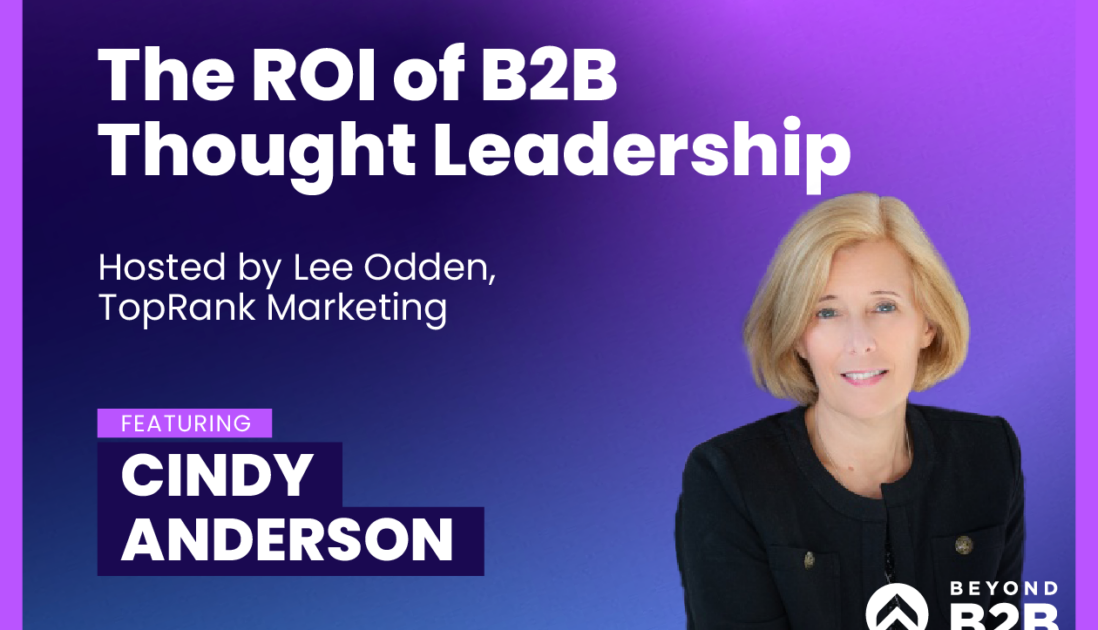
In this episode of Beyond B2B Marketing, TopRank Marketing CEO Lee Odden speaks with Cindy Anderson, Global Lead for Marketing and Communications at IBM who joined the show from Singapore, about how thought leadership grounded in credible research and independent insight has become a strategic growth driver for B2B brands. Cindy shares her perspective on what truly differentiates thought leadership from content marketing, emphasizing the role of data, expert perspective, and commercial independence in building trust with executive audiences.
Drawing from her work at the IBM Institute for Business Value and her book The ROI of Thought Leadership, Cindy explains why so many organizations struggle to measure impact and why that’s changing. She highlights research showing that a significant majority of executives make purchase decisions influenced by thought leadership and outlines how framing thought leadership as a platform, not a campaign, unlocks measurable business value.
Their conversation also explores how B2B marketers can scale impact through a hub-and-spoke model, adapt to AI-driven discovery, and protect credibility amid emerging trends like synthetic data. Throughout the discussion, Cindy makes a clear case for treating thought leadership as a long-term investment that fuels the full customer lifecycle, strengthens brand authority, and delivers demonstrable ROI.
Listen to the full podcast with Cindy here:
Key Takeaways:
- Thought leadership is not just content, it is evidence-based, independent intelligence designed to help leaders make better business decisions.
- Credible data and original research are foundational to effective thought leadership, separating authority-building insight from opinion-driven content.
- Thought leadership delivers measurable business impact, with research showing it influences the majority of executive purchase decisions.
- Treating thought leadership as a platform vs. a campaign enables it to fuel awareness, consideration, loyalty, and growth across the full customer lifecycle.
- A hub-and-spoke model allows one research-backed idea to scale efficiently into multiple assets without sacrificing credibility.
- Independence from overt product promotion is essential for building trust, authority, and long-term influence with executive audiences.
- AI can accelerate the extension and localization of thought leadership, but it should not replace human insight or original research.
- In an AI-driven discovery environment, research-backed thought leadership is more likely to surface as a trusted source in answer engines.
- Synthetic data may support niche analysis and derivative content, but relying on it too heavily risks undermining credibility.
- B2B marketers must measure and communicate the ROI of thought leadership in financial terms to earn sustained executive and CFO support.
Watch the interview on YouTube
Here’s a transcript of the full conversation:
Lee: Hello and welcome to the Beyond B2B Marketing podcast. I’m your host, Lee Odden, CEO of TopRank Marketing. And today our guest is someone that I first saw this summer at a Thought Leadership event in New York. And we were recently able to spend some time together during Content Marketing World where we both had a first time experience eating gold covered beef. I’m talking about a leader in the world of thought leadership, co-author of
Cindy: Thanks, Lee. I’m so glad to be here. Thanks for having me.
Lee: I appreciate you making the time. I don’t know what time it is in Singapore, but it’s very late. You have roots in the Midwest like myself, and now you’re in Singapore. You’ve been with IBM for about five years and you have a history working in thought leadership. Can you share a little bit about your career journey as it relates to thought leadership?
Cindy: When I was in college, I thought I was going to be a journalist. I quickly realized those kinds of deadlines were not my strength, so I moved into marketing. I’ve done a lot of work in PR, but thought leadership is really where my passion is. When I was at the Project Management Institute, I was asked to build a thought leadership capability by the then CEO, Mark Langley, and I loved it.
Lee: Thought leadership is increasing in importance in B2B and in marketing overall as brands engage audiences. You’ve defined thought leadership as distinctive, evidence-based intelligence that gives business leaders the insights they need to make better decisions and the inspiration to take action.
Cindy: We get that one a lot, and there are really three things about thought leadership that set it apart. Thought leadership is a niche part of content marketing. It’s content and it’s used as a platform for marketing, but three things set it apart. One is that thought leadership requires data. It requires research.
Lee: I want to ask you about your book. It’s a thought leadership book about thought leadership, and I highly recommend it, The ROI of Thought Leadership. The findings are striking. 87% of executives made a purchase decision in the last 90 days based on thought leadership they consumed. Why has it been so hard for companies to measure the ROI of thought leadership?
Cindy: We got really tired of having to justify our existence every single day. Those of us who work in marketing and thought leadership are familiar with the questioning. Why are we spending money on this? What’s the return? Could we spend our money somewhere else? We found that $265 billion of purchasing globally is driven by thought leadership itself, and it’s been kind of invisible until now.
Lee: Exactly. We’re going to do our best to make sure it has visibility everywhere. There are concepts in the book that align with what our agency calls best answer marketing, because the landscape for content credibility, content experience, and content discovery is changing, especially because of AI and consumer behavior. I want to ask about the Hub and Spoke Model of Thought Leadership and how it creates a multiplier effect. Can you elaborate on that?
Cindy: We talk about hub and spoke in a couple of different ways. One is with the content itself. The most effective thought leadership is built on a platform. That’s why we call thought leadership the 8th P of marketing, the platform, that other campaigns can be built on.
Lee: We use a metaphor that research-based thought leadership is an engine. It’s not just a research report, it’s a flywheel of derivative assets and formats customized to audiences while keeping the foundation intact.
Cindy: We fundamentally believe that, especially in B2B. B2C can use thought leadership too, but it’s tougher to figure out how it fits. In B2B, if you think about it, the big consulting firms have been using thought leadership for a long time.
Lee: There’s also a leveling-the-playing-field element. When we did original research and published a report about B2B influencer marketing, it helped us significantly. I want to drill into the Global Thought Leadership Institute. You’re the co-founder, along with Anthony. Who’s the audience and what’s the mandate?
Cindy: We founded an association for thought leadership producers because of the impact thought leadership has on business. We were surprised by the scale of the impact. Our goal is to embed the perspective of thought leadership as a platform.
We’re doing that through development of standards. We just introduced our first standard for public comment. We’ll be building certifications for people who produce thought leadership. One prompt for doing this was hearing from a reporter who said they didn’t want to talk about thought leadership because it was too squishy. The whole point of the research is to de-squishify thought leadership, and we needed a way to get that message out more broadly. APQC was aligned with the mission around knowledge management, benchmarking, and value delivery. We’re about a year and a half in and it’s going well.
Lee: That’s incredible, especially for only a year and a half. The website, board of advisors, and resources are impressive, and standards and certifications help build community. I’d like your take on a few findings from our upcoming research report, Answer Engine, focused on B2B thought leadership. We found that while two thirds of B2B marketers use thought leadership for top of funnel
Cindy: The way we talk about thought leadership at IBM and within GTLI is that it really is at the top of the funnel, designed to build awareness and consideration. But if you think of thought leadership as the platform, it can carry you through the rest of the funnel.
That’s the virtuous cycle. There’s a foundational report, survey, research, or perspective that forms the platform. Then the marketing team takes it and builds derivative assets that keep the foundation intact from a credibility and authority perspective, while connecting it to products and services, generating leads, generating loyalty, and building business.
We also see in the research that executives value original research over third-party research. We found something interesting when we did our first round of AI research in early 2023, shortly after ChatGPT emerged. Executives initially thought AI would eliminate bias, but we learned quickly that it reflects bias, and executives adjusted their perspective. Research and research-based perspective will continue to be important.
Lee: That makes derivative content even more valuable because answer engines and AI overviews are answering top-of-funnel questions and not generating clicks. It’s imperative that
Cindy: In B2B organizations, not many credible folks are using AI in production of thought leadership because it doesn’t get you where you need to go. It can help with topic ideas, but it won’t create the credible perspective you need. Where AI is valuable is in the extension pieces, the derivative assets. If you’re doing a major study, AI can help you create supporting formats while keeping the core research intact.
Lee: This connects to another finding on distribution. We found companies heavily distribute thought leadership on LinkedIn, YouTube, and webinars. But interestingly, B2B marketers said that
Cindy: I don’t think answer engines are going away. They’re here to stay. We need to figure out what the answer is, and I don’t think anybody has fully figured it out yet, but everybody’s thinking about it. The LinkedIn stat you mentioned probably explains why their algorithm changed to keep people on the site instead of sending people off the site. The message for thought leadership producers and marketers is to stay on top of it. Distribution strategies have to change as user behavior changes.
Lee: LinkedIn has released information about a major update, including developing their own foundational model. That reinforces their preference to keep engagement on-platform.
Cindy: They want you to keep activity on the platform. B2B marketers will need to figure out the balance because we want audiences on our platform and LinkedIn wants them on theirs. How do you work that through?
Lee: On the topic of AI, there’s also the idea of synthetic data. Some companies collect a sample of surveys, bring it into an AI platform, and simulate results. What’s your take?
Cindy: Like many organizations, we’re investigating synthetic data. Like answer engines, it’s here and not going away. We don’t have the answers yet. In the near term, synthetic data shouldn’t replace real surveys or real interactions with executives, if that’s your target. But it may play a role in derivative areas. We just have to figure out what that role is.
Our research also found that purchasers in the C-suite trust, on average, five organizations they get thought leadership from. It’s not the same five for everyone, but every thought leadership producer has the opportunity to be one of those five.
Lee: The whole point of thought leadership is to build trust, and trust is more valuable than ever. That Trust5 finding is really interesting. Let’s break out the crystal ball. What do you want to see happen next?
Cindy: I would love to see every B2B brand calculate their own ROI and start to position it as an authoritative, valid way to measure the impact and value thought leadership provides. It’s going to take a while to get CFOs to buy it, but we need to start now. The more we speak their language, the more we help ourselves stop having to answer questions about the value of what we deliver every day.
Lee: I agree. If we’re taking funding, it’s our responsibility to show it’s an investment with a return, and our operations need to support that.
Let’s wrap with something that goes beyond B2B. Since we’re publishing this in early October, Halloween month, do they celebrate Halloween in Singapore?
Cindy: We don’t have trick or treating, but Halloween is big. There’s Halloween stuff all over Singapore. Yes, we do celebrate here.
Lee: What’s the scariest thing you’ve ever done?
Cindy: I’ve been trying to learn Chinese for about 25 years. I started taking courses at a university, and my professor convinced me to do a three-minute introduction in Chinese at a Chinese New Year celebration in front of 300 Chinese families. I did it, I was terrified, and I stunned the room into silence. I still don’t know if they were impressed or wondering who this idiot was on stage.
Lee: My goodness.
Cindy: It was terrifying.
Lee: I’m sure they were impressed. My wife is Chinese and I can’t speak three minutes or even ten seconds. I need to fix that. Thank you so much, Cindy. What’s the best place for people to connect with you?
Cindy: LinkedIn. I love to connect with anyone interested in thought leadership there. You can find me as Cindy W. Anderson. If you add IBM, you should find me easily. And you can find the book on Amazon.
Lee: Thank you, Cindy.
Cindy: Thanks, Lee. Thanks for having me. It was great to talk to you.
To find the Beyond B2B Marketing podcast on your preferred podcast platform, check out the links below.