

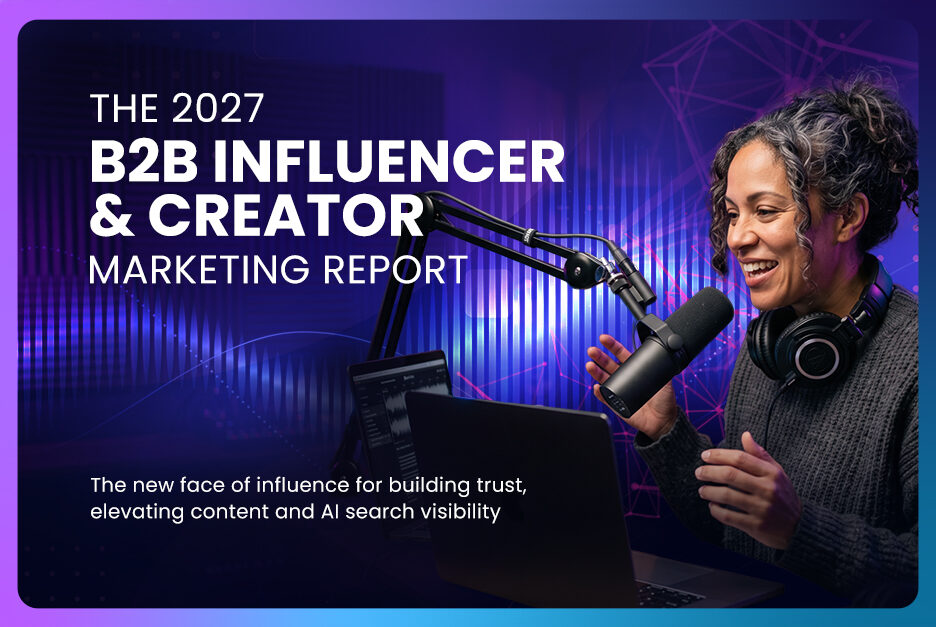
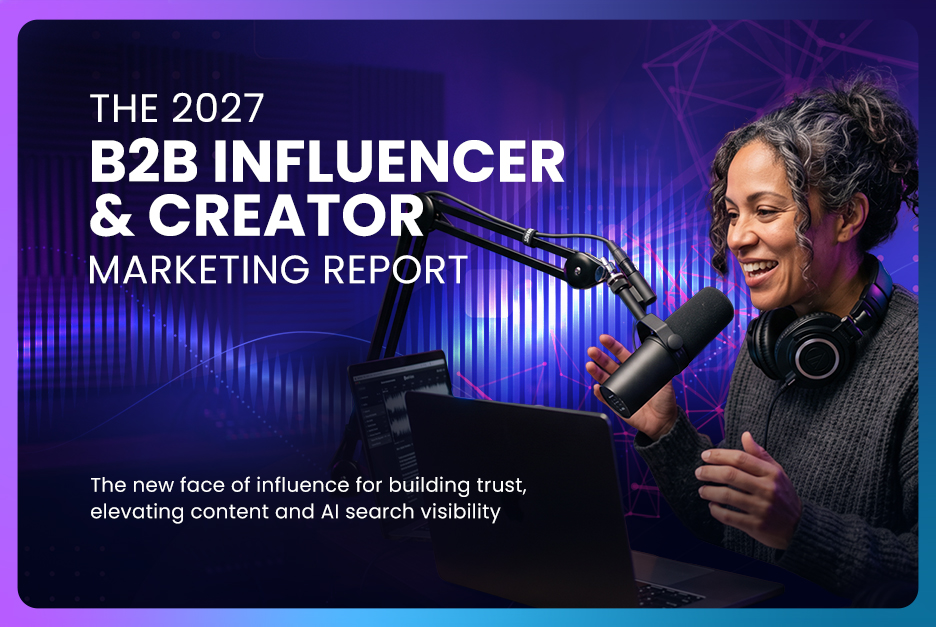
The team at TopRank Marketing and our research partner Ascend2 are happy to announce the release of the fifth edition of our original research on B2B influence: The 2027 B2B Influencer & Creator Marketing Report
While this blog post shares quite a bit of the report data, you can get the full PDF version of the report here.
When we published the first B2B Influencer Marketing Report in 2020, our goal was to answer an important question: can partnering with credible experts drive growth for B2B brands? After five editions and thousands of survey responses, that question has been answered. As the practice of B2B influencer marketing has matured, we’ve shifted our focus to a more timely question: what separates the top performers from everyone else?
It has become clear that today’s B2B buyers have changed how they discover, evaluate and choose solutions in ways that have made many traditional B2B marketing playbooks obsolete. Discovery is fragmented. Buyers develop opinions from feeds, podcasts and communities, and they ask AI assistants for shortlists long before they ever visit a website. The role of trusted experts and creators has elevated to inform LLMs as well as influence humans about which solutions are the best answer.
Visibility is no longer possible without credibility.
The supporting third-party research on this topic is hard to argue with:
- 96% of B2B companies are largely invisible in early-stage AI discovery (2X AI Visibility Index, 2X AI Innovation Lab).
- 51% of B2B buyers now start their research with an AI chatbot more often than with Google (G2).
- 89% of citations for unbranded prompts come from third-party sources rather than brand-owned content (Bain & Company).
Answer engines cite trusted third-party B2B voices on channels like LinkedIn, YouTube and others and influencer marketing has become the discipline to engage those voices at scale.
Why a fifth edition of this B2B Influencer Marketing research?
At TopRank Marketing, we’ve seen firsthand what separates B2B influencer marketing programs that compound from programs that reset with every intermittent campaign. With over a decade of helping B2B brands earn trust, relevance and engagement through influencer collaborations, the pattern is pretty consistent. Pilots and campaigns borrow attention for a few weeks, but always-on programs earn trust that lasts in places that matter. That includes peer conversations, in the answers AI search gives your buyers and across everything from events to sales enablement. This year’s data makes the case yet again.
To understand where B2B influence stands and where it is headed, we partnered with Ascend2 to survey 424 B2B marketers in manager-level roles or above at U.S. companies with 100 or more employees. The survey fielded from mid-May through mid-June 2026. Every respondent currently runs an influencer marketing program, is building one or plans to launch one within 12 months. Year-over-year comparisons draw on the 2020, 2022, 2023 and 2025 editions of this research, and effectiveness ratings are self-reported by the survey respondents.T
That data shows that B2B influence has grown up: documented, budgeted and measured. We also discovered that the distance between “effective” and “very effective” comes down to a short list of best practices that most B2B influencer marketing programs have not adopted yet.
For a quick view of the difference between the best practices used by top performers and all others, check out this Winning Moves Explorer
Winning moves explorer
What Separates the Best from the Rest
Seven practices stand out among B2B influencer programs rated very effective. Select any combination to see how many times more likely very effective programs are to use each one, compared with all other programs.
Source: 2027 B2B Influencer & Creator Marketing Report, TopRank Marketing with Ascend2. Survey of 424 B2B marketers, fielded 2026. "Very effective" is self-rated program effectiveness. Comparisons are correlational: programs that use these practices are more likely to rate themselves very effective.
Key findings from the 2027 B2B Influencer & Creator Marketing Report:
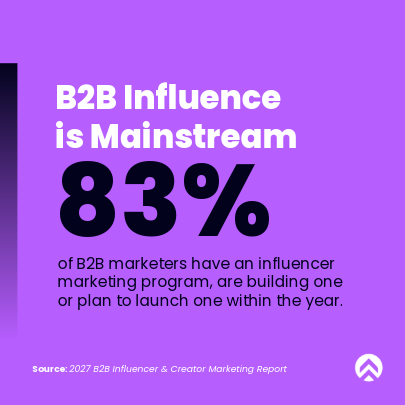
83% of B2B marketers have an influencer marketing program, are building one or plan to launch one within the year. 60% run an active program, 26% are early-stage and 14% plan to start within 12 months. B2B influence has crossed into the mainstream, and at the same time, it has not reached saturation. There is plenty of runway to grow, especially with the emergence of the creator class of influencers.
93% rate their influencer programs effective, and 46% call them very effective. Almost everyone is seeing results to some extent. The distance between effective and very effective is where the opportunity lies, and it is the lens for this year’s report.
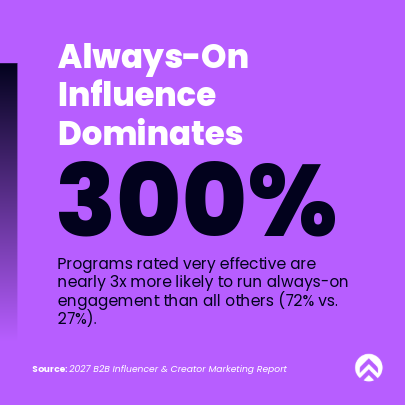
Programs rated very effective are nearly 3x more likely to run always-on engagement than all others (72% vs. 27%). That 45-point spread is the single clearest differentiator in the survey. Always-on programs also attribute nearly double the revenue to their influencer efforts compared to campaign-based programs (42% vs. 24%).
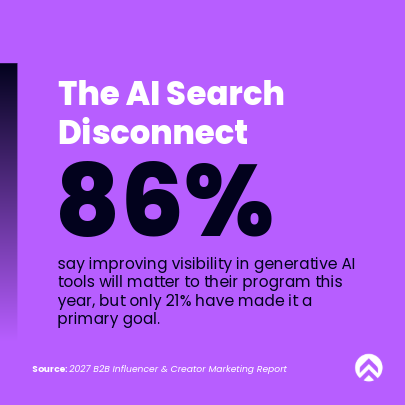
86% say improving visibility in generative AI tools will matter to their program this year, but only 21% have made it a primary goal. More than half (53%) call genAI visibility very important. Awareness is high. Action lags, and the gap will only get more expensive to close.
AI search optimization is the widest integration gap between top performers and everyone else: 49% vs. 27%. That 22-point spread is larger than the gap for paid media, events, ABM or sales enablement. Content marketing integration, by contrast, is now table stakes at 57% vs. 56%. Differentiation has moved.
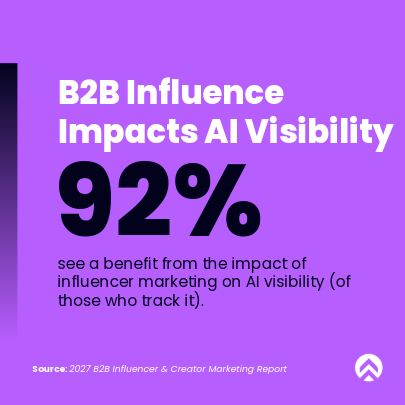
92% see a benefit from the impact of influencer marketing on AI visibility (of those who track it). 34% report their brand cited in AI-generated responses, 32% report Google AI Overview or SearchGPT appearances and 31% report referral traffic from AI assistants. Only 8% tracked these outcomes and saw no impact. Tracking pays off fast.
Trust beats reach when selecting creators. B2B marketers choose influencers and creators for trustworthiness and credibility (46%) and audience relevance (40%) well ahead of audience size (30%). This has been a consistent pattern across every edition of our research. Meanwhile, pay-per-deliverable (51%) has overtaken performance-based compensation (48%) as the top model, reversing last year’s order.
Beneath the data, there is an important theme. In a sea of AI generated sameness, humanity is the differentiator. The brands that get chosen will be the ones that earn belief through credible voices, useful experiences and consistent presence. Everybody wins when influence is practiced this way: customers get answers they trust, creators grow their credibility and brands make it to the shortlist.
More on what you’ll find inside the 2027 report:
This 54-page report is organized around one important question: what separates the top performer from everyone else? You’ll find answers to that in these chapters:
- The State of B2B Influence. Where the discipline stands today: adoption, program maturity, documentation, budgets and five trends from five years of benchmark data that show how B2B influence grew from an experiment into a measured discipline.
- Follow the Leaders. A head-to-head look at what very effective programs do differently, from always-on cadence and documented strategy to full-funnel deployment and investment in durable formats like podcasts, research reports and newsletters.
- The New Rules of B2B Discovery. How AI is driving discovery for B2B brands, why creator-produced content is becoming the raw material answer engines cite, and three movements that define the transformation of modern B2B marketing.
- B2B Influencers vs. Creators. Who B2B brands are actually partnering with today, what they’re selected for, how they’re compensated and what builds lasting, productive relationships. Find out why entertainment creators are the fastest-rising profile.
- Influence Multipliers: Always-On & Integration. Why programs that integrate broadly and run continuously outperform campaign-based efforts on nearly every measure, including revenue attribution and AI citation rates.
- Measuring & Proving the Value of Influence. How top programs measure success, win budget and bring AI visibility into the boardroom. Learn what the C-suite actually wants reported.
- The Future of Influence for B2B Marketing. Forward-looking signals for where B2B influencer marketing is headed next, from reach to citation, and how to get ahead of it.
The report also includes two tools you can put to work right away: The B2B Creator Content Marketing Maturity Model, a five-dimension benchmark for scoring your program against the data, and The Best Answer Marketing Action Plan for B2B Influence, which maps influencer marketing to the six pillars of our Best Answer Marketing framework.
There are also two B2B Influencer Marketing client case studies that show the data in action:
- Avalara built an integrated, always-on program that drove more than 600K in reach and an 8.7% landing page conversion rate while lifting organic search traffic 19%. ]
- Asana’s always-on, multi-tier creator program generated 21.9 million organic views across 52 videos, beating its goal by 433%.
Finally, the report recognizes 20 B2B Influencer Marketing Leaders to Watch in 2027, all B2B brand-side marketers at companies including Figma, Salesforce, Adobe, Anthropic, MongoDB, IBM, NVIDIA, Google Cloud, HubSpot, Canva and Workday who are moving the practice of B2B influence forward. B2B influencer and creator marketing is a team sport, and this report is proof of that.
Insights on B2B Influence from Top B2B Marketers:
On top of the research findings, the report features perspectives from B2B marketing leaders who are building, buying and measuring influence every day. Their contributions provide context and validation for what the data shows. All quotes below are verbatim from the report; contributors reviewed and approved their quotes prior to publication.
“Influencer marketing is no longer being treated as a nice to have. It’s not just an awareness tactic. It’s increasingly being used as a structured way to build confidence in a brand.” Kelsey Voss

Kelsey Voss
Principal Marketing Analyst
EMARKETER
/in/kelseyvoss/
“Your buyer will walk into rooms your brand will never be invited into. Creators can help equip them with expertise they trust, proof they can share and language that helps colleagues understand the choice. The opportunity is to build confidence that travels through the buying group.” Ty Heath

Ty Heath
Global Director, Thought Leadership GTM
LinkedIn
/in/tyronaheath/
“B2B creators are multifaceted. They understand that their expertise is an asset they own, not something that belongs only to an employer, and they’re using it to propel themselves and their careers. Visibility used to be a nice to have, something optional and adjacent to a resume, but it’s fast becoming one of the most valuable lanes a person can build in their career, often more durable than a title.” Roo Yeshpaul Johnson
Roo Yeshpaul Johnson
Head of Creator Marketing, Figma
/in/rooyj/
“Since our first report in 2020, I’ve watched B2B influence grow from a side experiment into something buying committees genuinely trust. In the programs I work on, three things consistently separate the leaders. Partners over placements. The best results come from creators who know a brand well enough to talk about it in their own words. This takes time and real collaboration, but a steady presence is what keeps a brand showing up in feeds and AI answers alike.” Debbie Friez

Debbie Friez
Associate Director, Influencer & Social Media Marketing
TopRank Marketing
/in/dfriez/
“Trust is not something you can get, it’s something you earn, through experience, expertise and authority. When an independent voice with real credibility speaks on your behalf, you’re borrowing trust they spent years earning. That’s worth more to a B2B brand than audience size alone.” Michael Brenner

Michael Brenner
VP, Storytelling
Workday
/in/michaelbrenner/
“Closing this disconnect is possible with the data that most marketers already have in hand. It requires two things. First, a living measurement approach with a stable core and a deliberate process for testing and folding in emerging signals like AI visibility as they mature. Second, custom scoring and bespoke analysis built around a brand’s own channel mix and variety of data sources. With those two things in hand, visibility gets tied to credible business-linked cases that leadership will act on.” Jane Bartel

Jane Bartel
Director of Search, Content and Analytics
TopRank Marketing
/in/janebartel/
We sincerely appreciate these B2B marketing leaders for sharing their perspectives on where B2B influence is headed, and for the practitioners recognized in the report as leaders to watch in 2027.
Questions about B2B influencer and creator marketing answered in this year’s report:
If you’re still wondering about the report, here are some of the most pressing questions B2B marketers are asking about influence, creators and AI search that the research answers.
What is the state of B2B influencer marketing in 2027?
B2B influencer marketing is mainstream. According to The 2027 B2B Influencer & Creator Marketing Report from TopRank Marketing and Ascend2, 83% of B2B marketers have an influencer program, are building one or plan to launch one within a year. 93% rate their program effective and 46% rate it very effective. 48% describe their approach as always-on, 33% run campaign-based programs and 76% have a stable or growing dedicated budget. Only 46% have a fully documented strategy.
What do very effective B2B influencer marketing programs do differently?
Very effective programs run always-on engagement (72% vs. 27% of all others), have a fully documented strategy (73% vs. 22%), integrate influencer marketing with AI search optimization (49% vs. 27%) and with paid amplification (53% vs. 38%), partner with executive-level leaders as creators (43% vs. 24%) and use a purpose-built influencer platform (52% vs. 24%). They also deploy influence across the full customer journey, including evaluation (62% vs. 44%), decision (63% vs. 48%) and post-sale (46% vs. 25%), and invest more in durable formats such as podcasts (37% vs. 19%), research reports (35% vs. 22%) and newsletters (38% vs. 25%).
How does B2B influencer marketing improve AI search visibility (AEO/GEO)?
Answer engines cite trusted third-party voices more than brand-owned content. 89% of citations for unbranded prompts come from third-party sources (Bain & Company), and only 4.3% of B2B companies appear in early-stage buyer questions inside AI environments (2X AI Visibility Index). Influencer and creator content gives answer engines credible, citable material about a brand. Among B2B programs that track the effect of influencer marketing on AI visibility, 92% see a benefit: 34% report their brand cited in AI-generated responses, 32% report Google AI Overview or SearchGPT appearances and 31% report referral traffic from AI assistants. Always-on programs report higher genAI citation rates than others (43% vs. 26%).
What is always-on influencer marketing and why does it outperform campaigns?
Always-On Influencer Marketing is an operating model in which a brand maintains ongoing relationships and engagement with a core group of influencers and creators year-round rather than activating them for isolated campaigns. In the 2027 report, always-on is the clearest differentiator between very effective programs and everyone else (72% vs. 27%, a 45-point gap). Always-on programs attribute nearly double the revenue to influencer marketing compared to campaign-based programs (42% vs. 24%), are more likely to report revenue attribution to leadership (42% vs. 24%) and earned media mentions (37% vs. 26%), and are far more likely to call AI visibility very important (70% vs. 38%). The reason is compounding: B2B buying runs on long cycles, and relationship equity, content quality and brand familiarity build with every cycle instead of resetting to zero with each campaign.
What is the difference between a B2B influencer and a B2B creator?
In B2B, “influencer” still names the practice, while the people who power it are increasingly described as creators. The creator as expert brings credentials, deep expertise or lived experience, such as an industry analyst or a well-respected executive. The creator as entertainer brings media savvy, storytelling instinct and performance skill. In 2027, B2B brands most often partner with content creators who have large professional audiences (44%), customer advocates (42%), independent consultants (37%), subject matter experts (36%), executive leaders (33%) and entertainment creators (33%). Entertainment creators are the fastest-rising profile: 43% of very effective programs partner with them, nearly double the rate of everyone else (25%).
How do B2B brands select and compensate influencers and creators?
B2B marketers select creators primarily for trustworthiness and credibility with their audience (46%) and relevance of their audience to the target market (40%), ahead of subject matter expertise (31%), engagement rate (31%), audience size (30%) and values alignment (29%). Trust beats reach, a consistent finding across every edition of this research. For compensation, pay per deliverable is now the most common model (51%), followed by performance-based pay (48%), credibility or reach such as co-branding and speaking opportunities (38%), product or service access (34%) and trade or reciprocal arrangements (25%). 22% of B2B brands are not currently compensating influencers.
How do B2B marketers measure and prove the value of influencer marketing?
The most common success metrics are engagement (48%), ROI (46%) and reach or views (45%). Revenue attribution (33%) and pipeline influenced (25%) lag behind. 92% of marketers feel at least somewhat confident justifying influencer budget to a CFO, but only 52% feel very confident. What gets reported to leadership skews toward brand awareness (54%) and engagement (47%), while C-suite respondents say they care more about revenue attribution (38%) and pipeline (25%). 30% of marketers now report AI search visibility to leadership, and marketers who feel very confident justifying budget are nearly twice as likely to do so (38% vs. 21%).
How has B2B influencer marketing changed since 2020?
Five editions of benchmark data show a discipline that has grown up. In 2023, half of B2B marketers did not track influencer performance at all; in 2027, only 3% go unmeasured. In 2022, nearly one in four had no influencer strategy; in 2027, just 2% operate without a documented strategy and no plans to create one. Always-on adoption more than doubled, from 21% in 2022 to 48% in 2027. AI went from an early advantage to an expectation, with 94% of B2B marketers now using AI somewhere in their influencer strategy, led by performance tracking (64%) and content creation (61%). Top-tier confidence grew 12 points, from 34% rating their strategy extremely effective in 2023 to 46% rating it very effective in 2027.
What are the top B2B influencer marketing trends and predictions for 2027?
The report points to five directions. Share of voice gives way to share of citation as AI-assisted discovery grows. AEO/GEO integration moves from differentiator to baseline as today’s 22-point gap closes. Durable content formats such as podcasts, research reports and newsletters keep gaining ground as short-form social content commoditizes. Compensation professionalizes further as performance-based and credibility-based models displace flat, ad hoc arrangements. And executives lead while teams follow, with leadership expectations around AI visibility filtering down into program design. Taken together, B2B influence is moving from campaign to system, from reach to citation and from tactic to infrastructure.
Is your brand the best answer for buyers who are asking AI?
Your customers are prompting AI, searching Google and turning to voices they trust. The brands that make the shortlist will be the ones that show up with credibility wherever the question is asked. This report shows what the programs earning that credibility do differently, and how to put the same practices to work.
Download the PDF of The 2027 B2B Influencer & Creator Marketing Report here.You’ll find the full benchmark data, the B2B Creator Content Marketing Maturity Model, the Best Answer Marketing Action Plan for B2B Influence and the 20 B2B influencer marketing leaders to watch in 2027.
A HUGE THANKS to our research partner Ascend2 for their work designing and fielding the survey and the initial analysis, now across five editions of this research. And another HUGE THANKS to Nick Nelson and Jake Murphy from the TopRank Marketing team for their amazing work bringing this report to life. MUCH APPRECIATION as well to the B2B marketing leaders who contributed their perspectives and to every one of the 400+ senior B2B marketers who shared their experience in the survey. B2B influence is a team sport, and this report is proof!