


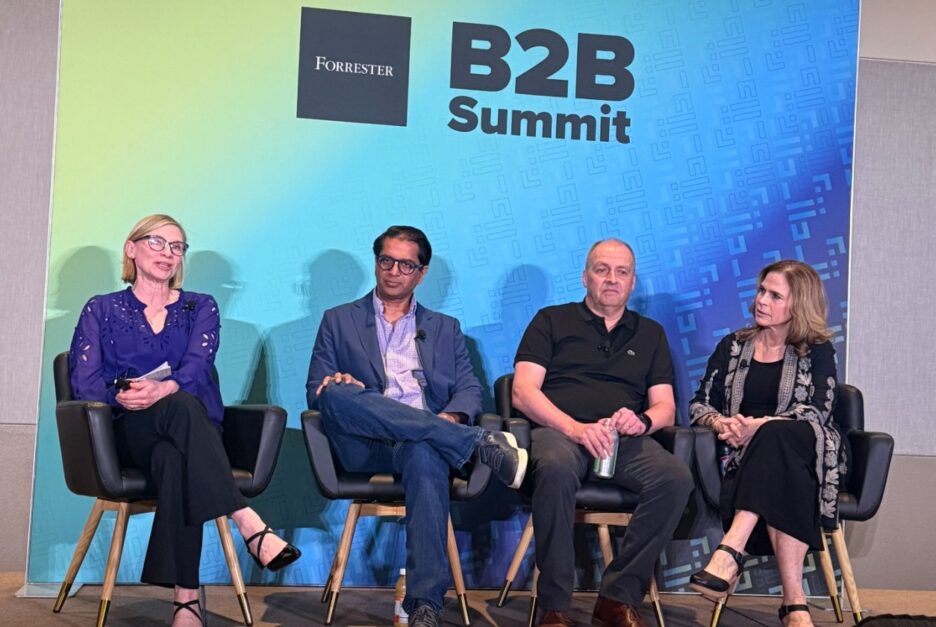
This post features insights from the “Authentic Content Builds Buyer and Customer Trust” panel at Forrester B2B Summit North America 2026.
The room at Forrester B2B Summit North America had all attention to the front for a reason. A panel featuring analysts from Forrester alongside marketing leaders from LinkedIn and SAP Concur who took on one of the most pressing questions facing B2B marketers right now: in a world flooded with AI-generated content, what does authentic content actually mean and what role does it play in modern information discovery, engagement and building decision confidence?
The answer, drawn from Forrester research, practitioner experience, and platform-level data, was both clarifying and actionable. The decision to emphasize authenticity in content is the foundation of building trust. With 94% of B2B marketers agreeing that trust is the most important factor for achieving B2B brand success, that foundation is more important than ever.
The visibility shift: AI has changed the starting line
The session opened with Forrester’s Karen Tran sharing a data point that is an important clarification about modern content discovery. According to Forrester’s Buyers’ Journey Survey, 2025, generative AI conversational search tools now rank as the single most meaningful interaction in the B2B buying process, ahead of social media, industry publications, product experts, and vendor websites.
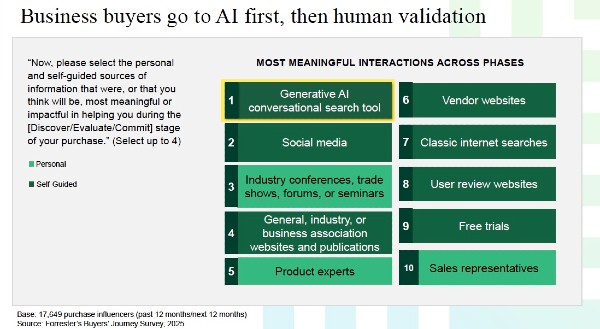
Buyers go to AI first. Then they seek human validation.
That sequence has direct implications for content strategy according to data shared by Karen from Forrester: 85% of brand mentions come from third-party sources, and 49% of executives report actively questioning how their brand and content appear in AI-powered search. Yet only 50% of B2B marketing decision-makers say they currently optimize content for AI-powered search, and just 47% create content specifically designed to directly answer the questions buyers are asking.
The gap between where buyers are looking and where most brands are present is the both a challenge and an opportunity. B2B brands across the board are seeing a decline in visibility and the sense of urgency to reclaim that lost attention is higher than ever. Of course being more visible is just the start. Being the chosen solution recommended by the trusted sources that influence buyers from AI search to Google to industry media to creators is where attention becomes intent and is at the heart of being the best answer.
Three audiences every B2B content program must serve
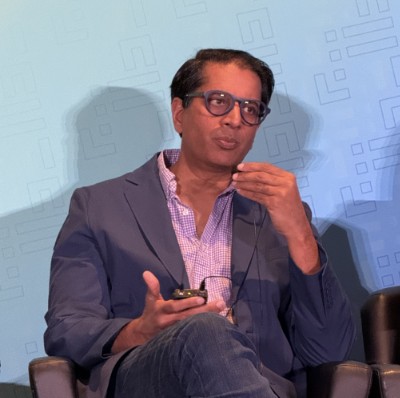
Davang Shah, VP of Marketing at LinkedIn, shared some clarity around the role of content in B2B marketing: today’s content programs must influence three distinct entities simultaneously.
“Content is grounded in trust that helps buyers make a decision that answers a question in a way that is useful. There are three entities to influence: end customers, LLMs, and agents. All of them are grounded in building trust.” – Davang Shah, VP Marketing, LinkedIn
For B2B marketers navigating their visibility gap, that framing of customers, language models, and AI agents is a useful one. What earns trust with humans (credibility, consistency, third-party validation) largely also earns inclusion in AI-generated answers. In some ways, those principles of being chosen as the answer converge. If you are treating AI optimization as separate from audience-first content, you are probably working harder than you need to.
Davang also added a demographic signal worth considering when you are making content decisions: 71% of B2B buyers today are Gen Z and millennials, and they are looking for content they can trust to help them solve problems, not content engineered to sell. The buying cycle, according to data from Dreamdata that Davang referenced, now averages 272 days. And buyer groups are larger, involving an average of 22 people (Forrester). In today’s customer journey, trust must be built across a long arc, with multiple voices, across multiple channels.
What authentic B2B content actually requires

Karen Tran, Principal Analyst at Forrester, pressed the panel throughout on one of the harder questions B2B content leaders face: how do you maintain authenticity while capturing the efficiency and scale that AI makes possible?
The concern she shared, that AI can make content vanilla, is real. But the panelists’ responses clarified that AI is a production accelerator, not a substitute for the source material that earns trust. And that means the authentic inputs have to come first.

Phyllis Davidson, VP Principal Analyst at Forrester, explained this as a primary and derivative model.
“Once you have high-value content – thought leadership, data from a third-party study – you can use that authentic content and use AI to create derivatives. Think of modules of content that drive trust, that are authentic and tell your brand story.” – Phyllis Davidson, VP Principal Analyst, Forrester
This insight shared by Phyllis maps directly to the content atomization approach at the center of Best Answer Marketing. Original research, proprietary data, and genuine expert perspective serve as primary assets. AI then helps scale those assets into derivative formats including social posts, video scripts, email sequences, summaries, etc that reach buyers across channels throughout that long 272-day journey. To maximize value and impact, the sequence matters: authentic inputs first, then scaled distribution.
Phyllis also shared a risk that doesn’t get enough attention: 60% or more of marketers recognize they are personalizing content based on the messages they want to deliver, not the messages buyers want to hear. AI risks scaling that misalignment. The fix is to train your AI systems to advocate for buyer needs, not brand preferences.
The case for third-party validation and its evolution

Rob Gubas, Senior Director of Global Integrated Campaigns and Content Strategy at SAP Concur, brought the practitioner perspective on third-party validation.
“Analyst content and third-party validation used to be table stakes. The real benefit now comes from marrying an analyst perspective with proprietary information from the brand. A five-stage maturity model built on 30 years of data, validated by an industry analyst – that combination creates something genuinely defensible.” – Rob Gubas, Senior Director Global Marketing, SAP Concur
Rob talked about three forms of third-party validation that matter most right now: analyst-validated proprietary research, customer reviews (which he described as a primary input for LLMs), and influencer programs. He said that his own skepticism about B2B influencer marketing had shifted considerably and that he is now a believer, based on measurable program performance.
The data from TopRank Marketing’s own research reinforces that shift. The State of B2B Thought Leadership in 2026 report found that 72% of B2B marketers who frequently collaborate with influencers report their research-based content is very effective, compared to just 29% of those who do not. That performance gap is a strong argument for ongoing influencer and creator investment as part of a trust-building content creation and distribution strategy.
Consistency and longevity over one-and-done
A theme running through the entire session was the importance of consistency over volume. Rob talked about how a unique perspective on a topic of persistent audience interest, built and sustained over time, compounds in value in ways that campaign-by-campaign content never can.
“No one-and-done. Something you build up over time, program over program, year after year. Having that patience is key.” – Rob Gubas, Senior Director Global Marketing, SAP Concur
Davang expanded on this into the question of how brands use the voices available to them internally and through influencer and creator partnerships. People buy from people, not from brands. His data point: 77% of B2B buyers are more likely to purchase when they see people from the brand active on social media. What matters is less how much your brand says and more who says it – and whether those voices show up consistently with genuine perspective over time.
This connects directly to a finding in TopRank’s thought leadership research: 97% of B2B marketers say thought leadership is critical to full-funnel success, yet only 43% extend it beyond acquisition to engage and retain customers post-sale. The long-term value of consistent, trust-building content is broadly understood – but infrequently acted on.
Integration across owned, earned, and paid
I asked the panel about the role AI could play in integrating content across owned channels, earned media, and influencer and community partnerships. specifically given the need for consistency and longevity across that 272-day buying cycle.
Davang’s response was that brand voice and unique selling proposition are the foundation. They are the lens through which consistency is enforced across every touchpoint. Without that foundation, AI-enabled integration risks scaling incoherence rather than coherence.
Rob stressed the importance of a collaborative process: maintaining a consistent narrative thread requires intentional cross-functional alignment. The message needs to travel through every channel, not just originate in one.
The conclusion of the session by Karen Tran from Forrester reinforced these points: build authenticity into all content and messaging across activation channels, prioritize co-creation with credible third parties to enhance brand visibility, and establish strong governance to ensure brand alignment and brand safety.
GEO: optimizing content for the AI answers buyers actually see
AI as a discovery channel is front an center in every B2B marketing conversation and this session provided multiple insights. Davang was unambiguous about the importance: “94% of buyers are using LLMs on their journeys. If you’re not present at that initial stage, you’re not on the day one list. If you’re not on that list, your chances of being chosen go down significantly.”
This is the domain of AI search optimization (AEO/GEO) and structuring content so that it is surfaced, cited, and recommended by AI systems, not just ranked in traditional search results. Forrester frames it as a zero-click visibility problem: when an AI tool synthesizes an answer directly, content that isn’t structured to provide upfront value gets bypassed entirely. It simply doesn’t get chosen as an answer that buyers will ever see.
What earns inclusion in AI-generated answers follows the same logic the panel applied to buyer trust. Specificity matters more than volume. Original data and proprietary insights are more citable than generic commentary. Third-party validation signals credibility to AI systems the same way it signals credibility to human buyers. And content organized around what buyers are actually asking vs. what your brand wants to say is more likely to be retrieved and surfaced as an answer.
Rob made a great point about customer reviews that applies directly here: he described them as a primary input for how LLMs characterize brands and products. Organic, third-party language in reviews and analyst reports carries weight with AI systems because it is independent. That’s one more reason the shift Rob described of actively combining third-party validation with proprietary research, represents an AI search optimization advantage as well as a trust-building one.
The good news: AI search-aware content is not an entirely separate discipline. It shares many of the same characteristics that the panel described throughout the session: structured around buyer questions, grounded in original data, validated by credible voices, consistent in perspective and terminology across channels. If you are applying those principles, you are already doing the right things. The question is whether your distribution architecture ensures that content is findable wherever buyers are looking. Or as we like to say it, are you the best answer where and when buyers are looking?
What AI and authenticity means for your content strategy in 2026
As you can probably tell, the panel’s central argument aligns well with our Best Answer Marketing framework: the brands that will earn visibility in AI-generated answers, in search, and in the minds of B2B buying groups are the ones building a genuine trust infrastructure, not a content production machine.
That infrastructure has specific parts: original research or proprietary data that gives buyers insight they cannot find elsewhere, third-party voices that validate your claims, consistent presence across the channels where buyers are looking for answers, and an AI strategy that accelerates distribution of authentic inputs.
Our research found that 93% of B2B marketers using research-based content say it is effective at driving engagement and leads, with nearly half calling it very effective. The session at Forrester B2B Summit confirmed why: research-backed content, amplified by trusted voices and optimized for the channels buyers actually use – including generative AI – is what it means to be the best answer when it matters most.
For more insights on putting Best Answer Marketing into action, check out the BAM Playbook.