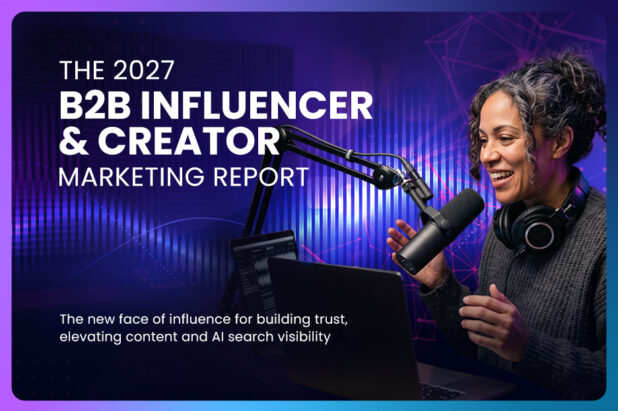



At Cannes Lions this year, creators moved from a side rooftop to the main festival footprint with more than 250 creators participating, the most in the festival’s history.
At the same time, LinkedIn launched Creator Marketplace, a tool built directly into Campaign Manager intended to help B2B brands find and partner with trusted professional voices. LinkedIn’s 2026 Global B2B Marketing Outlook research with YouGov reinforces that investment:
- 82% of B2B marketers say creators increase credibility with decision-makers
- 83% say credibility now matters more than traditional brand messaging
- 56% of buyers rely on creator input in the final stage of a purchase decision.
LinkedIn told creators at a recent event that their numbers on the platform have doubled since 2021.
B2B buying decisions have always been influenced by trusted individual voices more than brands, but that level of influence is accelerating.
And that means increased investment which has a few effects worth noting. One of which is that with more demand for creators and influencers, the less available the top influencers become. Every person working with creators and influencers right now is already having a hard time getting creators to respond to opportunity pitches, even when lucrative and with well known brands.
So where should a B2B brand look first for voices its buyers will trust? The answer is something our B2B influencer marketing research has been covering over the past 4 years. B2B brands should definitely engage with industry influencers and creators, but where your competition isn’t focusing is elevating the visibility and influence of executives already inside the company. They hold the expertise, the customer relationships, and the credibility of the kind of lived experience that AI can’t replicate and camera savvy creators don’t have the depth for. What most B2B brands lack is a system for turning that credibility into content that drives visibility, credibility and decision confidence.
This post makes the case for investing in B2B executive influence, explains why the rise of AI search makes that investment even more important, and shares ten high impact strategies for building executive influence whether your leaders are naturals on social media or not.
What is executive influence in B2B marketing?
Executive influence is the practice of building the visibility, credibility, and audience of a company’s leaders so their expertise attracts, engages, and reassures buyers across the customer lifecycle. It combines thought leadership content, social engagement, influencer collaboration, and earned media into an ongoing program. The result? Executives becomes trusted voices that buyers seek out, and the brand inherits that trust.
What does the research say about executive influence?
The evidence has been building for years. In a TopRank Marketing B2B Influencer Marketing Research Report, 65% of B2B marketers said internal executives had been very or extremely effective at increasing the influence of the brand. Not a single respondent rated them ineffective. 75% reported working with executives to build credibility with customers, and 63% did so specifically to improve sales conversations.
The appetite was already near universal: over 60% of marketers worked with internal executives to grow thought leadership and influence, and another 23% wanted to. That adds up to more than eight in ten B2B marketers who see executive influence as part of the playbook for relevance.
Our newer research shows why the B2B leaders that are pulling ahead keep investing in building influence. In TopRank Marketing’s State of B2B Thought Leadership in 2026, produced with Ascend2,
74% of B2B marketers who frequently collaborate with influencers rated their research-based content as very effective, compared to just 29% of everyone else.
Credible human voices, inside or outside the brand, are the single largest effectiveness multiplier the study found.
Other industry research points the same direction and thought leadership content is an ideal platform for integrating executive influence and industry influencers. The Edelman-LinkedIn B2B Thought Leadership Impact Study found that 74% of decision-makers view thought leadership as more trustworthy than product marketing materials, and 95% of hidden buyers, those not yet engaging with sales, say strong thought leadership makes them more receptive to outreach. And research from the IBM Institute for Business Value quantified the financial impact of thought leadership as influencing an estimated $265 billion in annual spending world-wide and delivers an average ROI of 156%, roughly 16 times better than traditional marketing.
According to TopRank Marketing research, 66% of B2B marketers say internal executives have been very or extremely effective at increasing brand influence, and marketers who frequently collaborate with influential voices are more than twice as likely to rate their content as very effective.
It comes down to the fact that buyers trust people. Executives are the people that your B2B brand already has. There’s plenty of evidence for the power of building influence from within, so how should B2B brands put that insight into action? First we need to talk about where AI fits in this conversation.
Why does AI make authentic executive voices more valuable?
There is great potential for B2B marketing and AI. At the same time, use of AI for marketing is not magic. I like to think of AI as something that makes you more of what you are. And B2B marketing does not have a reputation for inspiring levels of creativity. That means AI is accelerating what exists, the average of what exists. Put another way, AI is enabling mediocrity at scale for many B2B marketers. And that the rise of AI use in marketing has made human credibility even more valuable. At the same time it has changed where that credibility gets discovered.
One of the most important changes is with buyer behavior. Forrester’s Buyers’ Journey Survey found that 94% of business buyers now use AI in their buying process, and twice as many buyers named generative AI or conversational search as a more meaningful source of information than any other source, ahead of vendor websites, product experts, and sales reps.
The effect of this behavior shows up in how B2B vendors are selected. According to G2’s 2026 Buyer Behavior Report, which surveyed 1,076 B2B software decision-makers, 51% now begin software research with an AI chatbot more often than with Google, up from 29% just eleven months earlier. And interestingly, 69% of buyers chose a different software vendor than they initially planned based on AI chatbot guidance, and one third purchased from a vendor they had never heard of before
The use of AI has impacted thought leadership content specifically. The Answer Engine B2B Thought Leadership report found that 32% of professionals now discover thought leadership through GenAI tools, a channel that was not even included in most marketer distribution lists a few years ago.
There’s plenty of advice available about how AI engines decide which brands to recommend, but it comes down to consensus and proof. Answers from LLMs and AI search favor named, credible, expert-attributed sources that are corroborated across the web. LinkedIn has become one of the most cited sources in professional AI chatbot queries, and only public content appears in those answers. An executive that is publishing consistently in public is building AI citation inventory for the brand with every post, whether it reaches their immediate followers or not.
At the same time, the flood of AI-generated content has made authentic human perspective one of the scarcest assets (and most valuable) in B2B marketing. As was mentioned in the Answer Engine B2B Thought Leadership report:
“We’re surrounded by sameness right now, so when a real human voice comes through, when there’s empathy, curiosity, even vulnerability, that’s what cuts through.” – Brian Solis, Head of Global Innovation at ServiceNow
B2B executive influence content does double duty: it persuades the humans making buying decisions and it feeds the AI engines deciding which brands get recommended. Every podcast episode, LinkedIn post, contributed article, and co-created insight is both a trust signal to buyers and a citation source for answer engines. That dual payoff is the executive influence advantage, and here’s how you can put that insight into action.
10 high-impact strategies for building B2B executive influence
The strategies below reflect what we have seen work across more than a decade of building influence programs for B2B brands. Each one serves both B2B buyers and AI visibility at the same time. For a broader tactical menu, see our guide to building B2B executive credibility and thought leadership.
1. Launch a video podcast featuring your executives. One recording session can generate full episodes, short-form video clips, quote graphics, blog posts, newsletter content, and audio. That repurposing engine can multiply limited executive time across every channel where your buyers are looking, and podcasts can be a goldmine for the kind of content AI search and LLMs prefer to cite. The business executive does not have to be the host: a PR or marketing leader could host, or an industry influencer could be engaged to interview brand executives which lowers the lift and can add third-party credibility.
2. Co-create content with established industry influencers. What better way to create influence than to collaborate with those that already have it? Association transfers authority. When respected voices appear alongside your executives, their credibility extends to your leaders and their audiences extend your reach. This is what’s behind the 74% vs. 29% effectiveness gap in our thought leadership research, and it works in both directions because even when compensated, B2B influencers value access to genuine executive expertise and brands that align with their subject matter and community.
Consider a podcast program we ran for a global enterprise software brand:
An influencer host with a large, engaged technology audience anchored the series, interviewing expert guests mapped to specific business units. As the program matured, each episode wove audio from industry influencers, customers, and the brand’s own executives into a produced narrative, featuring more than 35 voices across a single season. Every episode shipped with a transcript, an optimized landing page, and social amplification activated by the host, guests, employees, and brand channels. The results: average 30-day episode downloads 71% higher than the prior season and 100% above the industry benchmark for new podcast launches, potential social reach of 39 million (a 200% season-over-season increase), and a 409% increase in social engagements. Executives from this brand gained visibility and credibility through association, without carrying a show alone.
3. Build a LinkedIn engagement system. Consistent publishing on LinkedIn matters, and engagement matters more: commenting on industry conversations, responding to buyers, and collaborating with other voices are all important part of social engagement. But you have to know which accounts to engage with, what’s important to those accounts and the context for interaction. LinkedIn’s creator investment means the platform is actively amplifying individual voices over company pages. B2B executives who cannot write daily can operate on an assisted cadence with editorial support that retains their authentic voice.
4. Contribute to and champion original research. Executives quoted in proprietary research inherit its authority and its citations. Original research is the most trusted content type: in our B2B Thought Leadership study, 35% of B2B marketers said original research is significantly more valuable than AI-generated content for building trust, and another 32% said it is more impactful overall. B2B brands that feature their executives in research reports provide a platform for the executive to provide context to the research but also a way for executives to be cited in industry coverage of that research, which expands their footprint and credibility.
5. Pursue earned media and analyst citations deliberately. Third-party validation is something that can compound executive influence. Press quotes, analyst mentions, and industry awards can build executive reputation with buyers, and brand mentions across credible third-party sources are among the strongest correlations to AI citations. Make media availability and commentary an ongoing part of the executive’s program should start with increasing the executive’s social footprint and credibility worth citing.
6. Speak at industry events, then repurpose everything. A single keynote can become video clips, a contributed article, social assets, and podcast material. In-person events consistently rank among the most effective B2B channels in our research year after year, and the stage photo alone is a credibility signal that outlasts the event. Events are also opportunities to appear on on-site podcasts, have your own editorial team cover the executive’s presence at the event, or have industry influencers interview your executives at the event for promotion on their channels.
7. Publish a signature point of view. A recurring, named editorial asset, whether a LinkedIn newsletter, a column, or a monthly video series, gives buyers a reason to subscribe and gives AI engines a compelling source to attribute. In this case, consistency of theme matters more than frequency: the goal is for the executive to become the recognized voice (or “best answer”) on a specific set of topics that your buyers care about. Unique POV perspectives shared through the lens of lived experience is not something AI can easily replicate nor a competitor.
8. Activate employee amplification around executive content. One thing I’ve said for years is that if they care, they’ll share. Your workforce can be a distribution network that brings built-in trust. Employee sharing of content on social channels can extend executive reach at no media cost and when done right, adds the authenticity of colleagues that are vouching for their leaders. We cover how to build this system in How to Build a B2B Influence Engine From Within.
9. Engage prospect and customer networks directly. Beyond content creation, executive influence can be a powerful relationship asset. Thoughtful engagement with the networks of key prospects and customers can warm sales conversations before they happen. In our past research, 63% of B2B marketers built executive credibility specifically to improve sales conversations, so this is an important area of focus with a direct connection to measurable ROI.
One program we manage for the CEO of a global technology company shows what this looks like in practice.
The program pairs strategic LinkedIn content built from the CEO’s own perspectives with targeted networking: deliberate, ongoing engagement with a curated list of prospect and consultant contacts. In one year, the program nurtured 204 targeted professionals through direct engagement, grew the CEO’s connections 8.4% and followers 10.3%, and increased content views 33% and engagements 43% year over year, at an engagement rate roughly double the industry average. The most telling: top-performing posts consistently reached audiences that were 90 to 99% external, including prospects, customers, and consultants, and the program secured new connections with senior leaders at some of the world’s largest enterprises.
10. Measure influence like a program. There can be a temptation to treat executive influence programs with a focus on the individual. For impact, it’s important to treat building executive influence as a program. And that means accountability. Track share of voice on priority topics, AI citations of executive content, earned media mentions, audience growth quality, and pipeline influenced. Like any B2B marketing activity, what gets measured gets budget, and executive influence programs that report business outcomes can survive leadership changes and budget cycles.
What if Your B2B executives are not naturals on social media?
This is one of the most common challenges we hear, and the answer is that influence programs are built on systems, not as personality contests.
Most successful executive influence programs involve a support structure: research, strategy and editorial support that preserves the executive’s authentic voice, a repurposing engine that multiplies limited executive time, influencer relationships that are brokered on their behalf, and coordination so multiple leaders reinforce a common narrative instead of competing with it.
Consider this program for a Fortune 50 B2B technology brand.
The company had multiple executives willing to participate, each with a different role, voice, and comfort level on social media. TopRank Marketing built a social engagement and influence development program tailored to each executive’s unique voice, coordinating their messaging so leaders across the business reinforced a common narrative rather than competing with it. The execution mix combined optimized social content creation, always-on influencer relationship building, and creative collaboration. The results: 480% over benchmark impressions, a 21% month-over-month increase in new followers, a 14% month-over-month increase in new LinkedIn connections, and multiple organic features in the LinkedIn newsfeed. The program extended beyond social too, producing real-world influencer relationships that led to livestream event hosting and speaking slots at quarterly sales meetings (See more details in the B2B Influencer Marketing Research Report).
The pattern across every executive influence program we have built is that B2B executives do not need to become creators themselves. They need a system that captures their genuine expertise and puts it where buyers and AI engines are looking.
The opportunity to build B2B influence from within is now
From Cannes to LinkedIn’s marketplace, the Creator narrative is proliferating B2B marketing conversations. Buyer trust in individual voices is on the rise, and AI engines now influence which brands get recommended and make the short list before a single sales conversation happens. There’s a reason we’re now seeing more B2B companies approach us for support of C-Level and executive visibility from podcasts to social engagement than ever.
Every one of the forces shared in this post favors B2B brands that invest in executive influence now. Credible executive voices take time to build, and the competition for attention in your category is compounding. The executives who publish, engage, and collaborate today will be the voices AI engines cite and buyers trust tomorrow.
If you’d like to see what the data says about where B2B influence is heading next, get early access to our 2026 B2B Influencer Marketing Research Report. And if you are ready to build influence for your B2B executives, whether they are naturals on social or nowhere near it, let’s talk.