



I vividly recall the experience that led to the biggest decision of my life. A good friend rang my doorbell and presented me with a small tub of my favorite ice cream, hoping to cheer me up after I’d been dumped. That was it — he left, and I stood there holding the ice cream, a sudden certainty washing over me. Over 20 years later, I’m happy to report that he still brings me ice cream.
There’s a particular kind of confidence that comes from making a clear-eyed decision. Not excitement, but rather a calm certainty. Big decisions often hinge on moments where integrity and truth are reinforced in real time through an experience that removes all doubt.
B2B decisions aren’t any different. Offering an experience that holds up under scrutiny can be the catalyst that moves buyers forward.
This series has been building toward this moment. After exploring how insight, integration, and trust shape decisions, the next pillar focuses on experience: what happens when buyers are allowed to engage with ideas.
Why experiential content is so important for B2B marketing
B2B buyers are often navigating a steady stream of information, from both your brand and your competitors. At pivotal decision-making moments, what they need most is reassurance that your claims can stand up to questions, context, and real-world application.
Experiential content addresses that need by creating opportunities for interaction, clarification, and shared understanding. Our findings from The State of B2B Thought Leadership in 2026 show that this is something marketers clearly recognize, even as execution remains a challenge.
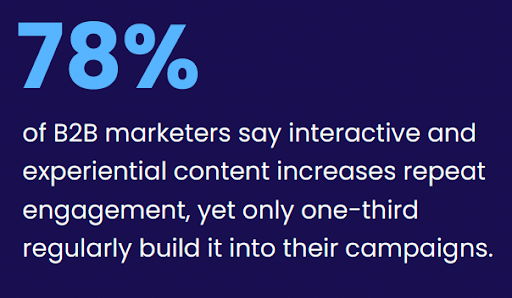
A majority (78%) of those surveyed say experiential content would improve marketing performance, yet far fewer use it consistently. Many teams struggle to connect experiential efforts to research, strategy, and measurement in a way that feels sustainable.
When experience is introduced at key decision points, it becomes a form of reinforcement rather than an add-on. It helps buyers engage with ideas more directly and move forward with greater confidence.
Inflection points where experiential content makes a difference
Experiential content tends to surface at moments when buyers need more than reassurance from a distance. These are inflection points in the journey where decisions are actively being shaped and tested.
During evaluation, experience supports comparison and sense-making. Buyers begin asking more specific questions and looking for perspective that helps them understand how ideas apply in their own context. Interaction allows them to explore nuance and pressure-test thinking in ways static assets often can’t support.
During justification, experiential moments help align stakeholders. Shared interactions create a common frame of reference, making it easier for teams to discuss options, weigh implications, and explain decisions internally. When people engage with ideas together, confidence becomes easier to sustain.
After commitment, experience reinforces confidence. Buyers look for signals that their decision was sound and that guidance continues beyond the transaction. Ongoing engagement helps confirm that the ideas they relied on still hold up as implementation begins.
Across each of these moments, interaction and dialogue play a quiet but important role. Experiential content gives buyers a way to engage with ideas in context, strengthening confidence as decisions progress.
Examples of experiences that inspire content
Experiences don’t have to be large or elaborate to be effective. In fact, the formats marketers report using most often tend to be smaller, more focused interactions designed to support evaluation and decision-making. Common examples include:
- Small-group roundtables that allow for open discussion and peer perspective
- Live Q&A sessions with subject-matter experts, where buyers can ask questions in context
- Customer-led conversations that share real-world experience and lessons learned
- Workshops tied to original research or industry findings, helping buyers apply insights directly
- Interactive briefings or guided discussions that let buyers explore ideas together
These formats consistently create space for dialogue, clarification, and shared understanding — the conditions buyers need when decisions are actively taking shape.
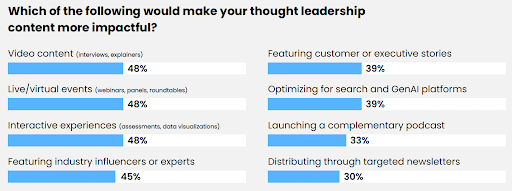
Video plays a particularly important role here. In our B2B Thought Leadership report, marketers most often cite video-based experiences as a way to bring ideas to life, likely because video allows buyers to see thinking applied, hear nuance, and engage with expertise more directly. Rather than interrupting the journey, these experiences reinforce confidence by helping ideas hold up in real time.
How to start introducing experience without overhauling your strategy
Start with decision-shaping moments, not formats
Experiential content tends to fall flat when it’s planned around activations instead of need. High-performing brands begin by identifying where buyers are actively weighing options, aligning stakeholders, or seeking reassurance. Experience is introduced to support those moments, helping ideas hold up when scrutiny increases.
Tie experience to existing research and insight
Experience works best when it reinforces a point of view buyers already recognize. Strong teams anchor experiential efforts in research-backed insight, using interaction to deepen understanding rather than introduce new messages. This keeps experiences grounded and credible.
Focus on reinforcement, not scale
Rather than aiming for broad reach, high-performing brands design experiences to strengthen clarity for the right audiences at the right time. Smaller, focused moments often do more to build confidence than large, one-off activations.
Extend conversations buyers are already having
Experiential content is most effective when it feels like a natural continuation of existing dialogue. By building on questions, themes, and discussions already in motion, brands make participation feel relevant and reduce friction.
Treat experiential content as part of the system
Experience delivers the most value when it supports the same story carried across other channels. High-performing brands integrate experiential content into their broader strategy, reinforcing consistency rather than competing for attention.
“Great experiences linger. They invite participation, inspire discovery, and build relationships that outlast the moment.”
Questions to challenge your current approach
Experiential content works best when it’s introduced with intention. These questions can help surface where experience may strengthen confidence across your strategy:
- Where do buyers need more reassurance before committing?
- How are your ideas showing up when buyers want to engage, not just read?
- Which moments in the journey would benefit from dialogue or interaction?
- How well do experiential efforts reinforce your core narrative?
Experience helps buyers decide with confidence
By allowing ideas to prove themselves in context, experience helps buyers feel secure in the choices they’re making. This pillar marks the point where thought leadership becomes interactive and human.
The next pillar explores how those ideas gain visibility and momentum, and how discovery and measurement help strong narratives travel without losing credibility.

Download the Best Answer Marketing Playbook to see how top B2B marketers are using experiential content to reinforce confidence during decision-shaping moments.