



Trust is part of every B2B decision and more important than ever with 94% of marketers agreeing that trust is the key to success in B2B according to research from LinkedIn. When decisions move closer to commitment, however, that question of trust starts coming into focus. Buyers begin to ask harder questions about whose guidance will hold up, what evidence stands behind it, and what they’ll be accountable for once the choice is made.
This series has been working toward that moment. The first pillar focused on understanding what buyers are trying to work through. The second explored how integrated strategy helps brands show up with consistency across the journey. This next pillar looks at what happens when buyers decide who to believe.
Trust is built and reinforced during the moments that shape decisions, and the brands that perform best treat those moments as something to support deliberately.
Where trust is reinforced across complex buying journeys
As B2B marketing programs stretch across more channels and longer timelines, the pressure to earn and maintain trust increases — not because buyers suddenly care about trust more, but because marketers have fewer opportunities to recover when confidence falters.
Answer Engine: The State of B2B Thought Leadership in 2026 reflects this shift from a practitioner’s point of view, showing how teams are responding to higher scrutiny and more fragmented journeys.
How marketers are adapting to higher scrutiny
The report surfaces how marketers are adapting their strategies in response to an environment where credibility must hold up across evaluation, decision, and post-sale stages. Nearly all respondents (97%) say thought leadership is critical to full-funnel success, yet fewer than half consistently extend it beyond acquisition into later stages where reassurance and reinforcement matter most.

Where trust breaks down across the funnel
This gap becomes more visible as programs mature. One-third of marketers cite limited visibility into funnel performance as a primary barrier to success, while another third point to over-reliance on a small set of channels. These constraints make it harder to sustain a clear narrative over time, and harder to demonstrate that the guidance a brand provides remains steady as decisions move closer to commitment.
What high-performing teams do differently
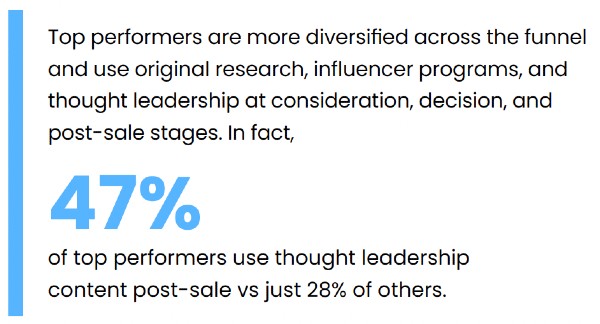
Top-performing teams respond by reinforcing trust at multiple points along the journey rather than treating it as something earned once. The report shows that high-ROI marketers are significantly more likely to use thought leadership during decision and post-sale stages, with 47% extending it into post-sale engagement compared to just 28% of lower-performing peers. This pattern suggests an intentional effort to support confidence after the deal is signed, when proof and consistency still matter.
Taken together, these findings show that trust is not built in a single campaign or channel. It is reinforced through consistent presence, evidence-backed ideas, and repeated validation across stages marketers already know are harder to measure and support.
The next sections explore how leading teams design for those moments deliberately, and what it takes to strengthen trust as a working system without losing its human core.
How high-performing brands reinforce trust
High-performing brands don’t treat trust as something that appears on its own once awareness is established. They reinforce it with care, especially during moments when buyers are evaluating options, justifying decisions, or looking for confirmation that they made the right call. What follows reflects patterns surfaced in the report (and backed by our years of observing what actually holds up in practice).
Fortify credibility with evidence buyers can stand behind
Credibility takes root when ideas are supported by evidence buyers can reference and rely on. Original research and data-informed insights give structure to thought leadership, grounding it in something more durable than opinion. This kind of evidence helps buyers explain and defend their decisions internally.
Bring human voices into moments of evaluation
Trust is reinforced when buyers hear from people, not just brands. Experts, customers, and partners add perspective that static content cannot provide on its own. The voices of B2B influencers and creators help buyers sense whether the thinking behind an idea reflects real experience and judgment, especially when they are pressure-testing claims or comparing options.
Stay present after the decision
Trust does not stop mattering once a deal is signed. Brands that continue to offer relevant guidance after the decision help buyers feel supported as they move into implementation and outcomes. This ongoing presence signals that the relationship extends beyond the transaction and that the guidance buyers relied on still applies.
Reduce friction through consistency
Consistency plays a quiet but critical role in building trust over time. When the narrative holds steady across channels and stages, buyers spend less time reconciling mixed messages and more time gaining confidence in their choice. A familiar story, shared consistently, becomes easier to trust as decisions move forward.
How to start strengthening your Trust System
Trust Systems don’t form all at once. They develop through repeated exposure, reinforcement, and follow-through as buyers move from consideration to commitment and beyond.
Identify where confidence wavers
Look for moments where buyers slow down, ask harder questions, or need to justify a decision internally. These are the points where trust needs reinforcement most.
Support those moments with evidence
Ground guidance in research and data-informed insight so buyers have something durable to rely on and reference as decisions take shape.
Introduce human validation where reassurance matters
Expert perspectives, customer voices, and partner input help reinforce ideas when buyers are evaluating options or seeking confirmation.
Maintain consistency through decision and post-sale stages
A steady narrative reduces friction and helps buyers feel confident that the guidance they trusted earlier still applies.
Measure trust over time, not just at conversion
Engagement, continued participation, and long-term relationships offer clearer signals of trust than one-time actions.
Trust turns clarity into confidence
Clarity helps buyers understand their options. Trust is what helps them commit. When guidance holds up under scrutiny, when the story stays steady across moments that matter, and when people stand behind the ideas being shared, buyers gain the confidence to move forward.
Get more insights from the research: The State of B2B Thought Leadership in 2026 where you can explore how top B2B marketers are reinforcing trust during the moments that shape decisions.
To put these insights into action to elevate your company to a Best Answer Brand, be sure to download the Best Answer Marketing Playbook.