



Across the industry, B2B marketers are feeling the effects of shifting discovery, longer buying cycles, and an audience of buyers that’s more selective about who they rely on for information. In an environment where buyers move unpredictably, adding more content rarely solves the problem. As our CEO Lee Odden has said,
“Buyers don’t need more information, they want answers. They want the best answer.”
What marketing teams need to deliver those answers is an architecture that connects their efforts into a content system buyers can trust. We cal that system, Best Answer Marketing.
A strong content marketing strategy begins with knowing what buyers are trying to understand. That’s the role of a data-informed approach: it surfaces the questions, patterns, and pressure points that should shape your marketing. The next step is turning those insights into a connected program that carries a clear story through every stage of the journey.
Original research can play a central role in that process. It provides the evidence behind the story and the clarity that buyers look for when they evaluate ideas. Original research also provides the kind of distinctive data and insights that are not easily duplicated by your competition or simulated by AI powered search.
An integrated strategy is what brings that story to life, linking each touchpoint to the same reliable narrative so audiences experience a steady, coherent path forward.
The value of that consistent narrative can also be found in the AI search experience. One of the most important visibility and engagement opportunities all B2B marketers are trying to get their arms around is AI-powered search or answer engines. Creating a consistent narrative across channels with an integrated strategy helps build one of the most valuable signals for LLMs to use when they choose the answers to provide buyers: consensus.
Why an integrated approach matters more than ever
The way buyers make decisions has changed (is changing, will continue to change…). People bounce between AI tools, social feeds, peer conversations, events, and whatever else helps them make sense of their options. If there ever was a linear buying journey, it no longer exists — with very little signal about what happens between one touchpoint and the next. The result is a journey that feels scattered for buyers and harder to support for marketers.
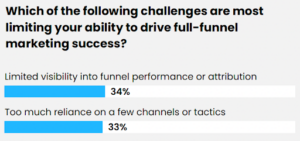
Our research with Ascend2 reflects this shift. A third of marketers (34%) say they can’t see how their efforts perform across the funnel. Another third (33%) say they lean too heavily on only a few channels. Both point to the same problem: when programs are disconnected, the story breaks apart and buyers lose confidence.
The marketers seeing stronger ROI aren’t running more campaigns; they’re building specific stories rooted in original research and letting those stories travel through every channel. The result is a consistency and cadence of association between your brand and the answers buyer groups are looking for. Integration becomes the way audiences meet the same clear idea no matter where they show up or who they including hidden buyers like finance, procurement and operations. It is through this consistent visibility across channels where B2B companies evolve from blending in amongst the sameness to becoming best answer brands for their customers.
Elevate Your B2B Marketing with an Integrated Strategy
What an integrated best answer content strategy actually looks like
It helps to ground the concept of Best Answer Marketing integration in a practical, full-funnel content marketing approach. These core steps show how B2B marketing teams turn audience insight into a system buyers can recognize and rely on.
Define a narrative based on insight
Integration begins with a clear understanding of what your audience is trying to work through. Original research and data-informed thought leadership turn that understanding into a point of view (your narrative) that reflects the questions, patterns, and pressures shaping the buyer journey.
Use that narrative to guide every channel
Once the narrative is established, it becomes the reference point for all activations: long-form content, media relations, influencer activations, experiential content formats, sales enablement, social content, events, and executive platforms. Each channel carries the same idea in a way that fits how buyers use it.
Coordinate teams and formats around shared insight
An integrated Best Answer Marketing strategy depends on alignment. Marketing, content, comms, and sales work from the same insight base, building assets that support one another rather than operating as separate efforts.
Deliver a consistent experience across the journey
With this structure in place, buyers encounter a steady, recognizable story whether they discover your brand through an AI tool, a peer or influencer share, an industry event, or through an answer community like Reddit. Consistency becomes a trust signal for both your buying committee and AI search platforms looking for consensus patterns.
The performance gap: what top B2B marketers do differently
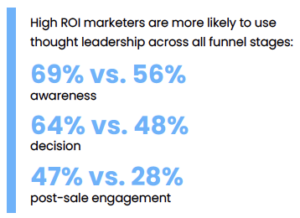
The marketers seeing meaningful results have stopped treating thought leadership solely as a brand or even a demand creation asset. They use it to support buyers across the entire journey: early in discovery, throughout evaluation, and well into the customer relationship post-sale. Their ideas move with the buyer, offering context and clarity wherever decisions take shape.
When B2B marketing teams struggle to maintain that kind of continuity, it makes it harder for buyers to follow a steady story. Our experience and research find that top performers reinforce their narratives through a set of practices that keep the message consistent, visible, and credible at every stage. Here’s what that looks like:
Activate thought leadership across the buyer experience
High performers don’t confine thought leadership to creating awareness. Our research found that nearly half of top performing B2B marketers extend these insights into post-sale moments as buyers move into onboarding, expansion, and advocacy. This continuity reinforces trust long after the initial decision.
Diversify channels to match how buyers learn
Because buyers evaluate ideas differently depending on the environment, top marketers rely on a wider mix of formats: video, events, influencer collaborations, and interactive content. A varied channel mix helps the same narrative travel more effectively and delivers information in the formats and channels that best align with the buyer. Continuity of message across channels and formats also contributes to the perception of consensus – that your brand is the best answer.
Prioritize programs that create human connection
Our experience has also found that top performing B2B marketers create opportunities for real people to carry the message. Expert interviews, live conversations, and collaborative formats to give buyers a chance to hear from credible, influential and trusted voices. As AI-driven discovery becomes more prevalent, recognized entities such as long time industry influencers for the topics that are important to your brand and customers can also contribute to the consensus that your brand is relevant, credible and trustworthy.
Address the experiential content gap
Our report data highlights a meaningful opportunity: 78 percent of marketers say experiential content would improve performance, yet only 38 percent use it consistently. Brands that invest in formats that bring their ideas to life have room to differentiate quickly. Not only are experiential formats good for buyers, they are the kinds of content experiences that get shared, discussed and that create ripples of relevance for many discovery surfaces.
Questions to challenge your current content strategy
An integrated content strategy based on thought leadership begins with understanding of where your current approach supports buyers and where it leaves gaps. A few pointed questions can help surface the areas that deserve more attention:
- How well do your channels reinforce one another, and where does the story start to pull apart?
- Which moments in the buyer journey feel under-supported or inconsistent?
- How are you preparing your programs for AI-driven discovery, where intent and authority shape visibility?
- What experiences are you creating that help buyers feel more confident in choosing you?
- Where could human voices from influencers, customers, or internal experts strengthen credibility across touchpoints?
These questions can reveal the places where an integrated Best Answer Marketing approach can create the most lift, especially when the goal is to give buyers a clearer, more reliable experience from first interaction to long-term relationship.
Elevate Your Content Marketing Impact
How to start building your own integrated Answer Engine
An integrated strategy becomes far easier to build when the process is broken into a few deliberate steps, each one strengthening the next and creating the architecture your programs rely on.
1. Clarify the insight your audience needs most
Everything begins with the question buyers are already trying to answer. Use the listening practices outlined here to pinpoint the signal that shows up across conversations, CRM patterns, search behavior, and industry tension points. This becomes your anchor.
2. Build your research around that anchor
Once the core question is clear, shape your research program to explore it in depth. Strong research creates the evidence that buyers need and gives your narrative a foundation that holds up across scrutiny.
3. Turn the findings into a unified story
Research reveals the throughline your channels can share. That story becomes flexible enough for social, deep enough for long-form content, actionable enough for sales materials, and credible enough for executive platforms. Each touchpoint adapts the same idea in a way that supports how buyers learn.
4. Expand reach with experiential and influencer activations
To help the story travel, identify one or two formats that introduce human connection. Influencer collaborations, interactive content, live conversations, or small-scale experiences allow buyers to engage with the ideas in a more tangible way.
5. Align measurement across the full funnel
Integration becomes clearer when measurement is shared. Track how research-driven content performs at awareness, how frameworks and activations support consideration, and how sales-aligned insight influences decisions and post-sale relationships. This gives you visibility into how the system works together.
6. Treat integration as architecture
The goal here isn’t more content; it’s a connected structure. Each piece reinforces the next, creating a steady experience buyers can trust regardless of where they enter the journey. This kind of Best Answer content structure provides a better experience for buyers with the added benefit of creating the kinds of signals that AI-powered search favors.
Integration lays the groundwork for trust
An integrated thought leadership marketing strategy works because a clear, steady narrative stands out from the fragmented nature of most digital experiences. The brands gaining traction today aren’t relying on isolated campaigns or disconnected channels. They’re creating systems that help people make sense of their choices, guided by research, reinforced through every touchpoint, and supported by human voices who add credibility where it matters most.
When the narrative holds together, trust builds faster. And when trust builds, buyers move through the journey with more confidence.
Download Answer Engine: The State of B2B Thought Leadership in 2026 to explore the full findings from our research with Ascend2 and see how leading B2B companies are becoming Best Answer Brands for their customers.