
You may have heard: 2026 has been a big year for creators. This is evident in our latest influencer marketing benchmark report and across the marketing industry at large. But it’s also a trend that goes well beyond marketing, permeating the media and entertainment landscape.
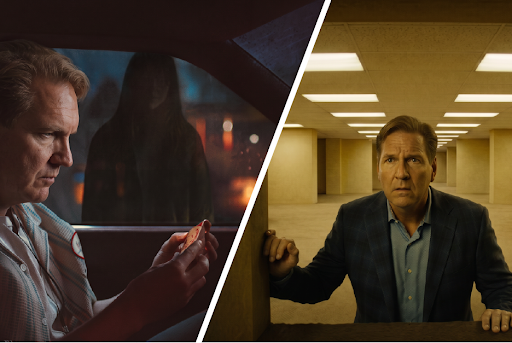
Given the time of year, a pertinent example is the two breakout indie horror films of 2026: Obsession and Backrooms. The ways in which their directors rose to prominence and brought these projects to life serve as great examples of how authenticity and creative integrity are taking center stage in this era of artificiality.
Incidentally, both movies also have a message that feels relevant to the current state of B2B influencer marketing, as reflected by our new survey data.
With spooky season fully upon us, let’s explore how marketers can end their obsession with the wrong metrics and escape the backrooms of circular results.
Fixated on the wrong numbers
Obsession is a movie with a pretty straightforward premise: be careful what you wish for. It tells the story of a shy record-store clerk who uses a wish-granting object to make his childhood friend fall in love with him. Her devotion quickly turns into a nightmare.
The film garnered acclaim for turning a small budget into huge results — music to any marketer’s ears. Its director Curry Barker originally made his name on YouTube, publishing comedy sketches on the channel “That’s a Bad Idea” and publishing a zero-budget found footage horror film Milk & Serial.
Obsession reportedly cost somewhere around $750K to make, and raked in more than $500 million globally in the box office. It resonated with audiences for being well-crafted, and also for having a relatable underlying message. Who hasn’t found themselves desiring the wrong thing and pursuing it to their own detriment?
TopRank’s 2027 B2B Influencer & Creator Marketing Report found that the most common success metrics in influencer programs are engagement (48%) and reach/views (45%). Many teams are obsessing over awareness. But what their leadership wants to see is business results. C-suite respondents weighted revenue and pipeline more highly, but these metrics lag behind in actual reporting structures.
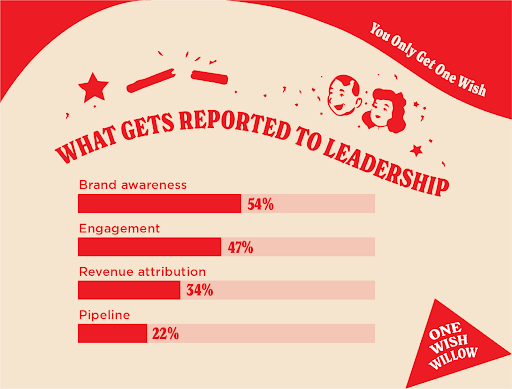
It’s a scary disconnect! And it helps explain why only about half of B2B marketers (52%) say they feel very confident justifying their influencer budget to a CFO.
If you’re not optimizing for, and measuring against, lower-funnel outcomes, you might as well crack open a One Wish Willow and hope for the best. Leading teams are thinking bigger about what B2B influencer marketing can accomplish and how to prove it.
Wandering through a liminal wasteland
Backrooms was not an indie film in the same traditional sense as Obsession. The theatrical release had the backing of a studio, a larger budget and a more recognizable cast. But it spawned from what began as a hand-crafted, solo VFX YouTube series that director Kane Parsons (aka Kane Pixels) started when he was 16 years old.
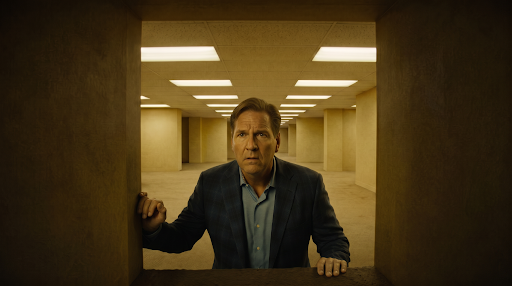
The movie follows a furniture store owner and his therapist who discover a door in the store’s basement that leads to a seemingly endless maze of empty, liminal rooms. They wander from one fluorescent-lit room to the next, each almost identical to the last, with no map and no sense of whether they’re making progress or just circling back to where they started.
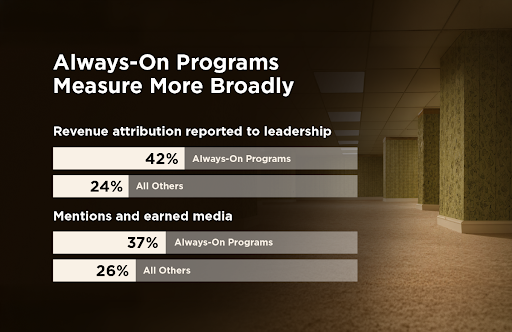
Too many B2B influencer marketing programs are similarly adrift. It shows up in the effectiveness gap between those embracing an always-on cadence versus a cyclical campaign-based approach. Nearly three-quarters of programs deemed “very effective” run always-on compared to around one-quarter of all others (27%).
When long-term strategy guides a B2B influencer program — serial content, relationship-building, compounding authority — momentum grows continually. When programs instead run campaign to campaign, every launch sends the team back to square one: new creators to onboard, new audiences to win over, and no built-up trust or authority to carry forward. It’s a lot of walking without getting anywhere, and teams stay trapped in the backrooms.
It’s no shock, then, that always-on programs are almost twice as likely to say they can attribute revenue.
Embrace the creator revolution for scary good results
Curry Barker and Kane Parsons didn’t break through by chasing formulas. They built audiences on YouTube by making things that felt distinctly their own, earned trust one upload at a time, and carried that energy all the way to the box office. The creator economy rewards authenticity, and B2B is no exception.
Our data shows the most effective B2B marketers are already leaning in. Very effective programs are nearly twice as likely as everyone else (43% vs. 25%) to partner with entertainment creators: storytellers and performers who bring media savvy alongside credibility. It’s a sign that B2B is growing more open to less conventional voices, and that the brands willing to take creative risks are the ones seeing results.
So this Halloween, don’t let your influencer program become a horror story. Measure what your leadership actually cares about, commit to an always-on approach that builds over time, and partner with creators who can bring your brand’s story to life.
Download the 2027 B2B Influencer & Creator Marketing Report for the full data, and follow TopRank Marketing on LinkedIn to find more insights on your feed.