


Updated 06/17/26
The standards of online search and SEO, as we once knew them, have changed forever.
Google’s recent search engine overhaul at I/O 2026 made it official: the era of the “ten blue links” is giving way to AI-powered interactive experiences, information agents and generative interfaces that build custom pages on the fly in response to a user’s query.
AI Overviews now reach more than 2.5 billion monthly users, and Google’s conversational AI Mode tops 1 billion. Meanwhile, B2B buyers are using LLMs like ChatGPT and Microsoft Copilot as primary discovery tools.
94% of business buyers now use AI in their buying process (Forrester)
This is a genuine disruption. There’s no sense pretending otherwise. Traditional referral traffic from search will continue to decline for many publishers and brands. Zero-click search was already a challenge; generative UI and information agents will steepen it.
What hasn’t changed: the brands that show up as the best answer for their customers – visible, trusted, and chosen – will continue to win.
Look beyond the SEO vs. AEO distraction
The optimization tactics that earn credibility with humans are the same ones that earn citation in AI-generated answers. SEO and what’s increasingly being called GEO (Generative Engine Optimization) are not entirely separate disciplines, but rather two sides of the same coin.
At TopRank Marketing, we’ve been SEO practitioners for over 20 years and have been closely tracking the intersection of traditional search, AI search and content strategy. These 10 tips reflect where things stand in 2026 and what it actually takes to remain visible and competitive.
10 SEO Tips for AI Powered Search in 2026
#10. Conduct research to identify topic-based opportunities that drive strategic planning
A list of keywords and associated search volume just won’t do the trick anymore. In 2026, a glossary goes beyond keywords and average monthly search volume (AMSV) to cluster prompts, queries, and search terms into make-sense groupings. For each, it’s important to also understand the search intent, funnel stage, competitor gaps, and the related questions your audience is asking.
With AI agents increasingly handling information retrieval, prioritize topics in your search landscape research that show potential to generate real traffic and engagement. Our Best Answer Marketing framework can use a number of data sources from CRM and web analytics to Semrush and Ahrefs for topic research with layered PAA (People Also Ask) data and query fan-out simulators to understand how AI systems are expanding on your buyers’ questions.
#9. Set clear goals, and track influence vs. clicks
With zero-click search and LLM citations that don’t always include source links, measuring success in 2026 requires expanding your definition of a win. In several ways, this is a good thing, because it’s forcing marketers to depend less on vanity metrics with questionable impact.
- Continue to set clear KPIs for organic traffic, CTR and keyword rankings. But also track brand propagation signals:
- Is your research being cited in AI Overviews?
- Are your frameworks or statistics showing up in LLM-generated answers?
- Are buyers arriving in sales conversations already familiar with your ideas?
Being chosen by search engines and AI tools is only partly visible in traditional analytics. The fuller picture includes whether your content is changing what buyers know, trust and do next.
#8. Find the question behind the query
For years we’ve been driving home the importance of search intent as a guiding light for SEO strategy. This principle is more important than ever, and it now extends well beyond Google.
Buyers are prompting AI tools with complex, conversational questions, not just predictable keyword strings. Your content strategy needs to reflect that.
To be the answer buyers are searching for requires understanding the questions they’re asking. Mapping topics to those questions is essential for any expectation of relevant visibility where buyers are looking.
Go upstream of your keyword data. Talk to sales and customer support teams about what prospects are actually asking. Mine your CRM. Conduct customer interviews. Run research with your target audience.
The most durable visibility – in search, in LLMs, and in earned media – comes from content that genuinely answers the questions buyers are asking, not content optimized around the questions you wish they were asking.
“To deliver best answer content, you have to understand the questions being asked. This means drilling down into the specific needs of each stakeholder on the committee from technical evaluators to financial decision-makers and end-users.” Lee Odden, CEO at TopRank Marketing
#7. Refresh and elevate your most visible content
Stale content is a liability when AI systems are evaluating freshness, authority and depth. Implement a system to continuously audit your highest-visibility pages and refresh when it makes sense. Update statistics, expert quotes, sharpen your brand point of view, and add original insight that no one else can offer. If your site has thousands of pages it is important to prioritize which updates or refresh efforts with have the most impact, so starting with an audit can save time, resources and accelerate impact.
Published content with built-up equity is often your most resource-efficient path to meaningful gains.
“Many businesses are sitting on a goldmine of published content. With a smart approach to refreshes and repurposing, the value of that content can be actualized with more visibility and better conversions from search.” – Jane Bartel, Director of Search & Content Marketing at TopRank Marketing
#6. Optimize for AI search and LLMs
B2B buyers are using ChatGPT, Perplexity, Gemini and other AI tools for research, and those tools are pulling from the same signals that traditional SEO has always prioritized: authoritative sources, well-structured content, credible citations and strong brand signals across channels.
Practical steps for Answer Engine visibility in 2026 include:
- Ensuring your brand is consistently mentioned alongside the topics you want to own
- Investing in original research that gives LLMs unique, citable data points
- Partnering with industry influencers whose content is indexed and authoritative
- Earning coverage in industry media that LLMs treat as trusted sources
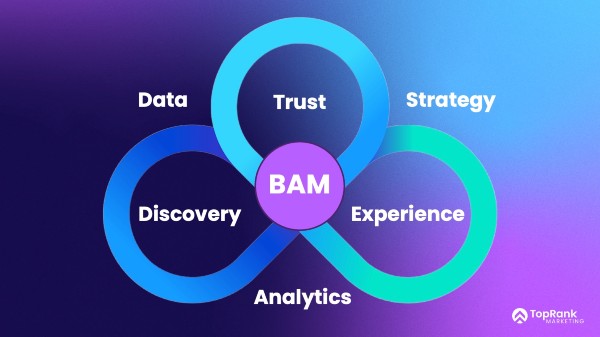
Our Best Answer Framework – a system for helping B2B brands become the most credible, specific and useful answer to a buyer’s actual question – is the throughline connecting traditional SEO, AI search visibility and content strategy.
#5. Publish content that earns belief, not just rankings
Visibility means little if the content doesn’t build trust. In a world where every brand has access to the same AI content tools and SEO frameworks, the differentiator is credibility, which comes from content that only your brand could produce and the consensus across media, conversations and channels that your brand is the source of truth.
Original research, first-person expert perspectives, customer stories, earned media and co-created content with respected industry voices are all forms of content that AI-generated sameness cannot replicate. This kind of content earns citations from LLMs, trust from buyers and coverage from industry media.
“AI can generate content that ranks. It cannot create content that only your brand could have written. That gap is where trust gets built.” – Ryan Leighty, Associate Director of Search
Go beyond answering questions to building consensus. Give LLMs the proof needed to chose your content as the answer and give buyers the decision confidence to act on those answers.
#4. Keep your technical foundation sound
Nothing in the AI search era has reduced the importance of technical SEO fundamentals. If anything, a well-structured, fast, crawlable, mobile-optimized site is the baseline that allows everything else to work. AI systems can’t surface content they can’t reliably access and parse.
Conduct regular audits of page speed, crawlability, schema markup, and mobile performance. Use specialist SEO tools to evaluate contextual relevance at the page level.
Think of technical SEO as infrastructure: it doesn’t win the game, but a broken foundation will lose it.
#3. Prioritize E-E-A-T to resonate with both humans and AI systems
Google’s E-E-A-T framework (Experience, Expertise, Authoritativeness, Trustworthiness) was designed to identify content worth surfacing. The same signals that satisfy these criteria tend to be the signals that LLMs use when deciding which sources to treat as authoritative.
E-E-A-T audits help bring key opportunities to light. Among them: Highlight human authorship and internal expertise, cite original data and make your credentials visible. Genuine expertise gets cited when buyers come looking for answers.
#2. Adapt your strategy to the new SERP reality
Google’s new search interface is rolling out now. Generative UI, AI Mode, and information agents are already changing what users see – and do – when they search. Brands can’t afford to wait.
This means doubling down on bottom-of-funnel content where purchase intent is high, investing in the signals that help AI systems identify your brand as a trusted source, and tracking AI search traffic separately as attribution becomes increasingly fragmented.
#1. Compound authority through 3rd party citations, content, and influence – integrated
Being cited by credible sources remains foundational, but in 2026 it’s most effective as part of an integrated authority strategy. For LLM visibility, links from other websites to yours matter less than credible citations from authoritative sources, but links can still send visitors to your website. 3rd party citations, internal linking and earned media coverage all send credibility signals to both search engines and AI systems.
Creating unique content that is worth citing (and linking to) is still an effective strategy, especially the kind of content AI systems (or competitors) cannot easily replicate. For example, it is particularly effective to integrate topic-themed original research with thought leadership: publish research, collaborate with authoritative industry influencers to provide context and validation, secure media placements of that research in the most trusted industry publications and drive social conversations around the themed topics through influencer, social and content marketing – all while ensuring a consistent internal linking structure.
Authority compounds. Investing in your differentiated authority now creates an advantage over competitors that are relying on the same AI advice and tools that everyone has access to.
Success in AI search builds from foundational SEO
There’s a lot of frustration being voiced over Google’s transformation, and its reinvention of digital search as we once knew it. But like it or not, it’s happening. The upshot is that the underlying logic of SEO – be findable, be credible, be useful – hasn’t changed.
The B2B brands that will thrive in 2026 and beyond are the ones that treat search visibility, AI search presence and content credibility as a unified strategy rather than separate workstreams. Tapping into a system that is data-informed, integrated and focused on creating multi-channel content experiences designed to build trust, citation and decision confidence is what separates those stressing out over AI search and those seeing genuine impact. That’s what it means to be a Best Answer Brand.
Ready to assess where you stand?