



Inherently knowing there is value in social media marketing and being able to clearly demonstrate that value are still two very different things.
Social media continues to offer one of the most direct ways to connect with customers, prospects, and advocates at scale. But measurement remains a challenge. While tools and analytics have advanced, many marketers still struggle to connect social activity to meaningful business outcomes.
According to our research with Ascend2, Answer Engine: The State of B2B Thought Leadership in 2026, only 44% of B2B marketers say they have high confidence in measuring the business impact of social and community engagement, especially beyond surface-level metrics like reach and engagement.
That gap matters more than ever. As buyers increasingly discover, evaluate, and validate brands across social feeds, online communities, and AI-powered tools, social media plays a growing role in shaping whether a brand is perceived as credible or forgettable. Becoming a Best Answer Brand means not just showing up consistently, but proving that presence contributes to trust, confidence, and action.
“Social media enables relationships to be built regardless of traditional barriers like distance or language. For brands, this provides a forum to listen and learn – and if you’re smart, take action based off of what you learn,” Alison Herzog, Global Head of Brand & Creative, VAS
Social media strategy is now firmly embedded in most marketing plans. The pressure, however, has shifted from participation to contribution. According to McKinsey, buyers now use an average of 10.2 channels during their decision-making process, reinforcing that social rarely works in isolation but instead influences trust and consideration alongside search, content, and peer input.
To help connect activity to outcomes, here are three practical ways to measure and communicate the value of social media marketing in 2026.
1 – How to asses your current situation with social networks
Effective measurement starts with clarity. Before selecting metrics, define the outcomes social media is meant to support. Awareness, credibility, engagement, demand, and advocacy each require different signals. Once success is defined, KPIs can be aligned to show progress toward becoming the best answer for your audience.
For example, if your social media goals include increasing brand awareness and driving qualified traffic back to your website:
- Set benchmarks for visibility and engagement across priority platforms
- Conduct a competitive analysis to understand relative share of voice, engagement quality, and content relevance
This context matters because attention is harder to earn. In the same 2026 Answer Engine research, 53% of B2B marketers say increased competition for attention across channels is the single biggest factor making audience engagement more difficult.
There are still many tools, both native and third-party, that support this analysis. Competitive and channel analysis platforms include:
- Sprout Social – Provides cross-channel analytics for engagement, audience growth, sentiment, and competitor benchmarking, with reporting designed for executive and stakeholder communication.
- Hootsuite – Offers social performance tracking, brand monitoring, and paid and organic reporting across major social networks, with strong enterprise governance features.
- Meltwater – Combines social listening, media monitoring, and analytics to measure brand mentions, sentiment, and share of voice across social and editorial channels.
- Brandwatch – Advanced social listening and analytics platform used for sentiment analysis, trend detection, and competitive intelligence across global markets.
- Sprinklr – Enterprise-grade social analytics and reporting across dozens of channels, with strong capabilities for governance, compliance, and unified measurement.
- Rival IQ – Focused on competitive benchmarking, engagement rate analysis, and social performance comparisons against direct competitors.
Used together, these tools help marketers move beyond surface metrics toward a clearer view of how social media supports trust, discovery, and engagement on the path to becoming a Best Answer Brand.
Beyond follower counts and posting frequency, marketers should pay close attention to engagement quality and brand mentions. Social listening tools can help identify how often your brand is referenced in relevant conversations and whether those mentions signal authority and trust.
To understand how social contributes to site and content performance, web analytics platforms such as Google Analytics or Adobe Analytics remain essential for reviewing referral traffic and downstream behavior. Link shorteners like Bit.ly can still provide directional insight, but increasingly the goal is connecting social engagement to buyer intent and confidence.
Once you understand the landscape, ongoing measurement becomes more actionable. Regular evaluation allows teams to adjust messaging, formats, and channels quickly. That adaptability is central to Best Answer Marketing, where insight informs continuous optimization rather than static reporting.
2 – How to set specific social media campaign goals
Different social campaigns require different definitions of success. Social media remains one of the most effective ways to reach defined audiences with content that feels human, timely, and relevant.
Research continues to support this. In The State of B2B Thought Leadership in 2026, 78% of B2B marketers say experiential and interactive content increases repeat engagement, yet only 33% say they regularly build experiential formats into their campaigns.
Social campaigns that invite participation and contribution tend to outperform static promotion, particularly when they align with a clear audience need.
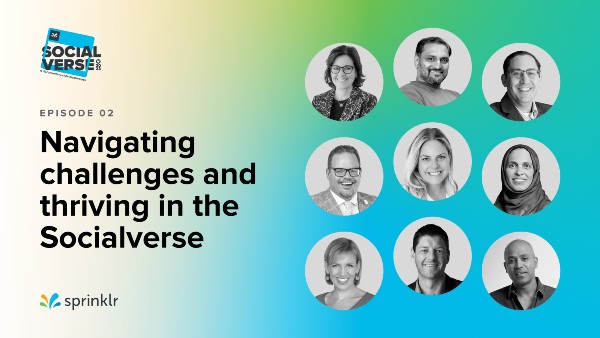
Sprinklr – “Across the Socialverse”
Sprinklr, a customer experience management platform, launched its “Across the Socialverse” campaign (case study) in partnership with TopRank Marketing by bringing together respected B2B social media thought leaders and influencers to create documentary-style content and live sessions that highlighted its Social Self-Serve product and CX vision. The campaign drove over 5,000 global registrations from B2B marketers across North America, EMEA, APAC, and Middle East markets. Organic and paid social promotion reached 23.4 million people and generated nearly 100,000 engagements, significantly exceeding benchmarks and contributing to a strong pipeline of qualified leads and new annual recurring revenue.
Demandbase – Superhero Storytelling Rebrand Campaign
Demandbase partnered with TopRank Marketing to launch a bold social-first rebranding campaign designed to unify multiple acquired MarTech products under a single, differentiated “Smarter GTM” brand narrative. (case study) To break through crowded social feeds and reach hard-to-impress sales and marketing leaders, the campaign transformed respected B2B influencers into superhero storytellers featured in an original infographic comic and motion infographics.
Launch week activation combined organic and paid social, influencer amplification, and sponsored influencer content across LinkedIn, Twitter, and Instagram, followed by co-created influencer blog content to sustain momentum post-launch. The integrated social storytelling approach generated 800%+ benchmark asset pageviews, 13,026 total campaign pageviews, and 3,638 total asset clicks, significantly accelerating brand awareness, credibility, and engagement while positioning Demandbase as the best answer for modern, intelligent go-to-market strategy.
While platforms and formats evolve, the takeaway remains relevant. Campaigns perform best when goals are explicit and measurement reflects intent. Whether the objective is awareness, engagement, or demand, social media works hardest when it delivers genuine value and reinforces the brand as a credible answer.
3 – How to communicate the value of social media to your internal audience
Most marketers are skilled at adapting content for external audiences. Internal stakeholders deserve the same consideration. For social media programs to earn continued investment, value must be communicated in terms that resonate across the organization.
This is increasingly important as attribution becomes more complex. According to the 2026 Answer Engine study, 34% of B2B marketers cite limited visibility into performance or attribution as a top reason content underperforms.
When presenting results internally, tailor metrics to each audience.
Executives
- Overall trends and trajectory
- Brand sentiment and credibility signals
- Competitive standing
- Contribution to conversions or pipeline influence
Managers
- Engagement rates on campaign content
- Best-performing creative or formats
- Insights relevant to their business unit
- Click-through rates to priority landing pages
Customer Service
- Response time and resolution rates
- Sentiment trends and recurring themes
Connecting these metrics back to shared business goals helps position social media as part of a broader system, not a standalone channel. In Best Answer Marketing, social supports trust, discovery, and experience across the full customer journey. Communicating that role clearly builds internal confidence and strengthens long-term investment.
By understanding your current situation, setting specific campaign goals, and communicating value internally, social media marketing can deliver measurable impact for both your audience and your organization.
We can help.
Learn about TopRank Marketing’s social media marketing services, including strategy and planning.