


For many enterprise tech brands, few third-party sources of credibility are as coveted as being included in a Gartner Magic Quadrant or Forrester Wave report. The credibility of Analyst recognition can be instrumental at helping buyers understand a category that is overloaded with options and give buying committees a credible and independent source of information for vendor evaluation.
But there is a cloud to this silver lining: the proof point that many B2B brands work so hard to earn might be one of the least visible assets where most buyers are now looking: AI answer engines.
Recent analysis by OtterlyAI reviewed a snapshot of 1,028,959 unique URLs cited across ChatGPT, Google AI Overviews, Google AI Mode, Perplexity, Gemini and Microsoft Copilot during a 24-hour window. Then they isolated citations from the primary websites of 10 major analyst firms. What did they find?
While Gartner represented 81.7% of those analyst-site citations, 96% of Gartner citations pointed to its Reviews product and gated research documents accounted for less than 1%. Gartner Reviews “Market” comparison pages generated 78.8% of Gartner citations.
Magic Quadrant mentions are as important as ever, but when brands put significant resources into earning that kind of recognition, the uncertain visibility of that recognition where B2B audiences and decision makers are increasingly influenced could be a lost opportunity.
In other words, prestige and AI visibility are different systems and in today’s discovery environment, you need both to truly realize the full benefit and impact.
AI influences the B2B shortlist
Earlier this year, G2 surveyed 1,076 B2B software buyers and decision-makers and found that 51% start their research with an AI chatbot more often than Google, which is up from 29% the previous year. G2 also found that AI chatbots were the leading source influencing buyer shortlists and that 69% of buyers have chosen a different vendor than originally planned because the vendor appeared in a chatbot recommendation. That is a powerful datapoint and it’s the kind of insight driving many B2B brands to focus on AI visibility.
Forrester’s 2026 business buying research based on nearly 18,000 global business buyers, found that 94% are now using AI during the buying process. At the same time, buyers still validate what they find through peers, product experts, analysts and others in their networks. The need to integrate is real. Forrester also found that an average buying decision involves 13 internal stakeholders and nine external participants.
That’s an important combination. Discovery and validation require a new kind of strategy that integrates the prestige of analyst recognition with visibility where buyers are actually influenced.
For B2B brands investing in analyst relations, this begs an important question: How do you extend the authority of analyst recognition into the places where buyers and AI systems are actually discovering information?
While there are limitations and guidelines around what brands can say about their inclusion in repots like Gartner Magic Quadrant or Forrester Wave, that Analyst authority can travel meaningfully for AI visibility through other trusted voices
According to OtterlyAI’s crawlability analysis, Gartner blocks several major AI crawlers, including GPTBot, ChatGPT-User, OAI-SearchBot, Google-Extended and CCBot. And yet Gartner still dominated analyst-domain citations in the study. How? OtterlyAI points to things like existing search indexes, previously indexed information and third-party citation chains where other websites reference Gartner content.
In other words, the authority signals needed for Analyst recognition to surface in AI search can travel through intermediaries.
For example, the same OtterlyAI analysis found that only 0.7% of Omdia-related citations within its publishing network came directly from Omdia’s analyst domain, while 99.3% came through affiliated trade publications, with TechTarget responsible for most of them.
This is where the opportunity becomes interesting for B2B influencer marketing and integration.
The Magic Quadrant may be the prestige asset, but the executive interview, industry expert article, creator video, podcast discussion, customer perspective or earned media story are the accessible assets that drive and grow the conversations around it.
The goal is to turn analyst recognition into a broader trust system that helps your brand become a credible answer wherever buyers are looking. Or as we’ve been saying for well over 10 years, to be the best answer where buyers are looking.
From analyst recognition to a B2B influence system
For many years, B2B influencer marketing has been treated as an activation layer. You find recognizable people, collaborate, ask them to post about the campaign they contributed to and measure the resulting reach.
But the opportunity around analyst recognition is more strategic.
B2B influencer marketing, executive thought leadership, content marketing, earned media, search optimization and analyst relations can all work together toward driving one market narrative. That’s especially important for today’s B2B brands because different voices influence different people inside the buying committee.
Here’s an approach to consider:
1. Start with the buyers you need to influence
Influencer selection should begin well before you search for names and that means start with the buying committee.
Ask: Who needs to understand your analyst recognition? Who influences their thinking? Which roles are users, recommenders, evaluators and economic buyers?
This matters because audience sizes can be misleading.
An influencer that is followed by thousands of individual practitioners could be excellent for adoption and education. However, an expert with a smaller network of relevant VPs, CROs, CIOs, RevOps leaders or other senior decision-makers may be far more valuable when the objective is category credibility and shortlist consideration.
At TopRank Marketing, we’ve prioritized relevance, resonance and reach along with values alignment, brand affinity, and topic/content matching when evaluating B2B influencers as the foundation for influencer validation. For influencer activations like an analyst-driven program, role relevance is also essential.
That means looking beyond follower counts and those baseline metrics to assess a bigger complement of characteristics:
- Audience job functions and seniority
- ICP and industry alignment
- Subject matter authority
- Professional experience
- Existing category associations
- Content quality and engagement
- Brand safety
- Relationships with other credible voices
- Presence across the channels your buyers use
- Potential to create content buyers would actually seek out
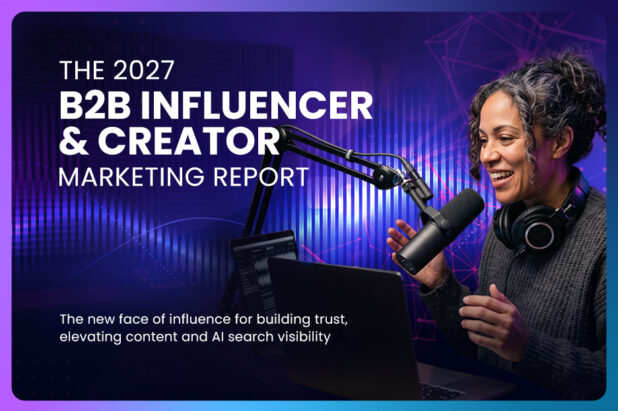
Addressing all of these dimensions is not easy for most B2B brands. Our research with Ascend2 found that 48% of B2B marketers struggle with identifying, qualifying and connecting with ideal influencers, making it the most commonly cited challenge in our B2B Influencer Marketing Report.
The best influencer for analyst amplification isnt’ necessarily the most popular. It’s the person whose credibility overlaps most meaningfully with the buyers you need to reach.
2. Give different influencers different jobs
An effective B2B influence program meant to optimize visibility of analyst recognition should include a portfolio of credible voices that are different according to their purpose and yet, work together.
Different people bring different forms of authority.
Category interpreters
These are experts who can explain how the market is changing, what the category means and which trends buyers should be watching. Their job is interpretation.
Practitioner validators
Practitioners bring experience from inside the problem. They can explain what implementation actually looks like, what pitfalls buyers should anticipate and which capabilities matter when theory meets reality. Their job is proof through experience.
Executive peers
Former CROs, CIOs, CMOs, operations leaders and other senior executives can engage audiences that practitioner creators sometimes struggle to reach. They understand organizational complexity, investment decisions, business risk and the realities of gaining consensus across a buying group. Their job is decision-level relevance.
Educators and creators
Some experts are particularly skilled at making complex topics understandable through LinkedIn content, video, newsletters, podcasts or visual storytelling. Their job is accessibility.
Industry media and publisher voices
Editors, journalists, podcasters and publishers can add context while creating earned visibility outside the brand’s direct sphere of influence. Their job is independent market context.
The people in these groups are not meant to be an unofficial sales force for the analyst report. Their value will come from having a useful point of view. That means instead of asking five influencers to say, “Brand X was named a Leader,” the most impactful activation would involve giving them meaningful questions to explore and react to. Questions like:
What is changing in this market?
- What should buyers evaluate before selecting a platform?
- Which capabilities separate sophisticated solutions from basic ones?
- What mistakes are companies making?
- Where is the category heading?
With answers to questions like these, your analyst recognition can become the catalyst for a useful market conversation.
3. Connect external influencers with executive thought leadership
This is where a strong B2B influence program starts to become much more interesting. Influencers should not exist in one campaign lane while executives publish in another. The utility of integration means more than marketing tactics working together. It also means bringing executive and influencer voices together.For example:
- An industry expert might interview your C-Level executive about how the category is evolving.
- Or an expert practitioner could join an executive for a discussion about what successful implementation looks like.
- An influencer could contribute perspective to a brand article that an executive reacts to through their LinkedIn account.
- An executive could respond to an independent expert’s analysis and add the company’s own experience.
- Three or four industry experts could participate in a virtual roundtable about the biggest questions buyers should ask before making a decision.
The formats for these executive and influencer integrations could be short form video, a video podcast, a LinkedIn Live, as well as text formats.
The result is richer than a traditional sponsored post because each participant contributes a different kind of authority. That said, if an influencer’s post does well it makes sense to license and put Thought Leader Ad investment behind it for extended visibility.
These integrations have multiple benefits including repurposing. One meaningful executive and influencer conversation can become:
- A long-form video
- Multiple short-form video clips
- Executive LinkedIn posts
- Influencer LinkedIn posts
- A blog article
- Quote graphics
- Newsletter content
- Email nurture
- Sales enablement
- Paid social creative
- FAQ content
- Search and AI-optimized answer content
- Podcast or webinar material
There are more than this, but I think you get the idea.
Our most recently published B2B Influencer Marketing Report found that 95% of B2B marketers involve influencers in content creation to some degree, and the marketers most satisfied with their influencers and those with the most effective programs were more than three times as likely to involve influencers heavily in co-creation. The analyst recognition creates the moment and the market conversation creates the content.
4. Build a Best Answer content ecosystem around analyst recognition
If you want your influencer marketing investment to become more than social amplification, then you’re want to understand the Best Answer Marketing (BAM) framework.
Our Best Answer Marketing approach is built around six connected pillars: Data Informed, Integrated Strategy, Trust System, Experiential Content, Multi-Channel Discovery and Unified Analytics. Together they help B2B brands create credible, useful content experiences that are visible wherever buyers are looking.
When applied to analyst recognition, the process might look like this.
Data Informed
Start with audience research and ask what questions do buyers ask about your category? What are they comparing? What concerns appear in CRM data, search behavior, sales conversations and social discussions? Then use the analyst recognition as one signal that helps inform those answers.
Integrated Strategy
Build one narrative that connects analyst relations, influencer marketing, executives, content, social, search, PR, paid media and demand generation. We don’t need everyone repeating the same messaging. It is their unique perspectives that contribute to the same buyer understanding that creates real impact.
Trust System
Research from LinkedIn found 94% of B2B marketers agree that building trust is the absolute key to brand success. How? We start by layering different sources of credibility around the topic that we want to be the best answer for:
- Analyst recognition.
- Influencer expertise.
- Executive perspective.
- Customer evidence.
- Original research.
- Earned media.
- Independent reviews.
Each of these credibility signals contributes something different to the story.
Experiential Content
Credible content isn’t so credible until it’s consumed. That means turning those insights into formats people will commit their time to including experiential formats like:
- Video conversations.
- Expert roundtables.
- Podcasts.
- Interactive assessments.
- Data visualizations.
- Live sessions.
- Research-driven content you can interrogate.
A Magic Quadrant announcement might create attention for a few days, but the content created around the broader category conversation can continue delivering value for months or more, especially if that content is an experience that audiences are motivated to share.
Multi-Channel Discovery
Credible content isn’t so credible unless it gets discovered. In today’s fragmented discovery landscape, being chosen by an LLM or Google requires more than simply adding keywords to your H2’s and SEO/AEO tactics. Being discovered in a meaningful way requires B2B brands to publish and activate content where buyers actually research and are influenced.
That may include LinkedIn, YouTube, industry publications, newsletters, podcasts, communities, Google and AI answer engines.
Our 2026 thought leadership research with Ascend2 found that 32% of professionals now use GenAI tools such as ChatGPT, Perplexity and Claude to discover thought leadership and I suspect that number is even higher as we approach 2027.
Visibility for B2B brands now needs to be designed for the behaviors of your audience that are searching, scrolling, watching, listening and prompting. That’s essentially the connection between B2B influencer marketing and AI visibility as being part of an integrated system.
5. Let B2B creators be experts within clear guardrails
Analyst recognition comes with another consideration: compliance.
Gartner maintains pretty detailed rules that govern Magic Quadrant terminology, quotation, promotional language and the use of Gartner content. Its policy allows certain terminology such as “Named,” “Positioned” and “Recognized,” while being more restrictive of stack-ranking language and claims that imply some kind of Gartner endorsement.
Forrester also has its own rules governing Wave references, citations, placement claims and licensed content.
That means you should NOT try to turn influencers into scripted spokespeople. It DOES mean compliance should be designed into the program itself.
How? The TLDR is that you would give creators/influencers approved public source materials that clearly identify permitted analyst-related language. Then explain which graphics or materials have licensing restrictions and establish an efficient review process for factual claims which would also iclude FTC disclosure expectations.
With those guardrails, you can then give the influencer room to do what you engaged them to do: contribute their expertise in a way that their audience will respond to.
The reason B2B brands engage influencers is to draw on the expertise and perspective that made them an influencer with their audience. The B2B brand’s job is to create a framework where accuracy and that authentic perspective can coexist.
6. Use earned media to extend the trust network
Of course, influencers are just one part of a B2B brand’s credibility ecosystem. Earned media can extend the same narrative through sources that buyers and AI systems already trust.
For evidence of this, Muck Rack analyzed more than 25 million links surfaced by ChatGPT, Claude and Gemini across 17 industries and found that earned media accounted for 84% of citations, while paid and advertorial content represented 0.3%.
But that’s not all. Meltwater and LinkedIn analyzed 9.5 million AI citations across six platforms and found that user-generated platforms including LinkedIn, Reddit and YouTube represented 47.5% of citations. Company websites accounted for 18.7%. Within LinkedIn citations, 75% of them came from individual members while 25% came from Company Pages.
The takeaway here that owned media is playing a different role and that authority becomes stronger when it appears across a network of credible sources. Citations are the name of the game when it comes to being chosen by LLMs and AI powered search. Driving citations is a team sport:
- An analyst milestone gives B2B comms teams a reason to engage the market.
- Influencer contributions create expert perspective.
- Executives add leadership context.
- Customers add proof.
- Media adds independent validation.
- Owned content creates an authoritative home for the narrative.
- Search and GEO optimization make the information easier to discover.
Together, these signals give buyers more ways to find the brand and more reasons to believe what they find. They also create the citations used by LLMs and search engines to chose your brand as the answer buyers are looking for.
7. Measure B2B influence from brand to demand
In our 13 plus years experience with B2B influencer marketing, measurement is where many influencer programs are lacking. Sure, impressions and engagement matter because they tell you whether people saw and interacted with the creator’s content. But they don’t tell the entire business story.
Our B2B Influencer Marketing Report found that 47% of marketers identified measuring and reporting results as one of their biggest influencer marketing challenges, so it’s no wonder so many B2B brands and even B2B agencies that are new to influencer marketing are lacking in the measurement category. Our research found that advanced programs were twice as likely as less mature programs to use Share of Voice and MQL/SQL metrics to evaluate performance.
For an analyst recognition program, measurement should begin by separating brand outcomes from demand outcomes.
Brand and influence signals
Track:
- Qualified audience reach
- Audience seniority and job function
- Target-account engagement
- Share of voice
- Influencer and executive engagement
- Earned mentions
- Branded search activity
- Content consumption
- AI visibility and citations
- Sentiment
Demand signals
Connect those activities to:
- Site visits
- Engaged accounts
- Content downloads
- Repeat engagement
- Demo requests
- MQLs and SQLs
- Influenced opportunities
- Pipeline
- Revenue where attribution allows
Each B2B influencer should have trackable URLs and campaign identifiers. And when possible, influencer activity should connect with web analytics, CRM data, paid media and sales outcomes in programs where those metrics align with expectations of the program.
More importantly than collecting this data is bringing these signals into a unified view.
Within our Best Answer Marketing framework, Unified Analytics is the feedback loop that connects visibility, engagement and conversion data so B2B marketers can understand which stories, experts, channels and experiences are actually contributing to business outcomes.
That unified view makes measurement more valuable than a campaign report and becomes intelligence for what the brand should do next.
What does an integrated B2B influencer marketing program look like?
At TopRank Marketing, we’ve been developing and executing B2B influencer programs for enterprise brands for more than 13 years, including work with Adobe, Dell, SAP, LinkedIn, Sprinklr and other leading B2B companies with many examples. One such example is Sprinklr’s Socialverse program.
TopRank helped Sprinklr bring together prominent industry influencers including Jay Baer, Ann Handley, Mari Smith and Paul Roetzer with internal experts and customers for a documentary-style masterclass. The program connected influencer content, social media, paid promotion and an event experience around one narrative.
The campaign generated more than 5,000 global event registrations. Organic and paid messages reached more than 23.4 million people and generated nearly 100,000 engagements. The program exceeded benchmarks for accounts reached and MQLs, contributed to new annual recurring revenue and won a Content Marketing Award for Best Use of Influencer Marketing.
Without question, a Magic Quadrant placement can create an important moment for a B2B brand. Influencer marketing can help turn that moment into an ecosystem of trusted voices, useful content, executive visibility and multi-channel discovery that continues working long after the day of publication.
Audit the gap between prestige and visibility
If you’re a B2B brand that has earned analyst recognition, I invite you to test how far that authority actually travels.
Identify 25 to 50 high-intent questions your buyers ask about the category.
Include prompts around:
- Best solutions
- Vendor comparisons
- How to choose
- Important capabilities
- Implementation
- Risk
- Business outcomes
Run those questions through the AI platforms your audience uses and then document which companies appear and which sources are cited.
Then classify those sources by their type: analyst research, reviews, company content, influencer content, executive content, earned media, communities and other third-party sources and compare your credibility investments with your actual visibility.
You may discover that one of your most important assets is not living up to its potential or your expectations for visibility. And that’s a disappointment for something that should be a competitive advantage.
That’s not a reason to invest less in analyst relations. It’s a reason to make the authority that you’ve earned work even harder. And smarter.
The Magic Quadrant placement creates prestige. A Best Answer influence system turns that prestige into trusted, discoverable visibility wherever buyers are looking.
Want to optimize the visibility of your analyst recognition?